When re-enchantment isn’t enough
This one is cross-posted from my substack, because I want to be sure as many people as possible are aware of Trueman’s book and the ongoing “enchantment” debate which I’ll post about over there again, soon. Happy Lent, friends! - Father Rennier
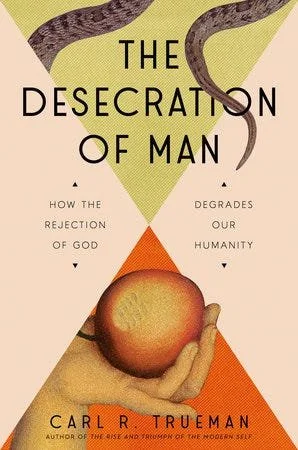
In his forthcoming book The Desecration of Man, Carl Trueman writes, “The sense we have today that everything is falling apart is simply the logical conclusion of...disenchantment.”
Disenchantment is trending. Lots of folks are writing and thinking about it, as in, what exactly has gone so wrong, and why does it seem as though everything is so superficial and terrible these days? The ancients built impossible pyramids oriented to the procession of the stars, memorized epic heroic tales, engaged in fanciful alchemical experiments, had tons of babies, fought each other, loved each other, explored, and curated some seriously impressive religious rituals. Us moderns, other than the fighting, have none of that. Instead, we have iphones, online shopping, AI slop, and fake Christmas trees. The magic is gone. The solution to our materialist modern ills, the seemingly only logical conclusion, is that it’s high time to re-enchant.
Easier said than done.
Plenty of ink has been spilled in the autopsy of enchantment. Plenty of arguments have broken out about how our world lost its vibe. Was it the Machine, the Communists, the French Philosophers, the Hipsters, the Grifting Politicians, the Second Vatican Council, the Woke Mind-Virus? Was it all of them? And is there anything linking all of them, an intentionally organized force or a nebulous-but-insistent cohesion of evil?
I’m on record that I’m more-or-less worn out with reading massive counterfactual interpretations of history. I’m tired of looking at the dead body.
In any case, the post-lapsarian world outside the Garden is less a closed system open to explanation and more a chaotic, irrational free-for-all, as is the way of all sin. We’re all hustling to throw on coats as we stumble from Eden before the winter wind chills us to death; what matter who or what gets slaughtered in our need for metaphysical animal skins. Our present condition is less the result of an evil mastermind and more the inevitable result of Godlessness - a dying quiver, a fading ripple, a mad scramble for sustenance after the branches of the apple tree have been picked clean. Sin isn’t rational and it certainly isn’t organized. I don’t hold to any massive human conspiracy via government power, secret society, etc… against humanity (Satan’s ongoing conspiracy against us, however, is another matter, although I suspect that, even here, the attempt is random and unorganized, albeit violent). We selfish individuals have made things bad enough purely through our selfishness as we stubbornly enslave ourselves to our pet vices.
To me, a more modest attempt at connecting the dots, one which doesn’t purport to mangle every single line of the picture into a grand narrative but, rather, examines how historical events may (or may not) have influenced subsequent events is more tenable, but at this point, I’m not particularly interested in this sort of argumentation, either. I’m just not that into fixating on what has gone wrong. Not that it isn’t a laudable service of historians and philosophers to offer a completed picture (and Trueman does make efforts in this direction). Someone has to do it and, after all, a good diagnosis goes a long way towards identifying the appropriate medicine. But I’ve read enough of it. Gone are the days when I would giddily devour a book in my college dorm room about all that has gone wrong in the world. Such books tend to conclude with only a slight nod to the work we might worthily engage in to help things actually go right.
If we’re going to make the effort to diagnose disenchantment, we can’t follow up with a shrug and the nebulous encouragement to re-enchant. For his part, Trueman doesn’t care for the enchant/disenchant framework. He finds it all too vague. Instead, he prefers to speak of desecration and consecration. The benefit of this language is a more precise diagnosis of the problem and thus a more specific proposed solution.

Desecration isn’t merely the loss of a nebulous golden era; it’s “the denial of sacred boundaries.” In other words, it’s an irrational rejection of all that which is good and authentic, all that is organic, beautiful, and fitting to our nature as created beings. There’s a temporary thrill in desecration and its attendant albeit temporary feeling of godlike power, which partially explains why we engage in something so blatantly counter-productive but, ultimately, desecration disenchants as it separates us from the Ground of our Being.
Trueman’s point is important. We shouldn’t overlook that desecration (or dis-enchantment) isn’t limited to a problem of aesthetics; it’s also a moral problem. The solution isn’t simply to return to idealized nature, a sentimentalized golden age, or some ideal political system (which inevitably was never put into practice correctly). As Trueman writes, “Reading Tolkien, talking about beauty, and respecting nature may all be good and worthy things. But they do not consecrate us...Only a renovation of the heart, redirecting it toward God, is able to do that.” As someone who loves all of the above, fair enough. As Trueman summarizes, consecration involves “creed, cult, and code.” In other words, consecrating a desecrated world involves specifically Catholic belief (not sure if Trueman indicates Catholicism specifically, but I sure do), with dogmatic definitions of the Faith; a liturgy that blesses, transfigures, and imparts symbolic knowledge; and a moral framework by which mankind can live. We’re talking about conversion, here.
I have a lot more to say about how conversion involves participatory adoption into the life of God, and how being set apart in such a way, or consecrated, places us on the mediating threshold of Heaven itself, and how grace overflows through such thresholds in a plenitude that spills over into the prodigal depth of transformative love by which all things can and will be blessed and handed into the care of the Divine. I could go on and on about how the Incarnate Christ is like the Sun at the center of our metaphysical planetary system and all creatures are satellites caught in his gravity and, as we orbit we are bent to his love, and in the bending we are curved into an ascending spiral, brought into a light too bright for us but which we can behold if we look very carefully and attentively into overshadowed mirrors. This takes me far beyond Trueman’s thesis but I think it’s an appropriate response.
Consecration, or enchantment, is transfigurative. It is participatory. As such, it must be concrete and embodied and personal. It’s the opposite of vague platitude, and involves everything we are. It cannot be limited to a moral code, a penchant for beauty, or the right intellectual ideas. It’s all of the above.
Consecration is only possible in and through the specific, embodied mediation of the Church. The Church is the threshold along which we push through the surface and into the deep. He, we are united to the mystical Body of Christ. What the world needs today, a world so terribly desecrated and hollowed out by sin, is the Church, a sacramental, unashamed, self-confident Church that makes sacrifice because sacrifice is love and love is the principle of self-renunciation by which everything we hold dear is made into a gift for God in whose economy that which is given away is returned, perfected and consecrated.