Iona and Patmos: A Tale of Two Sacred Islands
“In Iona of my heart, Iona of my love…ere the world shall come to an end Iona shall be as it was.”
- Anonymous prophecy
“Every man has within him his Patmos.”
-Victor Hugo
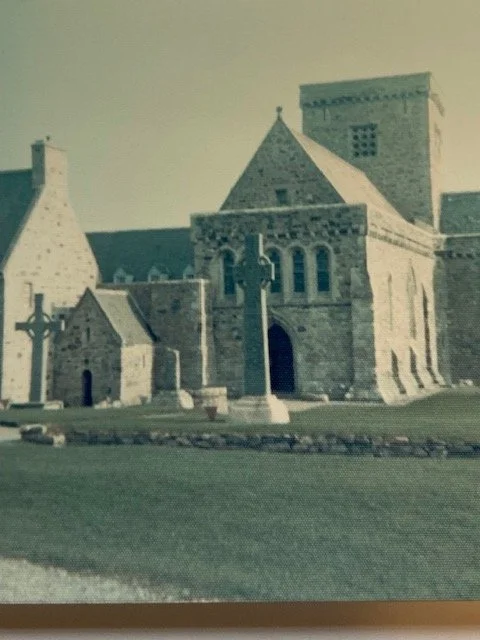
A snapshot of Iona Abbey in 1975. In the foreground is Saint Martin’s Cross, which has stood for some 1200 years. Photo: Mike Dillon
Twice in my life, I’ve stepped ashore on a sacred island.
The second came last October, in Patmos, Greece, when my wife and I debarked the ferry from Kos. As we strolled into the modest harbor town of Skala, a sign in English greeted us: Welcome to Patmos. Enjoy its Beauties. Respect Our Tradition.
We’d arrived at a different manner of Greek isle by design — a light-year away from the Dionysian scrum of Mykonos, or Santorini’s Instagramming hordes. On Patmos, it is said, “the soil is thin,” the border between Heaven and Earth porous.
Fifty years earlier, in June 1975, I came to my first sacred island where the soil is also famously thin. Iona, in Scotland’s Inner Hebrides, is a small, green and ochre place of rocky outcrops and Mediterranean-like sand coves. I landed as a callow, backpacking, twenty-five-year-old American on the first leg of my European wander-year.
Iona occupied a high place on my must-do list because of words I’d overheard, delivered in a plummy English accent, on my parents’ TV: “I never come to Iona…without the feeling some God is in this place.” I looked up to see Kenneth Clark stride across a wintery beach, talking about the Scottish island he often visited in his youth. The first installment of Clark’s “Civilization,” produced by the BBC, was off to a strong start in its American debut in the early days of PBS.
Before setting out for Europe five years later, I worked for nearly two years as a night janitor in a downtown Seattle office building. Awkward, post-college, lacking confidence in my place in the world and uncommonly shy around women, I lived a reclusive existence, sleeping by day, reading, writing, and studying up on Europe in my waking hours. When my savings account hit six thousand dollars — enough to travel on for a year then — it was time to go.
Of course, (surprise, surprise) I wanted to write. In Europe, I figured, I would find my phantom writer’s voice, as if I were on a treasure hunt. Maybe on Hemingway’s Left Bank, or Rilke’s wind-whipped sea cliff at Duino Castle. There were long nights when I doubted my sanity. While my childhood friends were establishing themselves in the world in the expected ways, I might be walking the plank above a cliff of my own making. Yet something down deep whispered: push on, or else betray the life you have been given.
In the sixth century, after setting out from Ireland in a wicker currach, St. Columba and his small band founded a monastic community on the island of Iona, enacting a scene out of Luke 5:11: “They pulled the boats up on the beach, left everything, and followed Jesus.”
In the Dark Ages Iona served as a candle-flame for Celtic Christianity and Western civilization. Ever since, the island has been a pilgrimage place of intense spirituality.
The restored Abbey, a place of ecumenical worship, was built by the Benedictines in the Middle Ages on the site of Columba’s original abbey. Near it, rising fourteen-feet high, is the intricately carved, eighth-century St. Martin’s Cross. Saint Oran’s chapel dates from the twelfth century. The Street of the Dead, a cobbled, grassy path and ancient pilgrimage route, runs past the burial place of Scottish kings, including, it is said, Duncan and Macbeth. And there is the small island at large, where people would fan out from the island’s two hotels in the morning to their favored places.
The hot weather, the serene setting, and a couple of beaches where I could swim in the turquoise water dissuaded me from a quick return to the mainland. I had figured on staying one night. I stayed five.
After dinner at my small hotel, the handful of guests would gather in the library for tea and cookies as the June light outside the window dwindled but never turned black in those northern reaches. The guests, all British, mostly widows, were as old, or older, than I am now. And endearingly, helplessly British: witty, erudite, eccentric. I was a curious anomaly: a tall, young American male in blue jeans with an interest in Keats and British history. They went out of their way to include me in their conversation.
On my third night I stood alone in the warm dusk not far from the Abbey. The wind rattled a low bush nearby. The sea darkened to purple; the gulls flashed like torn bits of paper. St. Martin’s Cross held steady in the wind. Eastward, a lone, gold bar of sunset cloud above the island of Mull reddened and drifted like a gashed salmon. A phosphorus flare — probably Venus — burned low in the northwest. And suddenly time and space were brushed aside. I seemed to stand at T.S. Eliot’s “still point of the turning world.”
It's no use in trying to stammer out the words for what I felt. I can only fall back on words, approximate words, I would encounter years later. “And all shall be well, and all manner of thing shall be well,” (Julian of Norwich). “All the way to Heaven is Heaven,” (Catherine of Siena). “We are blessed by everything,/Everything we look upon is blest,” (William Butler Yeats). “Life is this simple: we are living in a world that is absolutely transparent and the divine is shining through it all the time. This is not just a nice story or fable. It is true.” (Thomas Merton).
The moment lasted fewer than fifteen seconds.
On my last day there I sat on a bench in the village at dusk. Beside me was a British woman in her mid-seventies I had befriended in our hotel. As I tried to tell her about those fifteen or so seconds, she gazed at the darkened sea and said: “This island is famous for it.”
In the morning, as the launch carried me across the sound to Mull, I looked back on Iona and vowed, channeling Wordsworth: “that I should be, else sinning greatly,/a dedicated Spirit.”
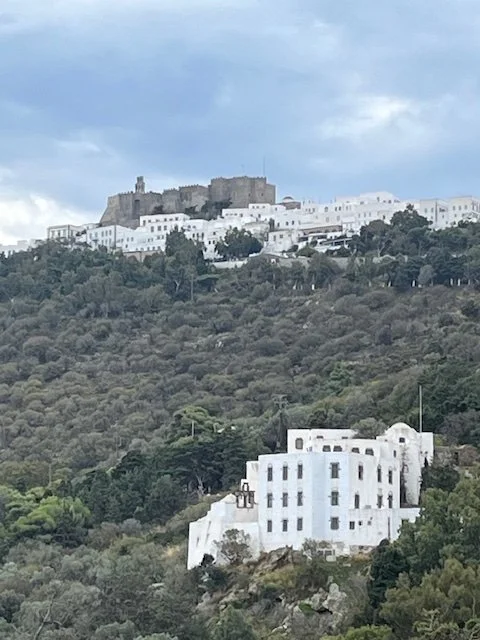
This is taken from the cobbled footpath on the way up Hora Mountain from Scala. The hallowed place of the Cave of the Apocalypse comes first. Higher up stands the Monastery of Saint John the Theologian. Both are UNESCO World Heritage Sites.
Photos of Patmos by Sydni Sterling
Fifty years later, as our ferry approached Patmos, my thoughts ran to Iona. Yes, I had written books of poetry, and essays, and put bread on the table courtesy of the newspaper business. And I had married an artist, strikingly beautiful inside and out. Our two sons, in their chosen work, advocate for the least of those among us. We have grandchildren. We have reasons to be proud. And humble.
As we stepped ashore, past the welcome sign, I looked half-way up the mountain of Hora in back of town to the white monastery enfolding the Cave of the Apocalypse. Topping the hill stood the fortress-like Greek Orthodox Monastery of St. John the Theologian, founded in 1088, the cubed, white-washed, labyrinthine village of Chora at its feet.
Patmos: the sacred island in the eastern Aegean where Saint John heard the voice of God in a cave, transcribed to become the last book of the New Testament. A metal-bracketed cleft in the rock signifies the spot where, according to oral tradition, John rested his head; a smaller niche marks the place where he would put his hand to lift himself up. Overhead, at the convergence of three fissures symbolizing the Holy Trinity, is the place, it is said, from where God’s voice issued. Suspended silver lamps, lit candles, ikons and artwork established an aura of peace and concentrated devotion.
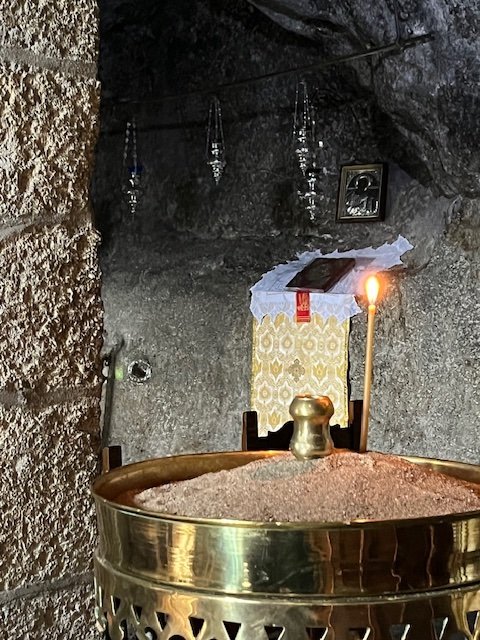
A detail from the Cave of the Apocalypse, where the last book of The New Testament occupies an honored place. The small hole in the rock to the left is where, according to tradition, Saint John would put his hand to lift himself up after resting.
There is no airport on Patmos, but there are cruise ships . They anchor outside the harbor and run passengers in tenders to the waterfront. Waiting buses deliver them to the cave, and then the monastery. For those who prefer to approach a holy site on foot, the hill-climb from Scala to both sites will work for any reasonably fit person. Mid-morning and late afternoons are best for avoiding the crowds.
Only parts of the multi-story Monastery of Saint John the Theologian are open to the public; those include an open courtyard, and the chapel of Virgin Mary with its eleventh century frescoes. Among the museum’s treasures are priceless books and documents from the medieval library in the basement, which is restricted to Byzantine and Biblical scholars. Beside the library door a marble plaque, installed in 1802, speaks of the library’s contents as “more enduring than gold.” Like Iona, the library and monastery are beacons of scholarship and sanctity radiating throughout the Aegean and Orthodox worlds.
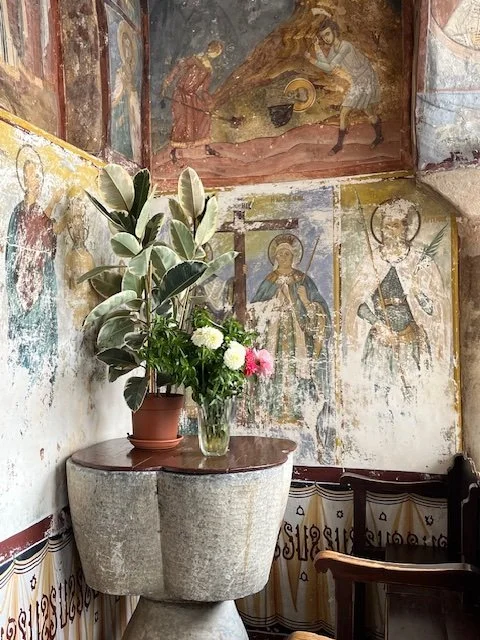
Timeworn frescos off the open courtyard at the Monastery of Saint John the Theologian.
Patmos is also the last home of Robert Lax, American poet, contemplative, Jewish convert to Roman Catholicism and one of the more intriguing figures in Merton’s autobiography, The Seven Storey Mountain. The two remained close friends until Merton’s death in 1968. Lax died in 2000 at eighty-four.
The tall, gaunt, white-bearded Lax — the very image of an Old Testament prophet — was drawn to the island’s numinous power, as seekers were later drawn to the door of the man who treasured silence and privacy. Down in the harbor Lax mixed happily with the fishermen. The locals considered him a holy man.
In Merton’s autobiography, finished when he was thirty-one, there is a famous exchange when the two college friends walked along Fifth Avenue sidewalk in New York City in the late 1930s when Lax asked: “What do you want to be, anyway?”
After fumbling for an answer, Merton replied: “I don’t know; I guess I want to be a good Catholic.”
Lax informed Merton that he should have said, “that you want to be a saint.”
Merton, thrown off guard, wanted to know how.
“By wanting to,” Lax replied.
In a marvelous series of interviews captured in The Way of the Dreamcatcher, Spirit Lessons with Robert Lax: Poet, Peacemaker, Sage, by S.T. Georgiou, Lax comes across as playful, direct (as Merton found out), complex, disarmingly simple, and loveable.
Here's Lax’s take on Patmos: “There’s just a certain feeling that something spiritually significant is here, waiting to reveal itself in its own good time. When I first came I strongly felt the power of St. John’s cave as well as the great monastery up there, but really the Cave of the Apocalypse is what moved me….The cave has been a magnet for all the Patmians since the days of St. John…It has made them loving, gentle, wise.”

By the time I reached Patmos the dreams and fears of the urgent future I carried to Iona had dimmed into dust at various stages along the long road behind. The truth behind the words written by the young Yeats, that “peace comes dropping slow,” is something that had taken me most of a lifetime to grasp. Once upon a time, I cast my bread upon worrisome waters. Fifty years after Iona, I came to Patmos — prow to the waves, at peace with whatever the future brings.
On our last full day there, my wife asked me what I wanted to do. I requested a second walk up to the cave; on our first visit, too many people jostled in the small, sacred space. The morning wasn’t old and the lone cruise ship hadn’t unloaded yet. Why not?
We walked twenty minutes uphill from Scala to find just one other visitor, a tall young man with sandy, close-cropped hair, his back to us as he stared into the cave. A cloth messenger bag hung from his right shoulder. He stood in his worn hiking boots and wool mountain pants as straight and focused as a compass needle. Northern European, I guessed. All three of us stood in the palpable silence without moving. He seemed not to register our presence.
With my head, I motioned to my wife: time to go; time to let the young man be.
I never saw his face.