I Would Rather Be a Saint Than a Great Novelist
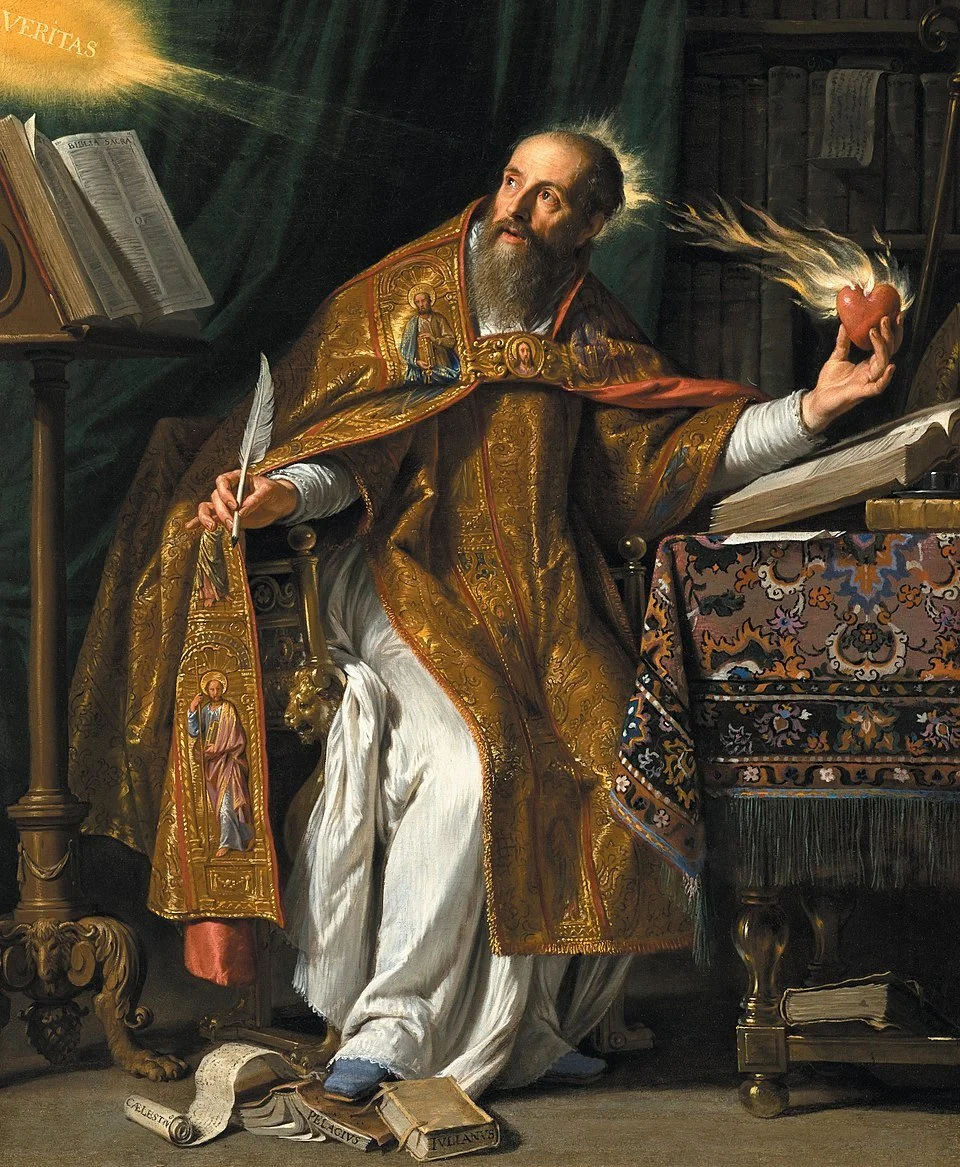
In Book I of Augustine’s Confessions, the saint relates a story about performing a passage of the Aeneid when he was a boy:
What did it profit me, O God, my true life, that my speech was acclaimed above those of my many peers and fellow-students? Was it not all smoke and wind? Was there no other material on which I could have exercised my intelligence and my tongue? Yes, there was: your praise, O Lord; your praise in the words of the scriptures would have supported the drooping vine of my soul, and then it would not have yielded a crop of worthless fruit for the birds to carry off. Sacrifice can be offered to those birds of prey, the rebel angels, in more ways than one.
While Augustine is writing here specifically about memorizing and reciting a section of the Aeneid, I see at the heart of this passage a challenge to myself, to all artists, and to each one of us: “Was there no other material on which I could have exercised my intelligence and my tongue?” This is a question we can all ask ourselves about the things we consume and spend our time on, a question that challenges all the ways we exercise our minds and time; but even more, it is a question that every artist must ask himself about his work. Is my work supporting the vine of my soul and of others, contributing to the kingdom of God, or is it a worthless crop, a sacrifice to the rebel angels? Is my work worth spending my mind, labor, and time on, both in my art and in the rest of my choices? These are questions of vocation that demand an apologia, a justification for the work that one spends, hour after hour, year after year, trying to write something that is worthy of being written and being read. They are questions with which any serious artist and Christian must grapple, and which I will try to wrestle out for myself in these lines.
Just a few paragraphs earlier in the Confessions, Augustine writes that the works of Homer and Vergil are “as empty as they were entertaining” and “empty in a thoroughly entertaining way.” He goes on to call his love and memorization of the Aeneid “frivolous studies,” saying he could have learned “useful words…just as well from texts which are by no means frivolous.” On their surface, these words seem to challenge the literary artist even further—are my works merely frivolous? Can my fiction only ever be empty entertainment which distracts from what is important? If even Vergil and Homer cannot rise above “emptiness,” how can I ever hope to accomplish something meaningful in my work?
Again, these questions challenge us whether we are pouring time and effort and soul into writing or simply reading and studying these texts. And while in these lines Augustine seems to condemn time spent studying Vergil and Homer, his own work speaks against this condemnation. Echoes of the Aeneid run throughout The Confessions, including frequent quotes and references. More fundamentally, Augustine recognized the parallels between Aeneas’s life and his own, and his vision and “confession” of his own life is shaped by his knowledge and love of The Aeneid. Augustine spent nine years in Carthage, in a relationship with a woman who was not his wife, coming gradually to know he must leave her to follow God, not yet wanting to go. Eventually, though, he did leave Carthage and his lover for Rome, just as Aeneas had to leave Dido and follow the same path in obedience to the gods. Other writers have exposited the parallels in greater depths, for those interested in a deep dive. Whether or not he explicitly acknowledges it, Augustine’s experience of life is informed by Vergil’s work.
Surely, then, literature is not necessarily empty and frivolous. In Augustine’s own life, literature had a formative power, and still has that power in lives now. Anyone who has seriously studied the great books knows this to be true—in literature we press into the questions, sorrows, and difficulties of human life and seek understanding of our existence. Approached in a spirit of humility, literature can serve as an aid in understanding the human experience and broadening our vision. Augustine’s statements about Vergil and Homer, therefore, seem to be exaggerations akin to Christ’s exaggerations in the Gospels (let the dead bury their dead, whoever does not hate his mother and father, etcetera). In reality, Vergil has a greater force in Augustine’s life than mere “entertainment,” just as a studied reading of Vergil or Augustine can be a powerful good in our own lives.
So, while Augustine challenges us on the points I raised above, he also helps provide answers. As another example of the guidance offered by Augustine, the saint was trained from a young age as an intellectual and rhetorician, one who could think and speak and write persuasively. Throughout The Confessions, he rebukes his former life and the career of selling rhetoric, but, importantly, he also makes great use of those skills. Without the training, the reading, the knowledge that he acquired throughout his life, Augustine could not have written the work that Christians have read and studied for centuries. Perhaps he would have written a form of his confessions, but if he had come from a different background and intellectual formation, the book would not be what it is.
After his conversion and in his confessions, Augustine aligns the gifts that he has received toward the true good, toward Christ, and toward the good of others. In this sense, Augustine’s writing serves as a sort of spiritual work of mercy. Throughout the book, Augustine instructs the ignorant, prays for the dead, admonishes sinners, counsels the doubtful. Certainly it is not writing or rhetoric themselves but his ill use of them that Augustine condemns. The problem with Vergil was not that it was truly empty, but that Augustine placed it above Scripture, above virtuous living, and used it to feed his pride in his schooling. He placed the non-essential in the place of essential pursuits.
Coming back to my initial questions, as a writer I still feel the urgency of Augustine’s challenge, was there no other material on which I could have exercised my intelligence and my tongue? To answer in one way, we know that we are formed by stories, by art, by literature. We know from our own human experience that beautiful art, whatever its form, can move us toward the truth and the good. How important it is, then, that we have artists creating poems and novels and stories that are directed toward these transcendentals, who strive to understand the fullness of the human experience and dilemma without reducing it to materialism or social forces or any other nihilist philosophy. We need to have artists who are rooted in the true and good and not just curiositas, novelty, or the philosphie du jour.
As an unestablished writer, though, it is difficult to justify large chunks of time spent not with my children, not helping at parish events, not planning elaborate lessons or giving more detailed feedback on homework assignments, not participating in Mass or in a Holy Hour every day, not doing a hundred other good things. It can feel at times that my work is empty, that there is so much more demanding work upon which I could exercise my intelligence and tongue, my fingers and eyes, my mind and my body. I can justify that someone out there ought to be writing great works, but it is harder to justify that time and sacrifice in my own life.
But here again Augustine offers me comfort. After his conversion and after becoming bishop, surely the demands upon Augustine’s time and efforts were great. His skills as a rhetorician and writer must be turned toward accomplishing God’s will, but he does not cast them off. He writes with even greater earnesty and fecundity, with purpose and direction. Augustine answers the call that God has placed within him to write, to write well, and to write truth. Augustine the writer responds to that call as an important part of his turning toward God, of following the divine will.

I have hope, then, that if I truly seek and desire to do God’s will, and he places upon my heart the work of writing, then by responding to that call I am responding to the divine will. There is even greater hope in the reality that if this is the case, the ultimate earthly success of my writing is not the most important thing. If it is God’s will that my work reaches an audience and contributes to building up his kingdom, His will be done. If it is God’s will that my own desires and soul are purified through my own mediocrity and the failure of my writing, still His name be praised. In either case, my goal is and ought to be to respond to the divine call, to be abandoned to His will.
Of course, I can write this, think through it theologically, and be intellectually satisfied with this reasoning, but as a fallen man, as an artist who sees and reads and compares himself to others, it is much more difficult to accept the idea that God may use my failure for my sanctification. With Flannery O’Connor I call out to God, “Mediocrity is a hard word to apply to oneself.” O’Connor goes on: “To accept it would be to accept Despair.” Even if I accept that my sanctification may include my failure as a writer, my ultimate mediocrity as an artist, I do not need to accept that mediocrity as already foregone. If in the end I die with no earthly success or accolades, and through that I attain heaven, I will have all the joy and fulfillment I need; but now, before that end, I do not, should not accept mediocrity without a fight. I must battle against it. For, if I believe the Lord has called me to this work, if I believe that it is for the good of my soul, it is in alignment with the divine will, it is a spiritual work of mercy to which God has called me, I must work to respond to that in the most magnanimous, virtuous, heroic way that I am able. Even as I accept that in the end God’s will be done, whatever that may be, until this earthly life is over, I must not believe that God wants me to roll over in sloth.
“Now cast aside your laziness,” Vergil says to Dante in the eighth circle of Hell, commanding him to continue his work and journey. Dante, as both pilgrim and poet, must rise and continue in his vocation until the Lord decrees his work is done. His pilgrimage through the afterlife is literally a journey of sanctification, moving past circles of sin, through purification, toward the beatific vision. Just as Dante is called on by Vergil to keep laboring, the philosophy and vision of my own artistic call which I have presented are not permission to be slothful or presume mediocrity. It is not to excuse myself, reproach the Divine, or complain about the divine will for me.
Rather, it is a proper ordering of the artistic vocation, understanding that every vocation is ultimately ordered toward sanctification. Each of us must respond to what we discern as the will of God. We must resign ourselves to that will, whatever it may be. I believe that my writing can be for my own sanctification, and I must treat it as such; if I do, then no matter what comes of it materially, artistically, commercially, it is time and effort that is properly ordered and correctly spent. Because if it is true, as the novelist Christopher Beha has said, that a saint cannot be a great novelist, and I am forced to choose—I would rather be a saint.