Why 3 Popes Think You Should Read Lord of the World
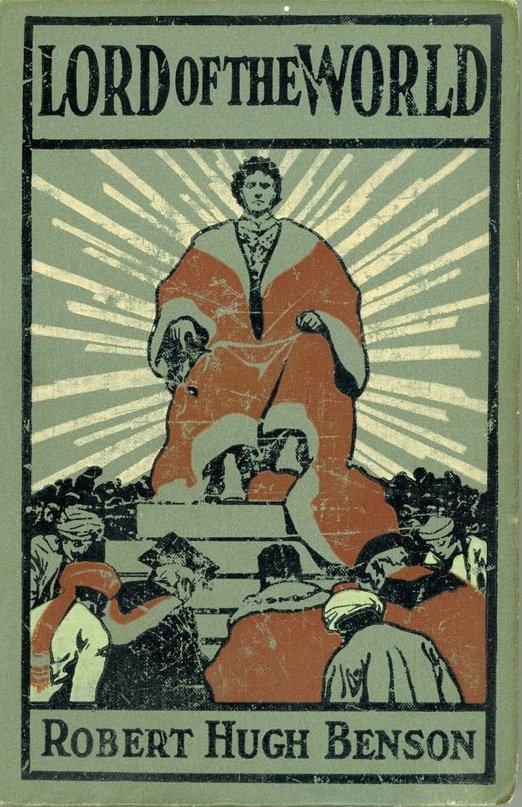
With Pope Leo’s recent remarks to writers, along with his citation of the Lord of the Rings in his most recent encyclical, the Catholic literary world is abuzz with excitement. Like Leo, Francis saw and preached the value of Catholics reading novels for their spiritual growth. One such novel has been acknowledged as spiritually fruitful by our three most recent popes, Benedict XVI, Francis, and Leo XIV: Fr. Robert Hugh Benson’s apocalyptic, and timely, Lord of the World (LotW).
This marks three popes in a row to recommend Benson’s 1907 novel. Like another dystopian novel written a short time later, Brave New World, Benson’s LotW was prophetic. Both novels warn of the rise of technocratic tyranny that will undermine true human dignity. What distinguishes LotW from its secular dystopian counterparts is its explicit apocalyptic Christian theology and biblically-inspired narrative.
Indicative of LotW’s prescience is Benson’s inclusion of the ubiquity of euthanasia. While Brave New World foresees a different bioethics travesty in the prevalence of artificial wombs, genetic modification and cloning, Lord of the World sees euthanasia as so ingrained in the future that it becomes an everyday reality. What was a fictional absurdity only fit for science fiction has slowly become a responsible expectation in many developed countries.
Benson’s inclusion of this issue is powerful because he makes it personal. One of the plots of the novel follows a character coming to terms with her decision to have another character euthanized. While her conscience is awakened, she despairs and eventually has herself euthanized. Benson illustrates the tragedy that a culture of death fosters on an individual and societal scale.
While this subplot powerfully moves one regarding a very real, and contemporary, cultural issue, Benson also presents a larger, transcendent theme that should inspire Christians on every cultural issue. The turning point in the novel, when things appear to be moving from bad to worse for the Church while the Antichrist’s influence rises, is instigated by the pope’s promulgation of a new religious order. The name of this order, the Order of Christ Crucified, indicates the posture of humility that those who profess it must take.
This moment in the novel is especially poignant for Christians today because of the unexpected subversion it provokes. St. Paul, rightly, simplified the entirety of the Gospel to “Christ crucified” because of all that is entailed in these mere two words (cf 1 Cor 1:23). It was a “stumbling block” and "foolishness” two-thousand years ago. “Christ Crucified” has a similar effect in this hypothetical future of LotW and continues to in our own times. When reality operates apart from grace, by power alone, it is undone by humble self-sacrifice.
Christ’s crucifixion, the humblest and most self-sacrificial of actions, upended the reality built on power. In establishing the Order of Christ Crucified, Benson’s powerless Church, in the worldly sense of power, fought the Antichrist the only way it ever could. In adopting the humility of Christ crucified, the Church’s true power becomes manifest. This is not a convenient turn for a plot. It is the deepest, most fundamental truth of the life and work of the Church, both the fictional one of LotW and the historical Church.
The apparent problem with taking this approach is precisely the “problem” with the crucifixion of Jesus initially. When it first happened, any witness could come to no other conclusion than that goodness had lost. God’s chosen one was abandoned. Followers were scattered. There is a seemingly similar result in the novel. Is the Church of today ready to accept a similar result? Can the Church accept “losing” influence, power, money, followers, visibility, for the sake of the truth?
If Benson had been asked back in 1907 whether he was living during the time of the Antichrist, as his novel depicts, he would likely say what the Church has been saying for nearly 1900 years to that point: that ever since St. Peter declared it in Acts 2:17 we are in “the last days.” There have been many “antichrists” in the way 1 John 2:18 uses the term: those who deny Christ has come in the flesh and is the Savior. These figures have sought to suppress God’s goodness implicitly or the Church explicitly, and replace it with themselves.

The answer for us is the same answer it was for Benson and for St. Paul in 1 Cor 1:23, to “preach Christ and him crucified.” In the fictionalized apocalypse of Lord of the World this required the formation of a religious order named and especially called to this charism. For now, it is the informal, though universal, call of every Christian.
Of course this means the preaching of the Gospel in the way everyone expects, but it also includes preaching Christ crucified by our lives. It is how the Christian lives out St. Paul’s call to “offer [our] bodies as a living sacrifice” (Rom 12:1).
Without giving the ending of the novel away, it is the paradox of self-sacrifice, the losing of oneself, that the individual’s eternal life is won and a culture is won for Christ. This reality is continually proven true in history, it is depicted powerfully in Lord of the World, and it will prove true when history concludes.
This truth is recognized by our last three popes and illustrated by Fr. Robert Hugh Benson’s Lord of the World, which is why they all want you to read it and take it to heart.