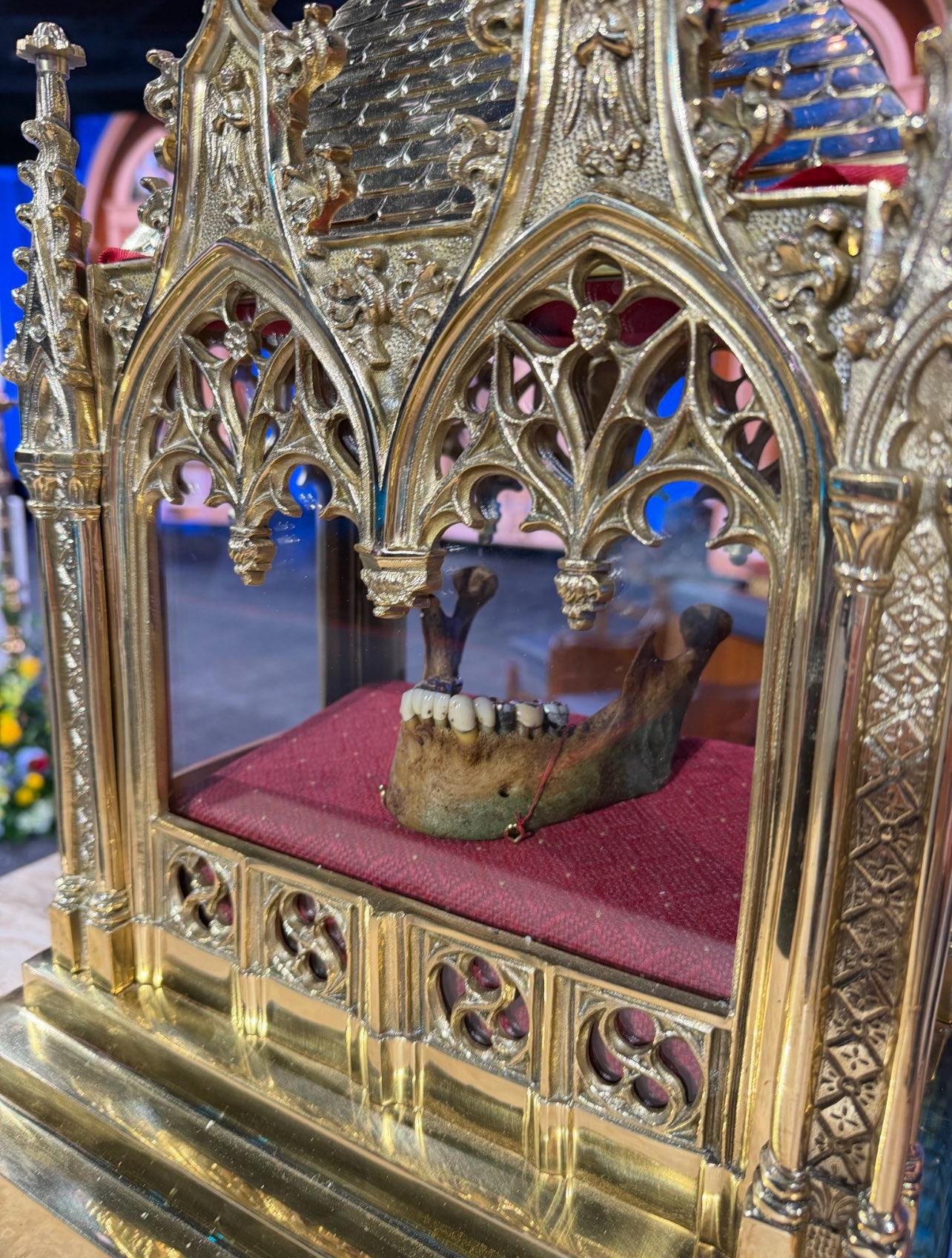
Fulton Sheen’s jaw
Many people think that bones are white, but they’re not. Not really. They’re closer to a yellowish brown, stained by time and marked by the flesh that once clung to them. They aren’t the neat, tidy, little skeletons that we hang up each October. You can see remnants of decay and dirt. Ridges, sockets and hollows. Aspects of bone that only become visible once the flesh is gone.
The jaw of Fulton Sheen sits behind glass. You can even see some of his fillings. Fulton Sheen’s newly unveiled relic made a lot of people uncomfortable, Catholics included, and rightfully so. Relics are intended to be jarring. However, some of this discomfort comes from another unfortunate truth: Many Catholics were never taught the spiritual meaning of relics. Sure. Many were taught their biblical evidence, and how to defend our devotion toward them. However, very few were taught what these strange bones say about the soul.
I’d also take my critique a step further. Most Catholic education centers on defense and duty, and lacks formation in the interior life. This deficiency leads Catholics to approach the supernatural in a very analytical way: “Each supernatural event within Catholicism must reveal something about the truth of Catholicism.”
And while, sure, this can and does happen, the supernatural often leads to a transcendental besides truth: The transcendental of beauty.
Despite the name, the transcendental of beauty is much deeper than lovely sacred art or Gregorian chant, it is anything that leads us into a state of wonder, awe and contemplation.
Even when that wonder and awe makes us uncomfortable.
We are slowly becoming a generation of Catholics who can explain everything, but tremble before nothing. Our faith isn’t just analyzing for truth, but also allowing the heart to be moved into a state of wonder and awe. A state of contemplation, which we believe, is the highest form of prayer. And when we are led to contemplation on Catholic supernatural matters, we often see something much deeper than intellectual analysis – we see that every strange Catholic phenomena reveals something about the soul’s journey toward God.
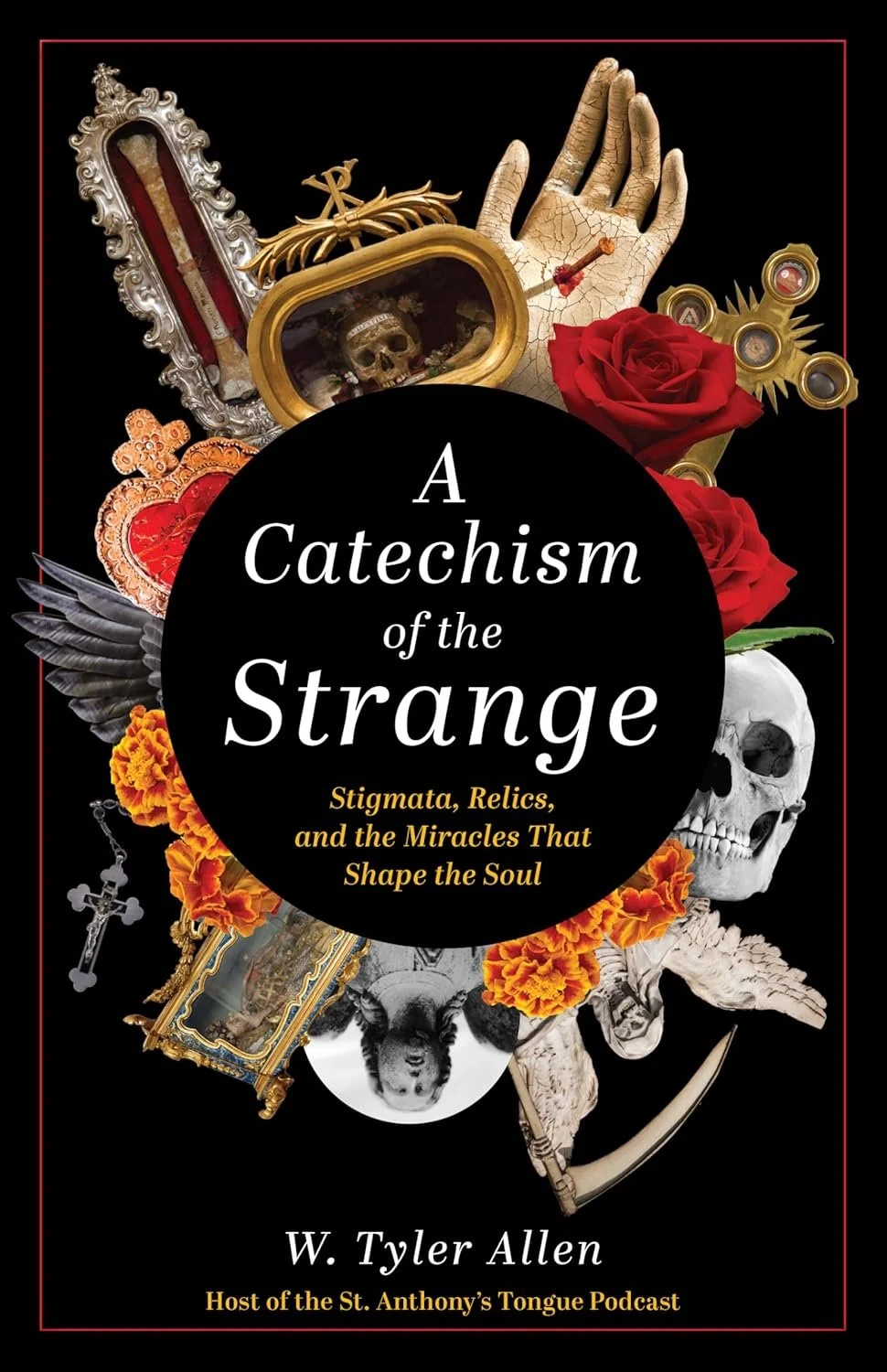
This is the premise of my book A Catechism of the Strange. We have a habit of treating strange Catholic things as sideshow attractions. A cabinet of curiosities that we only bring out when we want to prove a point. But in reality, the stranger aspects of our faith point toward the soul’s mirroring of Christ.
Take the stigmata, for instance. It points toward redemptive suffering. The wounds themselves may fascinate us, but they aren’t intended to be the final destination. They point back toward the wounds of Christ, and toward the Catholic belief that our suffering can be offered in love. The stigmata showcases our invitation to unite even the smallest sufferings of our lives to his.
In other words, the stigmata isn’t only something that happened to Francis of Assisi or Padre Pio. Contemplated properly, it tells us about what can happen within us.
Relics do the same thing.
Relics & Respectable Catholicism
Before we get into the supernatural, let’s bring relics back toward beauty. I think it is charmingly human that good, faithful and devout Catholics are turned off by the relic of Bl. Sheen’s jaw. But I wonder if those same Catholics were turned off by the skull of St. Catherine of Siena or the tongue of St. Anthony of Padua?
Perhaps not. And if not, it makes perfect sense.
These people never saw those saints in the flesh. But they did see Fulton Sheen. The same jaw that spoke, laughed, and smiled. The same jaw that cracked jokes with his audience with a flip of a cape. The same jaw that held the tongue that vibrated the vocal cords that pushed forth a voice that captivated millions.
Well, it’s in glass now.
It’s one thing to see the femur of an ancient saint in glass, but someone they saw in the flesh? Well, that’s different. It’s jarring. And it should be. We often create a box of respectable Catholicism. We believe that our faith must look and act a certain way. It must carry a certain aesthetic. But overtime, we gradually stop conforming to Christ, and begin conforming to content. We become attached to our idea of what holiness should look like. Our spirituality must look the way it’s depicted on social media posts and popular culture.
We like our saints to be washed, and well-dressed. They must look like a saint with folded hands, and pleasant faces. Little gold halos wrapping around their neatly painted heads.
A jaw with dental work still attached ruins that effect.
But jaw bones with fillings still fit well within the transcendental of beauty. A brutal depiction of the body of Christ isn’t meant to make us feel warm and fuzzy, and frankly, neither should a relic. A relic forces us to look at what remains when the flesh has melted away and ask a stranger question: What did God do with this body while it was alive? And what is He doing with mine?
Relics: Your Bones May Speak, Too
A key theme in my book is the concept of theosis. We sometimes call it sanctification or deification in the west, but to summarize – theosis is the slow process of the human person becoming more conformed to Christ. It is the slow transformation that every Catholic soul goes through as it journeys toward God.
One of my favorite explanations of theosis can be found in many of the medieval mystics like Catherine of Siena and Clare of Assisi. They speak of the soul as a gentle mirror of God. We were all made in the Image of God, the Imago Dei. However, our Image of God has been distorted by sin, selfishness and ego. Therefore, a major point of our faith is to cleanse the mirror of our soul, so it reflects the Image of God once more.
Sin, selfishness and ego smudge the mirror. The sacraments, prayer and acts of mercy cleanse the mirror. In essence, we spend a lifetime breathing onto the glass, wiping it clean, dirtying it again.
Our Lady is a fine example of theosis. She was so full of the Holy Spirit that she proclaims her soul “magnifies the greatness of God”. She became a mirror. We are to become mirrors, too.
Though, this process of becoming a mirror of God isn’t just something that happens in the soul. If God wills it, it can make itself visible in the body, too. This is why we have tales of glowing saints, another chapter in my book. The Holy Spirit envelops these saints so fully at times, that he makes himself known through a glow. This also points back toward the Transfiguration.
But holiness does not need to glow in order to enter the body.
Thomas Aquinas called the bodies of the saints “temples” and “organs of the Holy Ghost”—bodies in which the Spirit once dwelled and worked. And remarkably, Aquinas doesn't stop with what God did with those bodies. He points toward what God will still do with them: they are “destined to be likened to the body of Christ by the glory of the Resurrection.” Holiness, Aquinas says, needs organs.
Thumbs traced crosses over the foreheads of the dying. Fingers worked their way across worn rosary beads until the knuckles ached. Hands fed the hungry, and lifted the Host high above the altar. Arms carried children toward baptismal fonts and held grieving people when words could reached their limits.
These bodies did the work of God.
The relic, then, points in two directions. Backward, toward a body through which the Holy Spirit once worked. And forward, toward a body God has promised to raise.
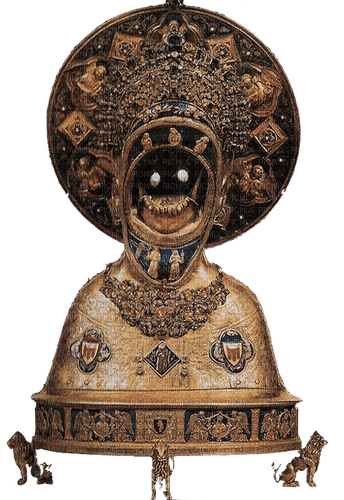
Anthony’s jaw
A Tale of Two Jaws
St. Anthony’s jaw is venerated as a relic because, like Sheen centuries later, Anthony was known for his preaching. But not many people know the story of his first homily.
The Franciscans and Dominicans were holding an ordination Mass, but no one had prepared a homily. Anthony of Padua, then a relatively new Franciscan friar, happened to be in attendance. The brothers knew he was educated and well spoken, so they figured — what’s the worst that could happen?
They prayed over Anthony before he preached, and tradition tells us that the Holy Spirit worked through him with extraordinary force. Some accounts even state that the Holy Spirit specifically animated his jaw and tongue as he spoke. That day, Anthony stood and delivered a homily so beautiful, poetic and theologically rich that the brothers were stunned by what they heard.
It didn’t end there. Anthony would go on to preach throughout Europe, drawing enormous crowds and calling thousands back to the faith. At one point, he even preached to the fish. Converting them, too, I’m sure. He became known as one of the greatest preachers of his age.
After Anthony’s death, his body was later exhumed when his remains were transferred to the basilica built in his honor. Much of his body had returned to dust, but his tongue was found remarkably preserved, still appearing pink and fresh. His jaw was preserved as a relic as well.
The parallel between Bl. Fulton and St. Anthony is almost too perfect. A man who spent his life opening his mouth to preach Christ dies, and centuries later, we still stand before his tongue and jaw that did the preaching.
The point here isn’t that the bone itself possesses some strange independent power. The point is that his body became an instrument of God’s grace. The Holy Spirit worked through a body. Which is why I find it so powerful that Fulton Sheen’s jaw was preserved as well. Because if we believe that the Holy Spirit worked through Sheen’s jaw as he preached and his tongue as he spoke, if we believe the Holy Spirit helped animate his fingers as he scraped chalk across the blackboard, why would we imagine that death suddenly makes that body meaningless?
Most of our jaws will never sit behind glass, and pilgrims probably won’t travel across the world to kneel before our bones. But that doesn’t mean the Holy Spirit desires anything less from our bodies.
Our mouths can proclaim Christ, pray for the dead and forgive the living. Our mouths can receive the Eucharist. Our tired hands can feed someone or hold someone. Trace a cross over the forehead of a frightened child. Our knees can ache from prayer. Our feet can lead us to feed someone who is in need.
These are small and ordinary things.
Holiness has always needed a body. It’s a hallmark of the Christian faith. One day, the flesh that hides our bones will be gone, too. Our jaws will stop moving. Our bones will become that yellowish brown that we’d rather not think about. And eventually, our bones will return to the earth.
Our faith makes another claim: God won’t leave our bones there in the dirt.
Those same bones through which the Holy Spirit worked will one day rise again. Hands will move, knees will bow, and mouths will open once more. So, perhaps the strangest thing about Fulton Sheen’s jaw isn’t that we placed it behind glass. Maybe it’s that when we look at his bones, we’re being asked to think about our own bones, too.
Not whether they’ll ever be encased in glass.
But what we’re doing with them while they’re still warm.
What have our bones spent their lives doing?
_____
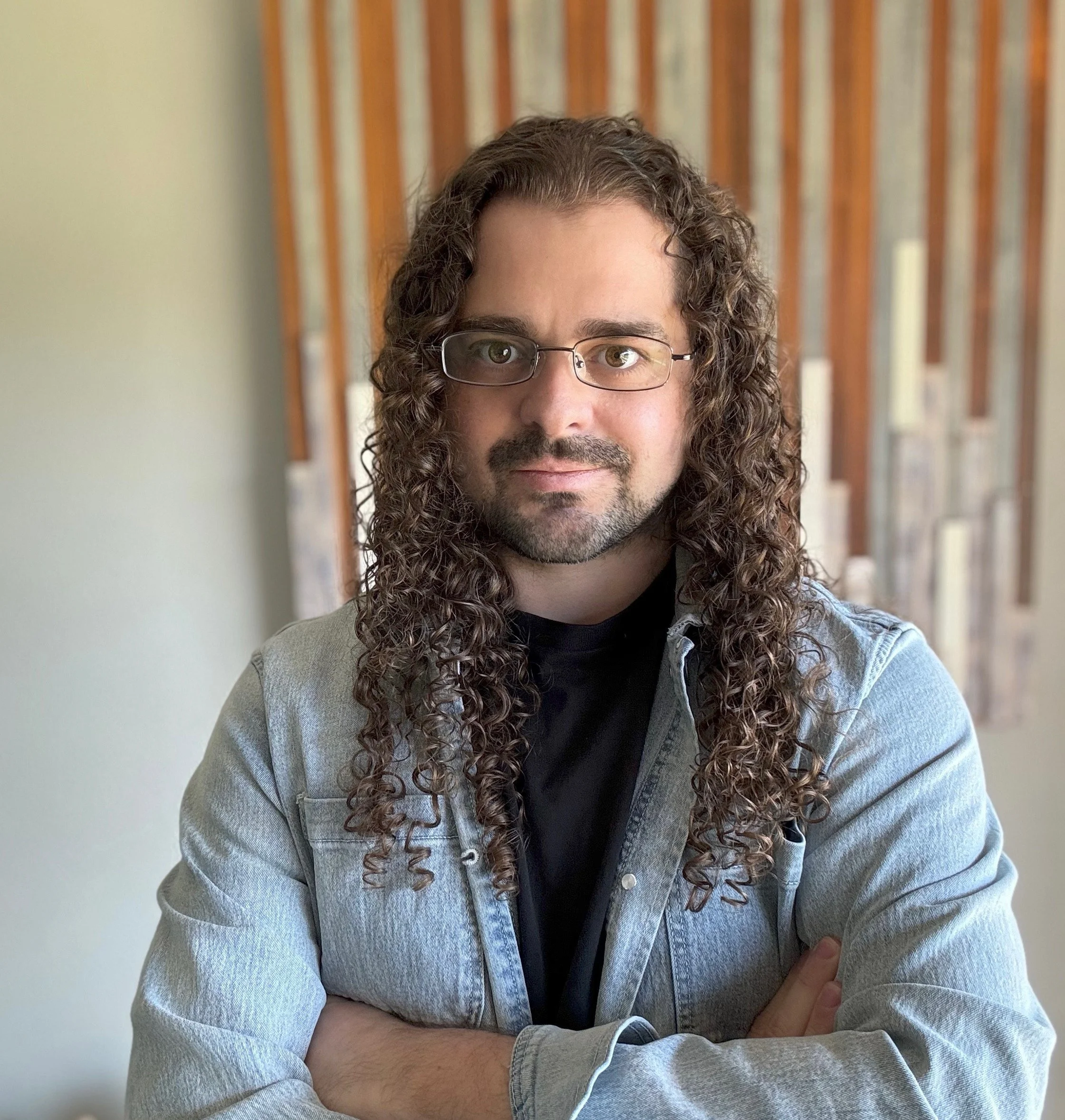
W. Tyler Allen is the author of A Catechism of the Strange: Stigmata, Relics, and the Miracles That Shape the Soul. He is also the host of the St. Anthony’s Tongue podcast and creator of The Margins, a monthly Catholic magazine.