The magical and the mystical
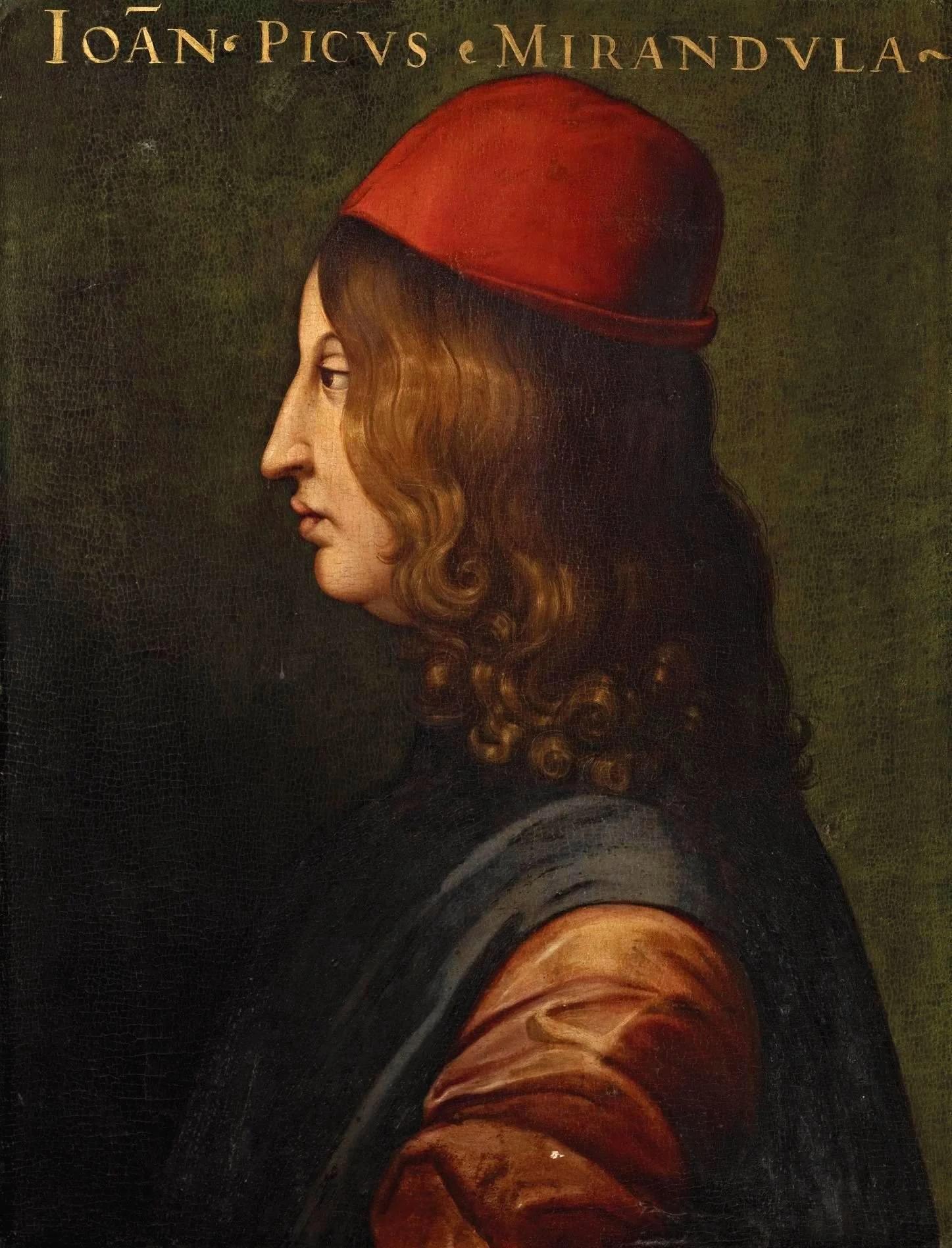
In his work, Oration on the Dignity of Man, Giovanni Pico della Mirandola advocates for a reconciliation of various types of knowledge to Christianity. Mirandola argues that increased knowledge leads to a greater appreciation of God. Because man is a reasoning creature, he can comprehend the “mysteries” of God and creation (34). As Russel Kirk explains in his introduction to the Oration, for della Mirandola, “The humanist does not seek to dethrone God: instead, through the moral disciplines of humanistas, he aspires to struggle upward toward the Godhead” (xv–xvi). For Mirandola, being a human is the greatest honor in all creation, and man can worship God best through embracing his human capacity to reason (4, 13–17).
While these ideas may seem orthodox, the philosophies Mirandola uses to attain the end of knowing God better are quite unorthodox, particularly his emphasis on using “white magic” in this pursuit of understanding God. Mirandola wants to comprehend God through his reason, but he also seems to desire some sort of emotional or intensely spiritual experience. Spiritual experiences—particularly visions or sensing a “still small voice,” as described in 1 Kings 19:12—are a long-established tradition within Christianity. However, Scripture and tradition make it quite clear that God-inspired spiritual experiences cannot be gained through magic.
Christian mysticism fulfills both Mirandola’s desire for a deeper, reason-based knowledge of God and a personal experience from God. While the tradition of Christian mysticism is wide-ranging and cannot be reduced to one representative figure, Julian of Norwich is perhaps the best-known English, Christian mystic. Her, Revelations of Divine Love, reveal a woman who, like Mirandola, desired to know and see God. However, Julian’s approach to understanding God did not rely solely or even mostly on her own knowledge. Julian’s Revelations fulfills the various needs and shortcomings of Pico della Mirandola’s Oration and his quest to experience the fullness of God (see Ephesians 3:19).
Mirandola’s Oration serves as an introduction to 900 theses, addressing the lead theologians and scholars of his day, and reconciling various forms of knowledge. As scholar Ernest Cassirer writes in his article, “Giovanni Pico della Mirandola: A Study in the History of Renaissance Ideas,” Mirandola takes interest in and tries to reconcile “metaphysics and theological dogmatics, mathematics and astrology, magic and cabbalistic speculation, the history of philosophy, church history, [and] natural history” (124–125). For Mirandola, all these ideas and areas of study can be absorbed in the Christian philosophical tradition because they were discovered through human reason.
While Julian of Norwich’s Revelations of Divine Love was not written to convince teachers of the usefulness of all knowledge, Julian did record her visions to share the “endless wisdom and teaching of love” that her mystical visions and sensations revealed (31). Both writers clearly emphasize the need for and capacity of human knowledge. For Julian, she desires that her visions would inspire and instruct other believers. While Julian emphasizes man’s identity as centered in God’s love, Mirandola highlights how man can center his identity within himself and his own potential. Mirandola disturbingly argues that men who do not use their reason are “vegetative.” For Mirandola, a person makes himself into whatever kind of person he endeavors to be (7–9).
This element of Mirandola’s argument is a clearly humanistic one. He believes that men can choose to be either “angelic” or “vegetative” (8). A person achieves angelic status through educating himself in various philosophies. According to Mirandola, when a person pursues higher knowledge, he can achieve unity with God “in spirit” (9). Similarly, Julian emphasizes unity with God. Julian writes “that our Lord is most worthy Being,” clearly implying that our existence is bound up in God and His love. Julian also asserts that God wants people to know that humans have an “excellency of [their] making” and are “above all his works” (32). These words echo Mirandola’s claims of man’s superiority to all created things in the Oration. While both Julian and Mirandola agree that man is great, they differ on several key points, especially how they discuss sin and their approach to accessing the fullness of God.

In his Oration, Mirandola only uses the word “sin” once. In this context, Mirandola is describing how various elements of the Old and New Testaments—such as the doctrine of “original sin”—are not unique to Scripture and can also be found in other ancient sources (65). Mirandola does discuss how man’s reason can fall short, but he seems to believe this happens if men are not actively training or employing their reasoning (12–18). For Mirandola, it is the responsibility of men to free themselves from their limitations. Christ as the God-man began the “first step” needed for men to have right reasoning, but Christ is not the only way to right reasoning (3–10). Mankind has correct reasoning inside himself. Mirandola does not seem to consider human reasoning as fallen. Instead, God has given man supreme abilities, and it is man’s choice “to descend to the lower, brutish forms of life” or “to rise again to the superior orders whose life is divine” (7–8).
This element of Mirandola’s philosophy appears to stem from Plato’s tripartite soul. Men can choose to follow one of their three natures: the rational, spirited, or appetitive natures (IV, ll. 439–441). The appetitive nature is the basest of all three natures and follows lustful desires. Mirandola here is arguing that men should follow the highest of their natures: the rational nature. He is viewing man from a Platonic point of view, while also appearing to minimize the damage of sin described in Scripture. St. Paul’s encouragement to believers to “walk in the Spirit” and “not fulfill the lust of the flesh” is something that can only be accomplished through the aid of the Holy Spirit and not through correct philosophical reasoning (Galatians 5:16 KJV).
Conversely, Julian of Norwich’s conception of sin is prevalent throughout her work. This difference between Julian’s and Mirandola’s writings could be due to the different purposes of their works. However, since both are written from Catholic perspectives and handle matters of theology, it is noteworthy that the two works consider sin very differently. For Julian, man is excellent, but God’s sacrifice for sin makes mankind glorious (32). Julian does not claim that reason is the primary way for men to come closer to God. Instead, she writes that the only way for people to escape sin is to be “[restored] but through Him that made man.” While Mirandola emphasizes that man was made for reasoning toward God, Julian says God “made man for love, by the same love he would restore man to the same bliss” (43). Julian also wants believers to know God through her personal experiences. She understands that revelation is for all believers and opens chapter VIII of the shorter Showings with the following statement, “In all this I was greatly stirred in charity to my fellow-Christians that they might see and know the same that I saw” (40). Julian wants other believers to share in her visions so they too can understand their freedom in Christ. It is important to note that Julian does not write that people can free themselves from sin through their own reasoning. Only trusting in Christ can free people from sin.
Another important difference between Mirandola’s and Julian’s writings is their discussion of God’s will. Mirandola’s conception of God’s will is directly connected to man’s ability to reason. For Mirandola, God’s will is revealed through the various schools of human thought. It is God’s will for men to pursue truth through their reason (5–9). Julian does not conceive of God’s will in this way. She writes about God’s will as something “to be abided [in] and to be trusted” (42). While both Julian and Mirandola believe God’s will should be sought; for Julian, this seeking comes through prayer and a strong desire to see God through the pursuit of a beatific vision (33). To Mirandola, not only is traditional philosophy part of the pursuit of God, but unorthodox “arts”—such as magic—are also part of this pursuit (53).
Though Mirandola is very clear that people should not use magic which interacts with or employs demons, his distinction between the various types of magic and their uses is unclear (53). Mirandola argues that non-demonic magic is basically philosophy, a pursuit involving math, rational thinking, and the “science of divine things.” Mirandola cites the Babylonians and Zoroaster as leaders in the use of non-demonic magic (54–57). This seems to contradict the biblical account of magic—which is condemned in both the Old and New Testaments—and specifically the Bible’s description of the Babylonian’s use of magic. The book of Daniel makes it clear that Daniel was blessed with the gift of dream interpretation from God, while the “magicians” were unable to interpret the dream of King Nebuchadnezzar (Daniel 2:2–49). While Julian of Norwich does not address magic in Revelations of Divine Love, her pursuit of a mystical experience is not found through magic. Julian’s visions largely agree with Scripture and tradition and clearly stem from her relationship with God.
At the end of his life, Mirandola gave up his endeavor to reconcile all knowledge to become part of a religious community. It seems that Mirandola learned what Julian of Norwich discovered and wrote about throughout her Revelations of Divine Love: man can only know God by His own revelation to mankind. While Mirandola and Julian’s writings contain drastically different approaches to knowing and appreciating God, both emphasize the importance of seeking truth and cultivating a desire to see God personally. For Mirandola, this personal knowledge comes through the intellect or philosophical tradition. Julian certainly engages her intellect through the profound theology she pulls from her visions, but she makes it clear it is not her own intellect bringing about these experiences (40). Rather, Julian’s mind is “renewed” as she experiences beatific visions (Romans 12:2). Mirandola’s experiment is a noble one, but it ultimately proved unfulfilling for him personally. Julian’s writings are helpful for many reasons; one being they remind the Christian that Christ cannot be accessed through his or her own intellect and power. Julian’s answer to Mirandola’s approach is not an affirmation of magic, but of mysticism—a mysticism that relies on the truths of Scripture and the reasonableness of the vision’s appeal to see and know God.
Relevant Sources
Bayer, Roberta. “Class Three.” Modern and Contemporary Political Theory. Class lecture at Patrick Henry College, Purcellville, VA, January 22, 2025.
——. “Modern and Contemporary: Class Two.” Modern and Contemporary Political Theory. Class lecture at Patrick Henry College, Purcellville, VA, January 17, 2025.
Cassirer, Ernst. “Giovanni Pico della Mirandola: A Study in the History of Renaissance Ideas.” Journal of the History of Ideas, vol. 3, no. 2 (1942): 123–144.
Duran, Jane. “Julian of Norwich: Mysticism and Philosophy.” New Blackfriars, vol. 90, no. 1029 (2009): 552–559.
King, Margot H. “The Desert Mothers: From Judith to Julian of Norwich.” 14th Century English Mystics Newsletter, vol. 9, no. 1 (1983): 12–25.
Kirk, Russel. Introduction to Oration on the Dignity of Man by Mirandola, Giovanni Pico della, vii–xx. Washington, DC: Regenery Publishing Inc., 1999.
Kristeller, Paul Oskar. “The Philosophy of Man in the Italian Renaissance.” Italica, vol. 24, no. 2 (1947): 93–112.
Mirandola, Pico della Mirandola. Oration on the Dignity of Man. trans. A. Robert Caponigri. Washington, DC: Regenery Publishing Inc., 1999.
Norwich, Julian of. Revelations of Divine Love. edited by Grace Warrack. CreateSpace Independent Publishing Platform, 2016. https://tinyurl.com/3cdtzxbt.
Plato. The Republic. Oxford: Clarendon Press, 1888, Book IV, ll. 439–441. https://tinyurl.com/38k2axaz.