
Friday Links
February 27, 2026
Glenn Arbery on Lyric as Disclosure
Matthew Crawford: Love in the Time of Mass Migration
The New Cool Thing: Being Human from Ted Gioia
Lent with the Saints from the Merry Beggars
Choosing Joy with Shemaiah Gonzalez & Collegium
The Rusty Paperweight
Glenn Arbery on Lyric as Disclosure
What do I mean by disclosure? I have to confess to a summer spent not just clearing the creek but also wrestling with phenomenology more seriously and systematically than I had done before. I don’t propose to turn philosopher at my age, but since I was in my early twenties, I have found phenomenology the most appealing of the philosophical approaches to literature. Fifty years ago, I used Gaston Bachelard in my master’s thesis at the University of Georgia. At various times since then, I have drawn from Georges Poulet, Hans Georg Gadamer, and Paul Ricoeur; since the 1980s, I have taught essays from Heidegger’s Poetry, Language, Thought. What I found the phenomenologists describing was similar to what John Crowe Ransom, leader of the Southern Fugitive-Agrarians, called the primary power of the poet: “the faculty of presenting images so whole and clean that they resist the catalysis of thought.” Ransom describes what Jean-Luc Marion later called a “saturated phenomenon,” an experience that exceeds the capacity of a concept to “constitute” it.
Matthew Crawford: Love in the Time of Mass Migration
Implicit in hospitality is the (rebuttable) presumption that one’s guest is not an opportunist. That is, he participates in a shared moral economy and feels a debt. Gratitude and hospitality are two expressions of the same relation, the relation that obtains among members of—let’s call it the community of the gracious, which transcends political and class divisions. Such a guest would offer hospitality of his own if the circumstances were reversed. Also, guests eventually leave. (Penelope’s suitors needed a firm reminder on this point.)
The New Cool Thing: Being Human from Ted Gioia
Apparently, we do matter:
As AI customer service becomes more pervasive, the luxury brands will survive by offering this human touch. I’m now encountering this term “concierge service” as a marketing angle in the digital age. The concierge is the superior alternative to an AI agent—more trustworthy, more reliable, and (yes) more human.
Lent with the Saints from the Merry Beggars
Lent with the Saints is a forty-episode series of Lenten reflections for children aged 5-8. Host Kiley Lawrence invites children to “walk through Lent” in a prayerful, imaginative journey with Jesus and the saints. From Monday through Saturday throughout Lent, each episode features a Lenten reflection to help children grow in understanding and faith, a fully dramatized saint story, and a short practical daily resolution for our child listeners. Parents, teachers and catechists will find this an invaluable resource for accompanying children through the Lenten season, helping them to experience Lent as a prayerful, fun and joyful journey towards Easter!
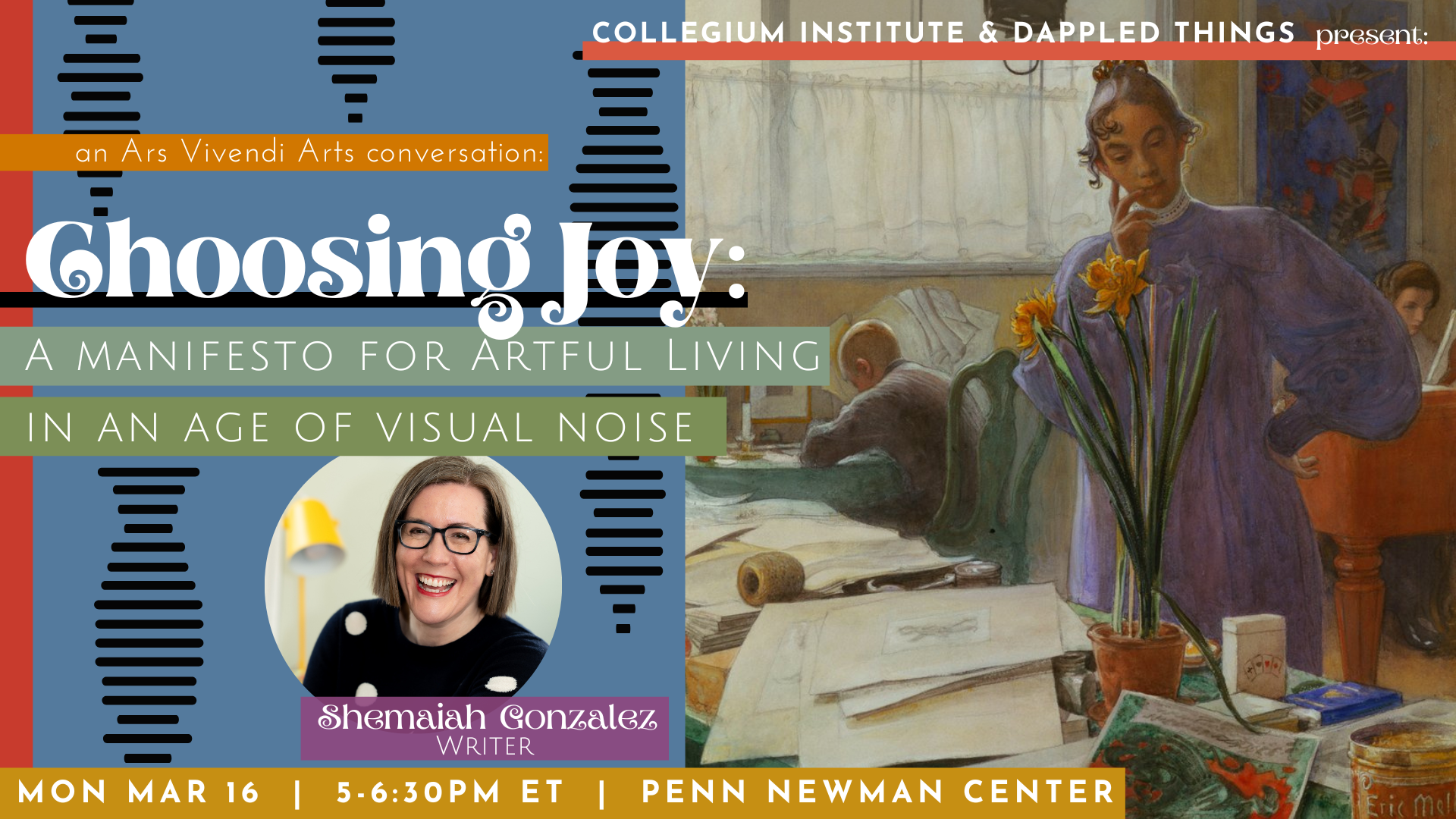
Choosing Joy with Shemaiah Gonzalez & Collegium
Join the Collegium Institute for it’s spring Ars Vivendi Arts Initiative conversation as we welcome writer, Shemaiah Gonzalez, author of Undaunted Joy: The Revolutionary Act of Cultivating Delight. In this evening conversation we’ll explore how we can carve our space for silence amidst the noise, find rhythm and pattern instead of the chaos of doom scrolling, how we can cultivate joy instead of anxiety? Ultimately we’ll explore how pausing and choosing to craft a life with space for joy and wonder and delight, what we might call an artful life, can do what Picasso claimed was art’s role: to” wash away from the soul the dust of everyday life.”
March 16 at U Penn in Philly. I’ll be there and you should come, too!
The Rusty Paperweight
A ton of great stuff in Steve’s February paperweight plus some recent reviews and essays that you should be sure to check out, including Roseanne Sullivan on The Living Fire Series from Wiseblood and edited by Sarah Cortez and Lesley Clinton, Daniel Cowper’s “The Aesthetics of Baseball,” and “Formalist, Farmer, and Faithful” by Marie Burdett.
