The Lost Parish of American Art
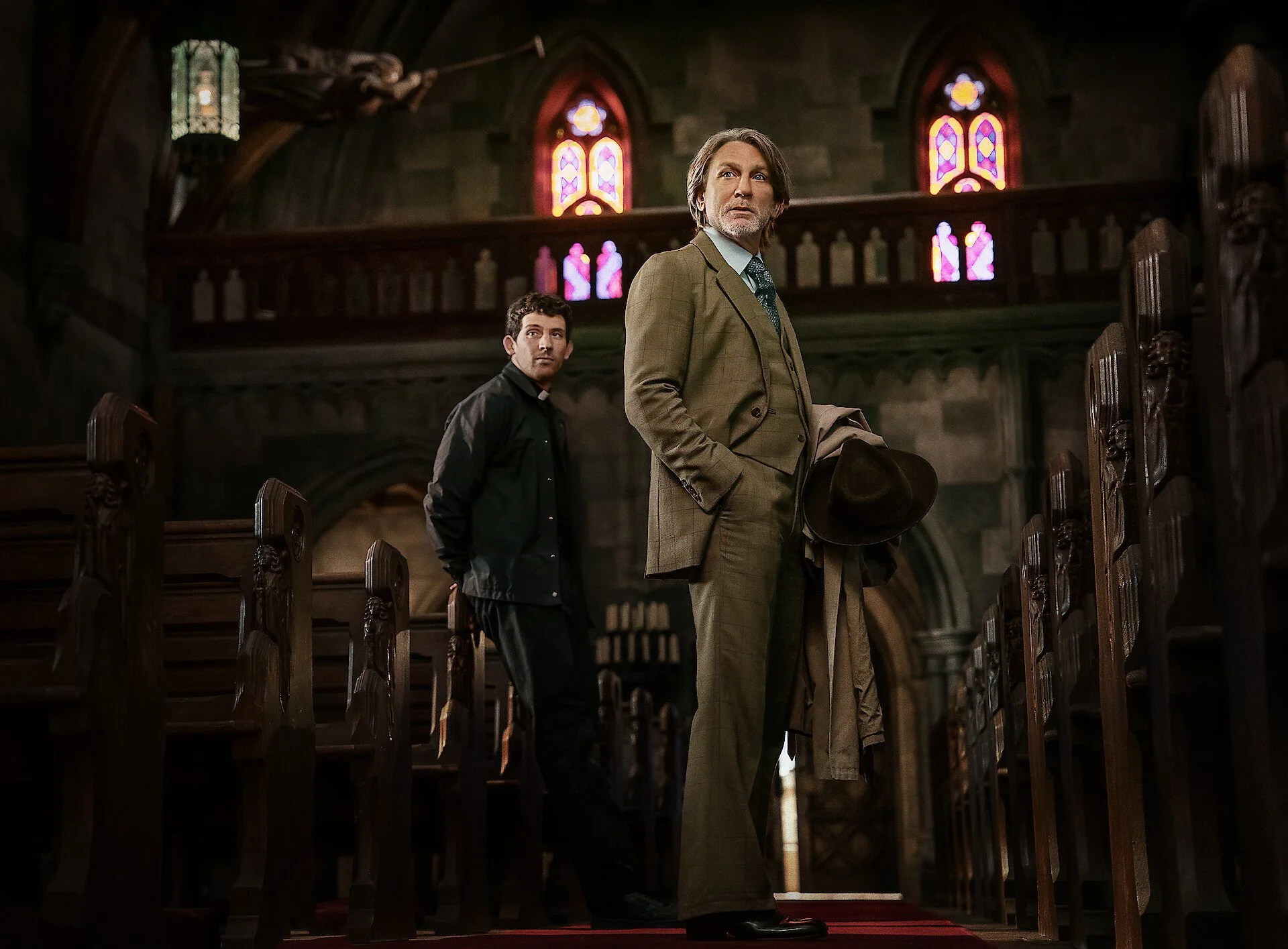
An image from Wake Up, Dead Man
For much of American history, art has functioned like a secular parish: a common ground where people recognized themselves and one another and learned how to name and discuss their anxieties in a common language born of a shared, if fading, moral imagination. Today, that parish has largely disappeared. In its place is a cultural landscape dominated by elite perspectives and stories that assume financial and material security as a given rather than a fragile exception. As political commentators and writers continue to attempt to diagnose the anger and disillusionment on the American right, far less attention has been paid to what has quietly vanished alongside stable wages and affordable housing: a body of popular art that speaks to working people rather than merely about them.
This vanished parish, and the vital shepherd's role it played, is poignantly illustrated in the middle of Rian Johnson’s new film, Wake Up Dead Man, the third movie of the Knives Out trilogy, where Jud, a Catholic priest played by Josh O’Connor, calls a construction company to find an important clue about the murder at a crucial moment in the film. The woman on the phone, a working-class secretary, interrupts the purpose of the call to note that she is in emotional distress as her mother is sick in hospice and they had an argument.
Benoit Blanc, played by Daniel Craig, attempts to pull Jud away from the phone so they can continue to unravel the murder mystery at the heart of the story but Jud, understanding that his purpose is first and foremost to attend to his flock, stops the momentum of the film in its tracks so he can do his job. Later, he says, “That's what I should be doing for these people. Not this whodunnit game.” In that moment, Jud performs the role of the parish priest, attending to a flock in disarray, even at the cost of the plot's momentum.
It is a striking moment where the film’s themes overlap with its form, where everything must stop because a person in distress is doing one of the most difficult tasks: reaching out and asking for help. If Jud were to push aside that task to solve the murder, we, as an audience, may have been more satisfied with the story, but we would lose what lies at the heart of the film, which is the power of storytelling itself.
In one scene, Jud asks Blanc, our dashing and purely rational private detective, if he believes in God. Blanc, in so many words, says that he does not because of the pomp and circumstance of the church and faith, saying it is just a made-up story. Jud, wisely, responds, “You're right. It's storytelling. The rites and the rituals. Costumes, all of it. It's storytelling. I guess the question is, do these stories convince us of a lie? Or do they resonate with something deep inside us that's profoundly true, that we can't express any other way except storytelling?”
The difference between Jud’s and Blanc’s perceptions of faith and religion is, I think, closely tied to their economic status. Jud has a working-class background, an ex-boxer who grew up in a rough neighborhood and, after killing a man in the ring, found his way to the Catholic church and became a priest. Benoit Blanc, as illustrated in Glass Onion, the second film in the trilogy, is a wealthy gentleman sleuth who lives in a beautiful apartment in New York City. Their earlier conversation makes this theological divide plain. Blanc sees ritual as hollow performance. Jud sees it as a true story made physical, a sacramental understanding his life has carved into him. Jud’s background has given him a much sharper understanding of his people, much like the Good Shepherd parable in John.
In the years since Donald Trump’s first election in 2016, numerous books, op-eds, and all manner of art have attempted to discern what lies at the heart of the Make America Great Again (MAGA) movement and the rage of right-wing voters throughout the United States. There were arguments about cost of living inflation, anti-elite sentiments, dissatisfaction with the Democrats, and changing demographic alignments. These explanations, however, diagnose the economic and social symptoms while missing the spiritual one: the collapse of a common story.

When that resonant storytelling vanishes from the mainstream for a vast portion of the country, it creates both a cultural gap and a vacuum of mutual understanding. Into this vacuum rush simpler, angrier stories that provide scapegoats rather than solidarity. The endless political post-mortems since 2016 have thus circled a void, diagnosing economic anger and anti-elite sentiment but failing to see them as symptoms of this deeper communal story being lost.
I was raised in extraordinary poverty, having been either homeless or living precariously for most of my youth. I still vividly recall asking fellow students in grade school how much they paid in rent, and they had no idea what rent even was, yet I knew exactly how much my mother paid in rent, how much everything cost, and how money dictated most of the decisions we had to make in our daily lives.
That is still resoundingly true for most people in the United States, and yet the working class are especially underrepresented in the modern media landscape. That lack of representation may seem trivial, or be seen as simply providing an excuse, for what some see as poor or misguided behavior, but it demonstrates how storytelling must attend to the concerns and anxieties of the wider public.
Even in my youth, I can recall Married… with Children, Roseanne, and In Living Color being emphatically about working class life and navigating that world. Whereas, today, the most popular shows, Yellowstone, The Madison, The White Lotus, Succession, Billions, and Industry, are often about navigating the perils of extraordinary wealth. Of course there are exceptions, but they do not change the dominant focus of our mainstream stories. By setting our cultural gaze on the elites, whether critically or not, we have left adrift the imaginative landscape of young people who are trying to navigate a world with diminishing natural resources and narrowing opportunities.

Married…With Children
I am not claiming that simply representing lower and middle class concerns honestly in film and media will suddenly lead everyone to utopian politics. It may, however, give us a shared language of mutual understanding that can substantively change the political landscape for the better. When our media and our art become economically stratified, where artists only come from wealthy families or those with extraordinary privilege, we lose a vital array of voices that must also contribute to American public life.
That is also not to say that wealthier individuals are incapable of imagining what it means to be homeless, or living in precarity, but the level of personal investment is different; they are a hired hand rather than a stakeholder in the enterprise. As Jesus explains in the parable of the Good Shepherd, a hired hand “who is not a shepherd and whose sheep are not his own, sees a wolf coming and leaves the sheep and runs away, and the wolf catches and scatters them” because his primary concern is payment, not the sheep. Jesus, however, models the good shepherd because “I know mine and mine know me . . . and I will lay down my life for the sheep” (John 10:12-15).
Art can be a shepherd. But an untended flock will drift and gather around whomever is willing to stand up and lead them. In times of duress, when the flock is scared for its life and livelihood, that fear leaves them vulnerable to a hired man who does not have their best interest at heart. The endless search for a political diagnosis, for what drove voters toward populist rage in 2016 and again in 2024, has produced its own muddled and frayed story, leaving so many in the wilderness seeking answers to some of the most basic questions: will I have enough food for my family? Will I be able to afford rent? Will any medical issue bankrupt us? Who, in all this mess, could I possibly trust?
Providing stories where these people can see themselves and individuals they recognize, represented in media, is certainly one way to shepherd them together into a larger, more substantial flock. That does not mean we all must agree with one another, or that we will live in peace and harmony, but it does generate a level of mutual understanding. This understanding is the foundation of any common hope. With it, we have the raw material to rebuild a story for the future, one that can gather many Americans back inside the same parish walls.