Detective Stories and the Incarnation
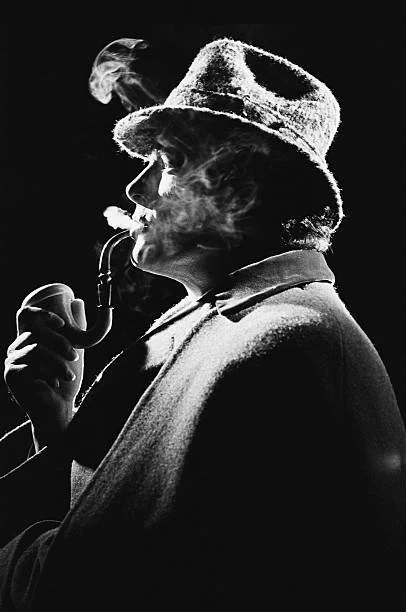
Sir Arthur Conan Doyle, the famed creator of Sherlock Holmes, is well-known for repenting of ever having created his detective, and choosing to destroy him in the deluge of the Reichenbach Falls. However, due to the clamor that rose to his ears from fans of the sleuth, Doyle promised never to destroy him in a flood again.
The relationship between authors and their literary creations is often fraught. Yet it is precisely this relationship which is used as an analogy to describe God’s relationship to the human race. Why? It all comes down to what Monsignor Robert Sokolowski calls the “Christian distinction” between God and the world, namely that God is not the greatest being among many, but rather “the sheer act of existing.” This distinction helps us to avoid false notions of competition between God and humanity.
The idea of God as creator is ancient, but the idea of God as the author of a story bears this truth particularly well because it presents God’s creation as existing in its own world entirely separate, yet altogether intimate to, the author. This analogy not only bears the truth of God’s creation, but also the truth that, in the fullness of time, God became man. It is not a stretch of the imagination to imagine an author writing himself into his own story and living in that world without ceasing to be the author living in his own world.
However, this analogy is often parsed as a dry abstraction which can leave hearers with the impression that God is as indifferent to His creation as a writer to an abandoned idea crumpled up and thrown in the wastepaper basket.
Running counter to this trend is Dorothy L. Sayers’s The Mind of the Maker, a meditation on the relation of the creative act of writing to the creative act of the Trinity. Yet Sayers and other writers often reveal as much if not more in their real-life relationships with their own characters as they do in their writings specifically devoted to this topic. Authors of detective fiction in particular offer a privileged vantage point to this relationship because many of them created characters who appear over the course of multiple stories.
In the next generation of detective fiction writers after Doyle, a similar problem inevitably arose between creator and character. Agatha Christie famously spoke of tiring of her most famous detective creation, Hercule Poirot. Even though she didn’t explicitly state how she chose to resolve this issue, a new sidekick appears in her later novels to replace Captain Arthur Hastings, who had narrated the earlier Poirot stories.
This new character was the detective novelist Ariadne Oliver, whom Christie acknowledges to contain “a strong dash” of herself. She used this character to allude to factual errors in her previous stories and to vent her frustrations toward Poirot in Oliver’s frequent complaints about her Finnish detective Sven Hjerson. This also gave her a chance to wink at the audience, as in Hallowe’en Party, when Poirot says, “When my friend, Mrs. Oliver asks me to do anything I always have to do it.” Podcaster Caroline Crampton says that one of Oliver’s primary plot functions, as hinted at by her mythical namesake, is to provide Poirot with the necessary clue that helps him solve the case. Incidentally, our use of the word “clue” as something which leads to the unraveling of a mystery comes from the myth of Theseus in which Ariadne leads him out of the labyrinth using a “clew” of thread.
In the case of Agatha Christie and Ariadne Oliver, it can be said that the author wrote herself into the story, perhaps in a similar way to how God appeared to His People in the Old Testament. He reveals Himself to them, but always in a mediated way, whether through angelic intervention or a burning bush, to provide them with assistance. In spite of this, there is still a distance between God and His creation as when He refuses to reveal His name in the mysterious encounter between Jacob and the angel at Peniel (see Gen 32:29). God doesn’t become one of them until the Incarnation.
When considered in this light, Christie follows a parallel course to another of her contemporaries, Dorothy L. Sayers. At first blush, it could be said that Dorothy L. Sayers dealt with this “problem” in a more direct way. In an essay entitled “Gaudy Night” (which shares the name of one of her most celebrated novels), she writes that she conceived her novel Strong Poison “with the infanticidal intention of doing away with Peter; that is, of marrying him off and getting rid of him.” To that end, she created the detective novelist and Oxford graduate Harriet Vane, whom most agree to be based on Sayers herself.
Sayers published her first novel featuring Harriet Vane two years before Ariadne Oliver’s first appearance. But what Sayers did with Vane is fundamentally different from what Christie did with Oliver. Harriet Vane was not just a sidekick to Lord Peter Wimsey. She was also meant to be the woman that he married. However,
Sayers realized that in order for Wimsey to be worthy of her, he would have to “grow up,” to develop into a three-dimensional character. So over the course of multiple books, the character of Lord Peter Wimsey grew and matured until Harriet Vane could believably accept a marriage proposal from him.

Pastor Timothy Keller uses this as a model in many of his sermons to illustrate what it means for God to become man. According to his account, Sayers fell in love with her character, and because of this, wrote herself into the story in order to rescue him. However, the brevity which can make this an effective preaching tool obscures the reality of Sayers’s relationship to her characters.
It is strange to say that Sayers fell in love with her fictional character. In his eulogy for Sayers, C. S. Lewis quotes a critic who says, “It would be truer to say she was falling out of love with him; and ceased fondling a girl’s dream—if she had ever done so—and began inventing a man.” Perhaps Wimsey had been conceived as Sayers’s ideal man. But her desire to finish him off by marrying him off does not come from love. It was only in the realization that he needed to grow into a complete person in which we can speak of love, not in the sense of infatuation, but rather in the sense of willing his good.
Likewise, in speaking of “rescuing” Lord Peter, we run into a similar problem. Sayers did not simply throw a stand-in for herself into the story as a form of wish-fulfillment or self-aggrandizement. The manner in which Harriet Vane enters Lord Peter Wimsey’s life in Strong Poison is in perhaps the most helpless way imaginable. She appears in the dock accused of murder with her best hope being that Wimsey will prove her innocence. So in order to “rescue” him, she puts herself in need of rescuing by him.
Lest we mistake this for a simple rhetorical flourish on the part of Sayers, we must consider the crime of which Vane stands accused. She is on trial for murdering Philip Boyes, a man with whom she had a longstanding affair. The details of this affair closely mirror Sayers’s own relationships. All these facts were unknown during Sayers’s life and deeply painful to her. And yet she places them in the introduction of Harriet Vane, as if she were trying to make her as vulnerable as possible.
This “maturation” of Lord Peter did not leave Sayers unscathed. In Gaudy Night, Peter and Harriet discuss the mystery novel she is currently working on. When Peter says that she “would have to abandon the jigsaw kind of story and write a book about human beings for a change,” Harriet responds, “It would hurt like hell.” Nevertheless, Harriet takes Peter’s point and begins to focus on “humanizing” her character Wilfrid.
Podcaster Cindy Rollins points out a clear parallel between Harriet’s novel and what Sayers herself is doing to Lord Peter, even to the point that they both use the word “humanizing” to describe what they are doing to their characters (not to mention that “Wilfrid” sounds a bit like “Wimsey”). This process doesn’t just affect the character in question, but also profoundly affects the author. And yet through it, both author and character are healed.
All this elaboration of the idea of Sayers writing herself into her story is not mere pedantry. Instead, it is intended to add more depth to this analogy, to show that the author can truly care enough about a creation in order to enter into the story. But as she does this, she makes herself vulnerable and suffers so that her character can be raised up to become like her.
This is both where the analogy breaks down, but also where it is at its most brilliant. Of course God cannot change or suffer or need to be healed. But God is love, and out of love, He chose a course which led St. Catherine of Siena to call Him a “mad lover,” as she tells Him in her Dialogue, “because you have fallen in love with what you have made!” This love brought Him down to our level in the vulnerability of the Crib and the Cross so that we can be raised to His, as adopted sons and daughters of God.
Maybe we wonder if Sayers did this intentionally. The biographical facts that connect Sayers and Vane—especially those which were unknown during her lifetime—could seem to indicate this. Additionally, one of the authors who is most famous for inserting a fictionalized version of himself into a story is Dante Alighieri, and Sayers’s magnum opus is her unfinished English translation of the Divine Comedy.
On the other hand, when Sayer speaks about the Incarnation in The Mind of the Maker, she does not use the analogy of an author writing himself into his story, but rather the example of an author writing his autobiography.
In the end, as with most touches of authorial genius, the question of intent is largely irrelevant. The fact remains that, in some sense, Dorothy L. Sayers wrote a version of herself into her stories, and through that character, completely transformed her fictional creation. Of course, in seeing this as an analogy for the Incarnation, we must always keep in mind the caution of the Fourth Lateran Council (quoted in the Catechism) regarding analogical language: “Between Creator and creature no similitude can be expressed without implying an even greater dissimilitude.” And yet, perhaps we can say that Sayers has taken this analogy of an author entering his own creation and given it flesh.