
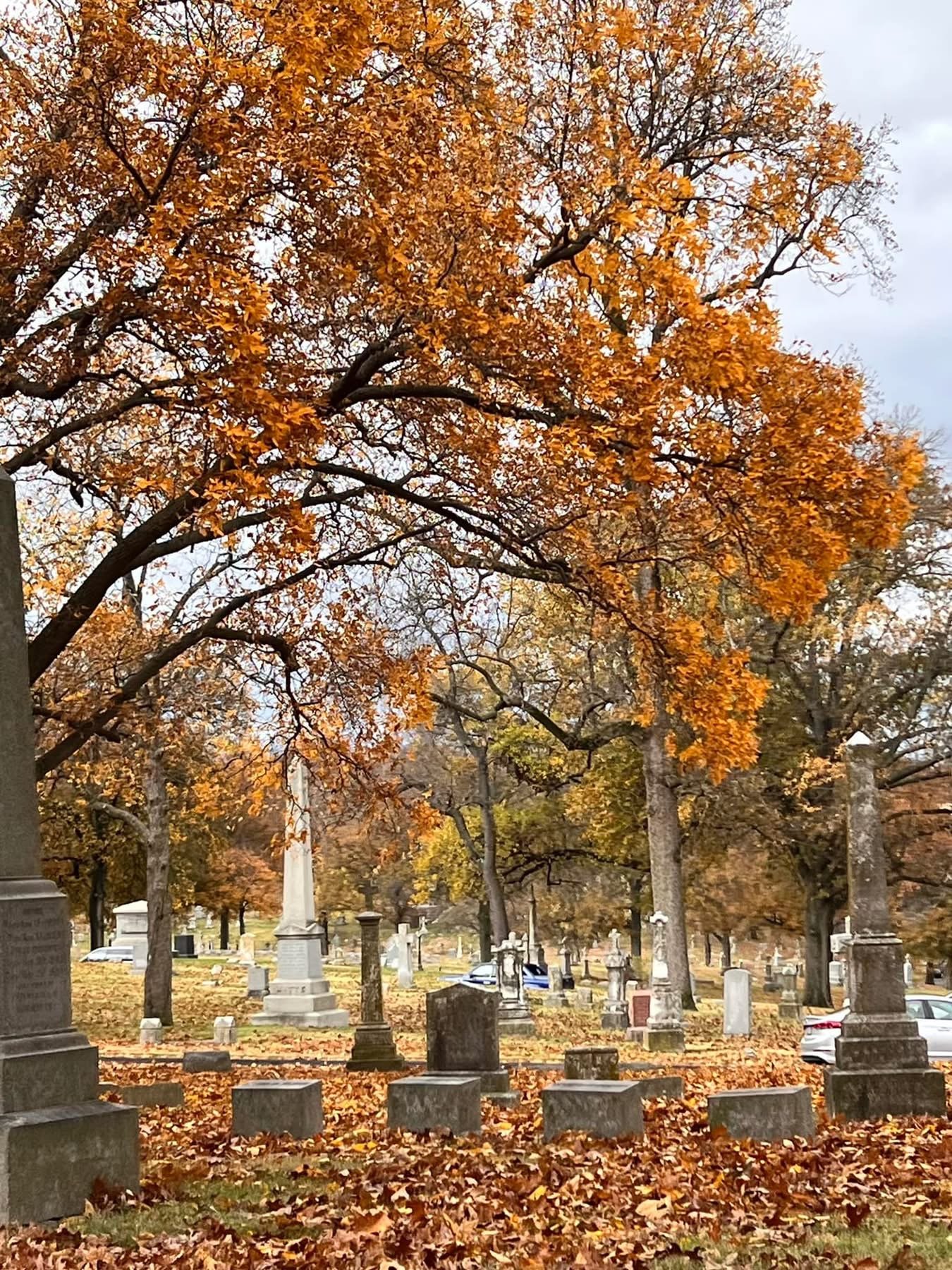
I am sixty-eight years old and it occurs to me, upon reflection, that I have never once witnessed the final breaths of any human being on this earth. That fact washed over me in a great wave one afternoon in early November. I lost my Mom and my Dad, of course, but I was not present at their bedside when they actually died. And to this day, they are the only two people I have known intimately over time, who have come even remotely close to my personal experience of someone passing from this world. Death, therefore, is not viscerally familiar to me - not part of my own personal history thus far. I find that sudden revelation strange.
I also grew up in the 70’s, when Holy Mother Church was still reeling from trying to frantically gather up all the major doctrines which had been carelessly spilled and pushed overboard in the tumultuous wake of Vatican II. She succeeded in righting the barque after the initial storm, but other, smaller casualties, some precious traditions and practices were lost for many years until more recently; those long time, smaller traditions and customs that helped us grow in love and awareness of life beyond this world. Visiting cemeteries to pray in November was one of them for me. I never knew this was a custom, and so I never had cause to step foot in a cemetery often. I only discovered this practice in the past four years and it grew slowly in my mind.
I know where my mom and dad are buried. They chose very humble gravestones flat to the ground. I remember vividly how a kind, French priest with deep brown pools for eyes, handed me a golden bucket and encouraged me gently to sprinkle holy water upon my mother’s casket as it was poised above the turned up earth. That was a tremendous moment I will not forget. Like “shining from shook foil” upon the sting of death.
I don’t find her presence especially strong at that gravestone now, though, as some people might. I find my parents more in photos, little memories from my childhood, and stories people have told me about them. I have hardly visited those two graves in the cemetery. I in no way have a history of doing so before this and so it seemed strange and odd. I don’t find it to be neglect. I pray for them often. I think of them. But I have never found a great need to place flowers on their grave or sit quietly near the stones like so many people do. I find I honor them more by praying my rosary before the Blessed Sacrament or thanking them at odd times for things they gave to me, or things from which they had protected me. A grave is not a familiar place of prayer or conversation for me. They are not there, though their bodies lie quietly honored and protected in death as an act of mercy commands. This is right and just.
I wonder if I am the only one who feels this way.
Perhaps this attraction to the graveyard is more prominent in people who have a longstanding family history which has grown like a great tree, and rooted deeply in one place over many years. Where grandparents, aunts, uncles, children, and family friends all lived and died in close proximity to one another. When I visited Concord Massachusetts and walked the ‘author’s ridge’ of Sleepy Hollow Cemetery, it was quite moving to me that all the Alcotts were gathered closely together inside a little fence - intimately bound to one another in death as they were in life. Still under the watchful care of Louisa, whose gravestone was as simple as all the rest. This little scene made me want the long withheld experience of living out life with an extended family. Of a history which unfolded with all gathered in one place.
I am wistful for all that has not been.
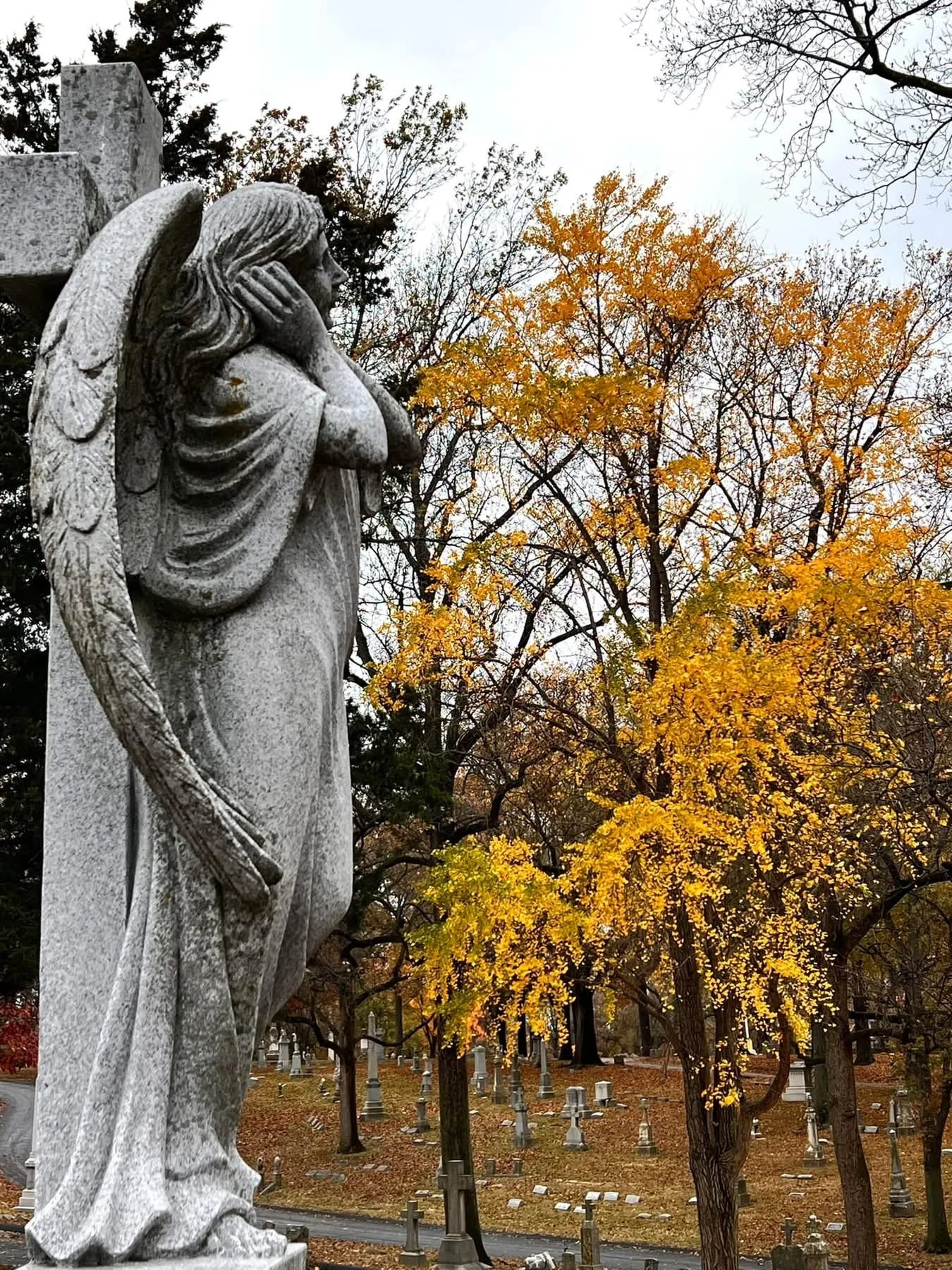
My mother and father, like so many from their time, were like migrating birds. They flew from Canada and New Hampshire and hardly ever went home again. I had no experience of grandparents, aunts, uncles, or cousins. I met them once or twice, but hardly knew any of them. I heard stories which I have written down, but I never knew my extended family. We were very much our own thing the ten of us - a very “immediate” family. This never seemed odd to me most of the time, as I didn’t know any better. But sometimes I would visit a friend whose grandpa would take us on a walk or give us candy from his pocket; whose grandma would smile at me from the sofa as I passed and compliment my two long braids. I wondered then what it would be like to have all these generations surrounding me and how different and richer my life would have been. How filled to bursting the table would have been at Sunday dinner. Providence, in some hidden wisdom, has not granted that to me. I trust God had His reasons.
November has filled me with questions this year that I have never asked before. Where are they all buried - the members of my family tree? What ancient, snow-covered cemetery in Quebec holds the bones of my Grandpapa Joseph, he of the twinkling eyes and practical jokes and a great library of books which he read in his silk smoking jacket. Where are my artistic aunts buried? The ones whom, my mother had always assured me, I was so much like. Or my uncle who could tat lace because he had mended nets on a ship. Or my Grandmama Elizabeth for whom I am named and whose wedding ring I wear. Where is she buried? I didn’t know. How could I not know? I had never thought to ask, because they were so far away living lives I knew nothing about. Like strangers.
Truthfully, it left me rather despondent for a few days. How uprooted I felt. At sixty-eight I wanted grandparents in the worst way. I wanted uncles who played games and read me books. I wanted grandmothers who would tuck me in with the promise of pancakes in the morning. I wanted to see my mom and dad in context - with brothers and sisters who could round out their personalities for me. I wanted aunts to finally explain to me where I got my tastes, my singular laugh, my love of road trips and my personality. Oh, the talks we could have had to clear up all the mysterious questions I had about me! And them. And their adventures. But that has not been my history.
In recent years, November has also brought death quite close to my own door in a sudden cancer diagnosis right before Thanksgiving, 2024. Death lurked quietly outside my life for a year, and then without any explanation, decided not to knock this time, for reasons I was not privy to. Mere mortals never are. I stand cured, now, but truly left always wondering if and when he will return and what was it all for when he passed the first time. Cancer cures are always mercurial in this way. They haunt.
All these emerging questions, these ponderings and these sudden feelings of despondency worked on me. I began to wonder about cemeteries and their importance once again. Holy Mother Church tells us to visit the actual graves and to pray there. This admonition comes with a plenary indulgence for our own souls. It is all so gracious and kind of her to gift us in this way - even in death. It made me think of Greg.
Greg is a friend who himself had a large, extended family presence here. He loved cemeteries for their history and the stories they held. He also lost his own young son and finds great solace in visiting his grave. He once invited me to visit the cemetery with him - just to experience it. I felt strange, but I went. It turned out to be a beautiful, comforting experience. A place of death and yet of hope.
We have two of many historic cemeteries here in my home town. One is Catholic and the other is ecumenical in nature. Both are like parks with large old trees and meandering pathways. They existed as the only bucolic sanctuaries within the busy, crowded city in the early days of St. Louis. People would come simply to find some peace and to walk in the quiet. To escape the loud and bustling world. In Victorian times, whole families would come to the cemetery and spend the whole day with a picnic lunch and to sit and visit with one another. They sat among the graves of their relatives and it did not seem odd or macabre to them. They were close to death in those days. They had lost children to epidemics, and mothers and fathers had also died too early and left orphans in their wake. Death was an everyday, experienced occurrence. They did not run from it as we might in our modern day. We are embarrassed of death, of reminding us we are not in control, that we are not rugged individuals or masters of our own destinies. That we are truly, in the end, made of dust. The modern world has lulled us into avoiding the thought of death. It is swept away almost as soon as it happens. But in some sense we miss out on what these 19th century people had discovered - we are all one in life and in death. We all have the same destiny - some have just gotten there before us. And we want to be with them to remember their journey and learn from them to follow our own. Cemeteries gave people time to contemplate this fact and to be physically present to those who were taken all too early. It comforted the heart. They welcomed the encounter and spread their picnics on the ground.
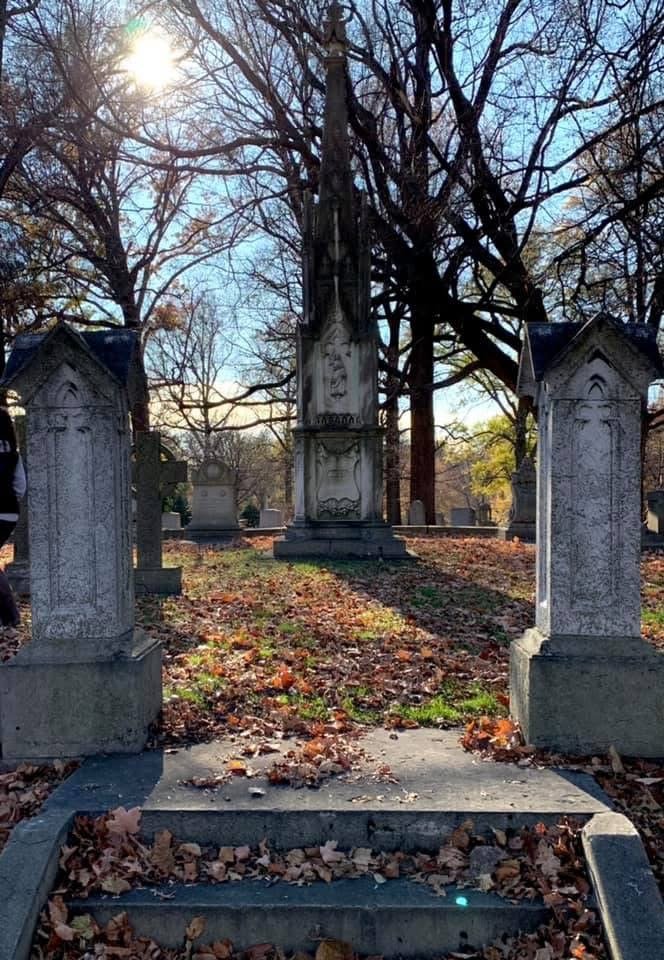
As Greg walked us around, the silent atmosphere was palpable on a moody autumn day: peace dropping slowly from everything. Whole families were buried here. Prominent, landed gentry and their progeny occupied the highest hills. Graves with angels and scrolls and ornate crosses. Rows of tiny stones with children’s names above dates whose spans were breathlessly short. The yellow fever had passed through that particular year. I wondered at how much sorrow a parent could bear to lose three or four children at a time and so many did bear it back then.
The pathways were not lacking in cautionary tales, either. Some grandiose citizens had Mausoleums with stained glass. There was a wealthy beer mogul who was snubbed by the “old money” citizens of the city for being in ‘trade’ and he got his revenge by building a larger, more prominent Mausoleum on a higher hill still - looking down on their family plots in triumph. I wondered what that precise moment was like when they all discovered with terrifying clarity that none of that mattered in the end.
The pathway meandered through row upon row of ‘faithful wives’, ‘beloved husbands’, cherished children ‘gone too soon’. Priests. Nuns. Businessmen. Father Peter De Smet is buried in the Catholic cemetery, here. And many of his Jesuit missionary brothers as well. This brave man who loved Christ and loved the Indians he served. He is our sainted missionary, buried here in this place. I knew his story. I touched his grave with reverence and awe. I felt his presence that day. Dred Scott, the freed slave was buried here in our city. And so many more. There was a sense of history as I walked. I saw names everywhere for whom the streets of my city are named. Philanthropists who gave us gardens, libraries, and hospitals. I shared their history. They were part of my own. I did not have relatives here, but I had a sixty-six year history in this place. I belonged in this town. I have lived here many, many years. I was reminded as I walked that I saw the Gateway Arch go up and the walls of the Cathedral Basilica being filled with mosaics coming to life on the walls. This walk through the cemetery gave me a place and a history and a meaning. I felt gratitude. I felt peace. And I prayed for them all - beer moguls all the way down to the littlest child. I felt the weight and the glory that both belong to the fact of being human.
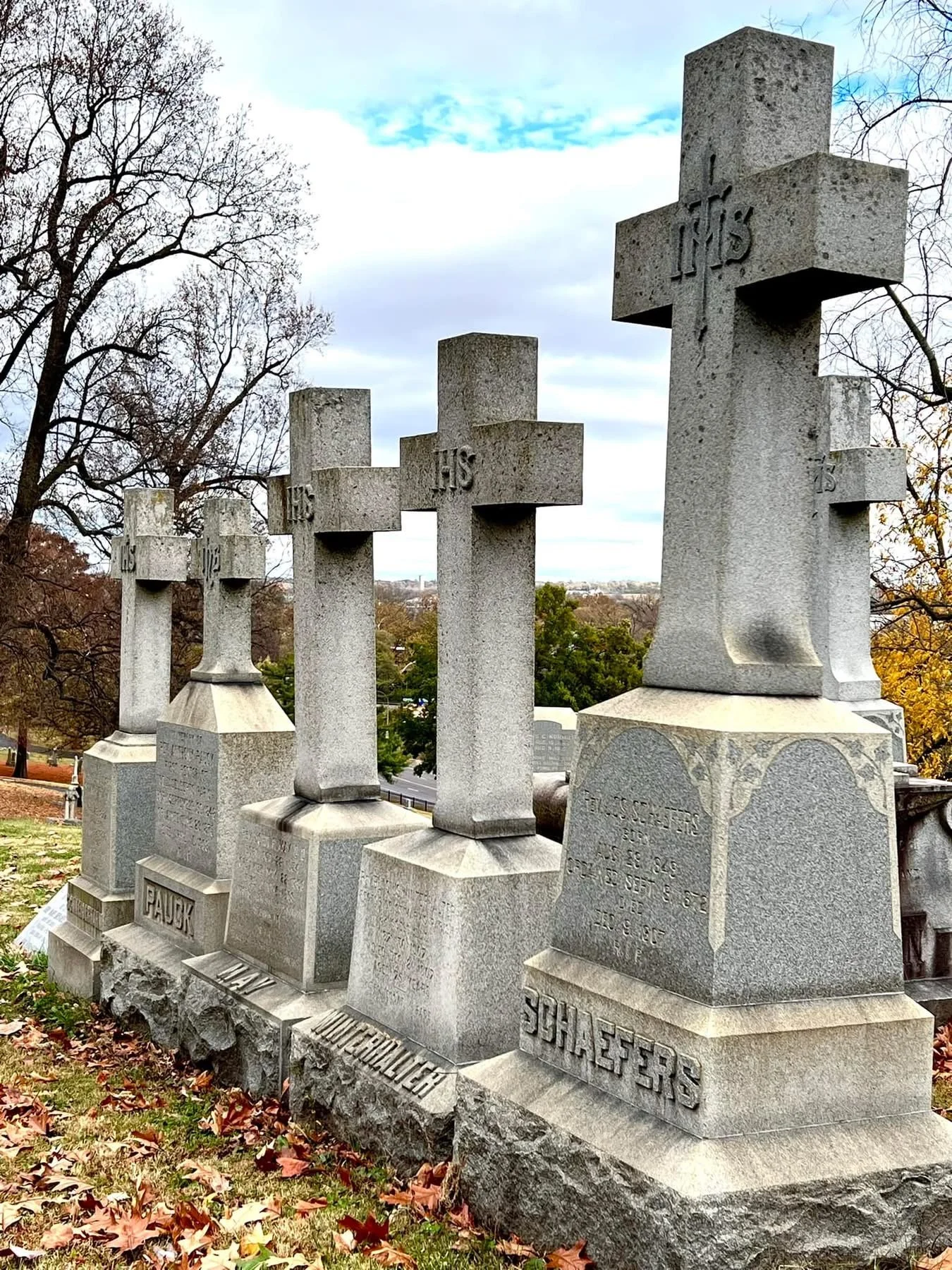
The Church knows this about us. That is why she asks us to visit the dead. To wander through gravestones and to breath in the autumn air and gaze at the setting sun shining on the crosses in the glen. We are the Church militant mingling with the Church suffering - these souls waiting for heaven, some of them. We pray for them and we know that they are going to pray for us. It is the best meaning of symbiosis. This mutual prayerfulness. Cemeteries give us a calm and beautiful visual of what that might be like. And we are comforted.
When I happened to find myself teaching a parish religion class to some 7th and 8th graders a few years ago, I remembered this visit. I asked Greg to take us as a class, with all the parents in tow. We walked as a group around the cemetery. We prayed a decade of the rosary at intervals. The kids were visibly moved in places. They didn’t want ‘out’ as quickly as possible. Fathers were hugging daughters as we prayed that rosary. Boys were looking thoughtfully at the graves of children their own age and their faces betrayed surprise at how many there truly were. The Hail Marys were heartfelt. It was a beautiful experience. It was my way of passing on a tradition that had been absent from my own life for so many years. I felt that was one of the greatest gifts I could have given to them as their teacher for a brief time. It filled me with joy.
Cemeteries help us to see life the way it truly is. That this is not our home. That others know this now and want us to know it as well. That wealth, power, or prestige simply whither to nothing in the end. That Holy Mother Church comforts us here and gives us graces for life even as we walk among the dead. That she helps us honor the bodies made in the image and likeness of Christ, who became one of us. That even if we do not know our extended family, or if we are haunted by the possibility of cancer returning, or if we feel alone in the world - we are not alone. These graves are a tangible sign of the great cloud of witnesses waiting for our prayers to make them fly heavenward. And they won’t forget us.
May the souls of the faithful departed, through the mercy of God, rest in peace. Amen.