I do not think the whole world would contain the books that would be written. - John 21:25

The “True Myth”
So much has already been written about the monumental phrase “true myth” in reference to the conversation between the professors J.R.R. Tolkien and CS Lewis, in how this prompted Lewis’s conversion. However, it seems more attention has been on the “true” part when it was the “myth” aspect that captivated Lewis so much. Myth is the element ubiquitous to humanity. The fact that it happened to be true is what makes it divine. It pulls the human myth out of itself and into the heavens.
If one wants to share with others the truth of Jesus Christ, one must be willing to plumb the depths of humanity as he did, even when the myth doesn’t appear to resemble that divinely true element that Christians recognize in him. This is where myth comes in. If one gets hung up on certain elements of a mythology, either pre-modern or post, because it doesn’t reflect some aspect of Christianity, then one will surely miss opportunities to evangelize a culture more familiar with the post-modern mythology than Christianity anyway. Worse yet, one will miss out on an opportunity to form real unity between Christianity and the culture, the sacred and the secular, God and Man.
Campbell’s Hero’s Journey
This is where Joseph Campbell’s idea of the monomyth, popularly known as “the hero’s journey,” comes in. The basic idea behind the monomyth is that every culture’s mythological structure follows a relatively basic pattern of Departure, Initiation, and Return, with several sub-elements in each. In this journey the hero receives a call from without, perseveres through a series of trials, and returns home having mastered both the old world from which he was called as well as the new world in which the story took place.
Recognizing mythical parallels in the Gospels need not undermine the originality or historical truth of Jesus. In fact, one finds biblical precedent for this in the theological topic of recapitulation as presented by St. Irenaeus. He saw in Jesus a re-living and fulfillment of the nation of Israel. One even finds this in the composition of many Old Testament stories as there are repeated “creation,” “covenant,” and “fall” narratives that follow a pattern within Genesis and Exodus.
These “myths” would have been the cultural and theological formation for the 1st century Jewish people and it was those same myths that the Gospel writers would have drawn upon to draft their own narratives. This doesn’t trivialize the importance of the Jesus “myth,” but actually became a way to evangelize, as one finds in St. Justin Martyr’s Dialogue with Trypho.
A brief overview of the three basic elements of the Hero’s Journey, the Departure, the Initiation, and the Return, can be considered in light of the story of Jesus as presented in the Gospels:

The Departure
Joseph Campbell defines the first step of the Departure, The Call to Adventure, as “something disruptive that pulls the hero out of their ordinary world and toward a journey that will ultimately change their life.” This call is reflected upon in John 3:16, “God so loved the world that he sent his only Son…” The disruption one could argue was Original Sin, but on an even deeper level it is God’s love. Jesus was called by God the Father at his baptism at the beginning of his ministry, similar to Noah, Abraham and Moses.
Initiation
Jesus experiences trials and temptations in the chaos that both the sea and desert represented to ancient cultures. Christ’s conquering of trial and temptation indicates the fulfillment that the Jewish people saw in the Messiah. Jesus’s greatest trial, both metaphorical and literal, takes place over his Passion, beginning in the Garden of Gethsemane, his arrest, and trials by both the Sanhedrin and Pilate, and then his suffering on the Cross before his death. Here, attentive readers also notice his atonement with the Father, a sub-element of Campcell’s “Journey,” as well. This conquering is realized upon Jesus’s Resurrection, which makes visible that Christ has already begun his final stage of the “Journey,” inviting us to take part.
The Return
On a cosmic scale, there is a return element for the Old Testament patriarchs as God forms a covenant, establishing a new relationship, with all three on a mountain, the point of origin for the biblical man and meeting place between heaven and earth in virtually all mythology. One sees this fulfilled in the entire Paschal Mystery, the Passion, Death, Resurrection and Ascension of Christ, as they all participate in his, and by his humanity’s as well, return to God the Father.
In historic Christianity there has always been a beautiful, fruitful marriage between faith and reason. Reason includes the human knowledge and experience that for most of human history has been communicated through myth. It continues to be communicated through our modern myth of comic books, sci-fi and fantasy. This is the reason that faith can wed and build upon in order to draw us to the Hero who initiates our own call to adventure, an adventure that finds its return in the One upon whom all adventures find their End.
Letting Wonder Lead
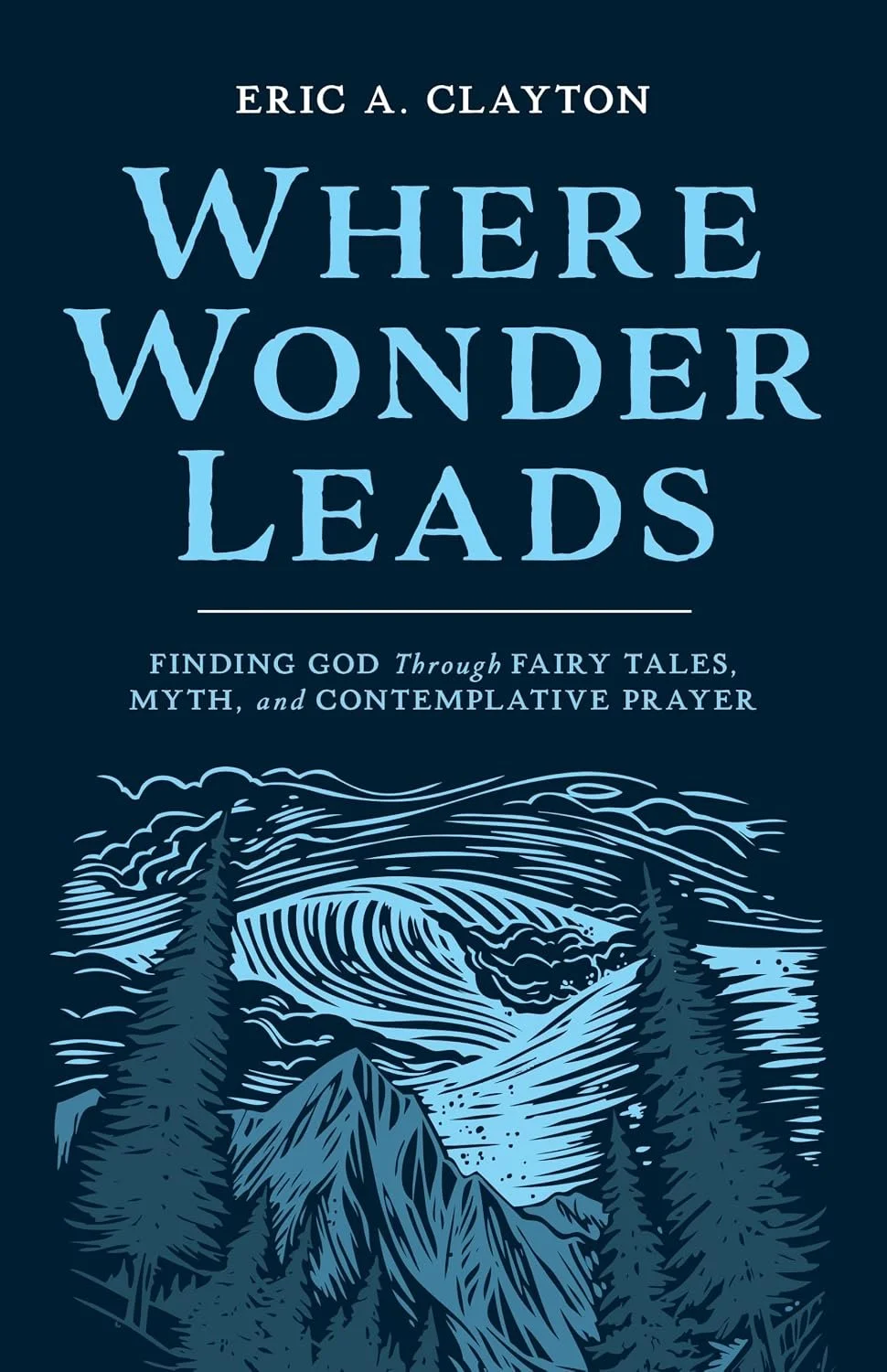
A book that seeks to move the reader beyond mere recognition of these connections between Christ and other stories is the recently released Where Wonder Leads: Finding God Through Fairy Tales, Myth, and Contemplative Prayer (WWL) by Eric Clayton.
Where Clayton’s book seeks to stand apart from the increasingly growing, already congested, “Re-enchantment” genre of books, videos, and think-pieces, is that instead of a call to write stories that reflected the sacramental worldview, or explanations on how to think with a re-enchanted mind, WWL emphasizes something more fundamental. WWL is first and foremost a book of spirituality before it is one of literary criticism or sociological review. If a writer wants to have any hope in presenting a re-enchanted, sacramental, biblical worldview in a story, then that writer must immerse one’s whole heart into it– with the mind and will sure to follow.
Fortunately, because Clayton writes from the perspective of Ignatian spirituality, the heart and mind need not be separated. This book is modeled after the 30-day Ignatian retreats required of all prospective Jesuits. Like an Ignatian retreat, each short chapter calls upon one’s imagination to enter into a story more deeply. For these, Clayton invites one into his own, unique story that reflects the theme of that chapter. Then, he follows with a short essay explaining how the topic of that chapter connects to the Christian faith. Finally, each chapter ends with a return to his narrative, inviting the reader to meditate more deeply on that theme.
Ultimately, this is a practical book to facilitate someone becoming an “instrument of salvation” (21). It is why Clayton believes “praying with these stories…will prove transformative” (12). Just as individuals who have experienced military or police training describe how they see things differently, so too must the one who has been trained to look through this mythical, contemplative lens. Not only are elements of story meant to look different to one with the sacramental vision, but reality itself.
Cultivating the Seeds of the Word
Like the Hero’s Journey, to which Clayton alludes and references throughout this book, is a going forth, initiation, and return with the hero having changed from the experience, so too must the contemplative act be a moving deeper into a subset of reality, engaging with it in a way that lets that reality change us, and then a return to one’s normal life with a new understanding. Clayton’s book seeks to develop in one that habits of mind, heart, and soul that facilitate this engagement and contemplation. From these, one’s journey into reality, further up and further in, can begin.
Christians are to follow in the example of St. Paul, who sought to be "all things to all people" in his desire to bring them to Christ (1 Cor 9:22). Paul was following Christ’s example as the Word Incarnate, planting himself as “seeds” (Justin Martyr, 2nd Apology, ch 8) throughout the mythologies of human culture since its beginning as a preparation for his incarnation in Christ. In order for Christians to recognize this seed, and then water and cultivate it in the world, they must be able to recognize how the story of Christ shares elements with every other story. Only then, can the Christian illustrate how Christ fulfills those stories as well.