Surely Some Revelation Is At Hand
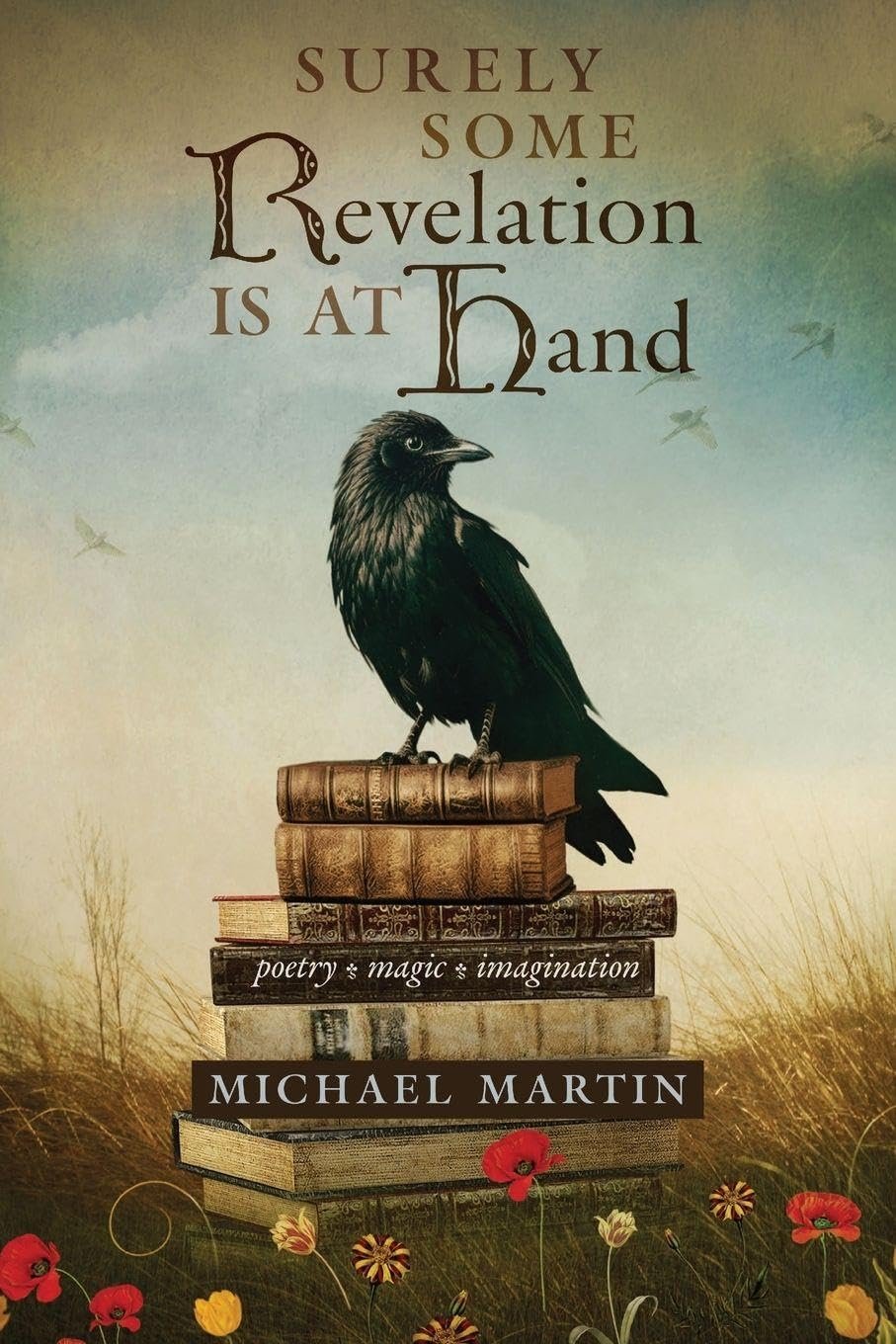
“For a poem, in its deepest sense, is an incantation; that is, a magical act.” Thus writes Michael Martin towards the beginning of his new book, Surely Some Revelation Is At Hand. What does he mean by this? It’s a bold statement, but one he backs up by noting that the poetic is an embodiment of the imagination and, if Coleridge is right that the imagination is the spontaneous expression of an infinite mind, then it follows that the images resident in the imagination possess transcendent, transformative power. Images produced in the imagination open up into intelligible forms, pushing into that which is beyond the image. Truth beyond comprehension is conveyed in and through the poetic image. As Martin notes, William Blake contends that poetry and the imagination are not only magical but even redemptive.
I’ve already thrown a word in, here, that can cause discomfort for modern man - Magic. The Catholic world has gone back and forth about the word for quite a while. Here’s how Martin explains it at his substack:
In a recent interview about my latest book, Surely Some Revelation Is at Hand: Poetry, Magic Imagination, I was asked if “magic” isn’t a scary word that some Catholics (and Christians in general) might find threatening or troubling in some way. That is more than a valid concern, but, as I told my Catholic interviewer, “It depends on who you ask. Even though most Catholics would never think of the Sacraments as ‘magic,’ certainly a lot of Protestants would suggest that the way Catholics think of the Sacraments—not to mention sacramentals like holy water, relics, holy sites, and the like—is nothing but magic.” So what we have here at issue is a matter of semantics…
So here’s the thing: We are already under enchantment, and a very dark one at that. As I argue in my book, we are under an enchantment directed by expert magicians and propagandists and many of us have surrendered our wills to their deceptive power...What is needed, then, is a swift and decisive disenchantment. In truth, what people call “re-enchantment” should more properly be called “a proper orientation to reality.
We inhabit a reality that, by its very nature, is a mirror of the divine. All things, in this sense, are “magic.” All things point to God. Or they point to the devil. The fact is, nature is not neutral. Things have a res, a deeply rooted reality that stretch through this world and beyond it. Things are things, not objects reducible to their surface material appearances. To think otherwise is idolatry. Everything opens up onto eternity. Everything, as GM Hopkins would say, is inscaped with Christ. Their inner landscape rises up to meet God.
When Catholics speak of sin, what we mean is a condition of having been ripped from the Source, stolen away from God and disconnected. In other words, sin is the deconstruction of reality. It’s the fragmentation of what, by nature, is meant to participate in the whole. Sin flattens out and, in the long run, dis-enchants. In the short run, however, the condition is closer to mis-enchantment because even those who are in full rebellion from God nevertheless continue to rely on him for continuing existence. In this sense, the condition of sin is self-defeating. It ultimately ends up completely detached from reality. Until then, however, sin does its work by distorting the real. Martin considers this distortion to be a magical operation. Because sin - or more in line with the vocabulary he uses, those who wish to control, manipulate, and dominate – possesses no independent reality. It operates entirely by deception.
“Persuasion,” writes Martin, “can be thought of as a branch of magic.” Rhetoric is the manipulation of the imagination in order to control the underlying reality. Perhaps you think this doesn’t happen to you. For a long time, I thought there was no way I could be influenced so easily. But consider this, writes Martin:
The subtle power of the Facebook “like” or the infamous Twitter / X heart. And at its heels, leashed in like hounds, slogans, gestures, and images crouch for employment; “Safe and Effective,” “Love Is Love,” “Build Back Better,” “The New Normal,” “Getting vaccinated is an act of love,” the rainbow, the mask, and every kind of flag. We are surrounded by magical operations.
If we consider ourselves immune, neutral, and infallibly rational, this makes it all the easier to manipulate us. We hardly know what’s happening, and if we do, we don’t mind. In fact, argues Martin, “People even like being enchanted.” I think he’s right. We love being part of the crowd, having an in-group, and congratulating ourselves on our adherence to sophisticated, trendy social and intellectual fads. There are many situations that we know are wrong but we go along with them in order to fit in, not cause a fuss, or our feelings and anxiety override our intellect. “There is danger...in a magical understanding of the world…” writes Martin on his substack, “But, I would argue, there is just as much danger—and probably much more—in not realizing the potential for danger in an understanding of the world that ignores its magical underpinnings.”
In other words, we must pause, look deeper, and be attentive to reality. Poetry, art, time in nature, reading, raising children, prayer...all of these help us disconnect from the algorithm and be human persons. Let existence be wild and mysterious, understanding that we are already in a metaxological (or in-between) space. We are travelers and pilgrims pushing up against a threshold. Not only should we be comfortable with a contemplative participation in the cosmos (by which I mean, an imaginative glance that searches out the sacred), not only should we be open to it but we absolutely cannot do without it. Martin quotes Plotinus who says, “Contemplation alone remains incapable of enchantment,” and then Paracelsus, “Imagination destroys imagination directed against us.” Contemplative thought, beauty, piety, and goodness all work as a counter-spell that protect us against the propaganda that would separate us from reality.
The chapters in Surely Some Revelation Is At Hand are loosely connected meditations on the nature of imagination and reality. Some of Martin’s arguments, I will admit, push me past my comfort zone (very far). I don’t know if I would endorse them. But I do know that I benefited from having read them and thinking about them. Martin is an original thinker who rewards those who spend time trying to get into his perspective. I’ve read several of his books now and am firmly convinced he’s a writer worth reading because he stretches out into new ways of thinking and offers different paths of being in the world.
I particularly enjoyed the chapter on William Desmond, of whose work I’m a huge admirer. The chapter on Dylan Thomas is fantastic. I’m also more than willing anytime to read notes on a poetic metaphysics, a subject that Martin explores with great depth in one chapter. I’m currently working on a manuscript on St. John’s Apocalypse and his chapter on the eschaton is entirely in line with my own approach to the Apocalypse, which he describes as a “dream journey” meant to be read poetically if we are to understand its logic.
The chapter on the Apocalypse, ultimately, suggests the path forward for us in our age of dis-enchantment, which is to push through our anxiety and fear of the unknown in order to actively seek the end. Why? Because the end is our beginning and the sooner we put to death the old self and put on the new, the more bold we are to push into reality and the mysterious plenitude that unfolds and overspills from that which we think we know, the sooner we will move from time and into the timeless, from our potential into our destiny. I don’t have in view, here, morbidity but rather the fullest embrace of life and apocalyptic unveiling right here and now.

Back to the theme of magic and enchantment, I think we need to pause and carefully understand what we’re talking about when we discuss “magic” or “fairie” or “enchantment.” We can approach the topic fruitfully by thinking, briefly, with Tolkien, who uses the word “fairie” to refer to the elusive, numinal quality at the heart of good stories. He also uses the word “magic,” but seems unsure of how he wants to define it. Ben Reinhard points out in his book The High Hallow that Tolkien’s drafts of his essay on fairy stories argue that “’Magic’ is that by which fairies live and have their being…” Reinhard comments, “successive drafts of the passage make it clear that wonder can also be reimagined as magic, and magic identified with ‘the occult power in nature’…” In a subsequent drafts, Tolkien begins to separate fairie from magic. After reading Christopher Dawson’s Progress and Religion, he writes that the two “cannot here be regarded as synonymous.” In any case, it is Dawson himself who writes that nature possesses “a kind of magical potency.”
Tolkien is quite clear, though, that “the road to fairyland is not the road to Heaven, nor even to Hell.” It is not evil nor is it equivalent to the grace of the sacraments. Rather, fairie is the wild and untamed quality that sparks and shimmers in creation. It is indefinable and thus properly explored in the realm of fairy-tale, story, and poetry. Tolkien notes that it is found in “the seas, the sun, the moon, the sky; and the earth, and all things that are in it: tree and bird, water and stone, wind and bread, and ourselves, mortal men, when we are enchanted.” There is, in other words, significance and wonder and beauty in everything God has made. But always remember that this magic can be abused. It is not automatically the way to Heaven. Fairyland, at its best, restores a proper relationship with God and prepares the way for the sacraments. Perverted by sin, it’s the road to perdition.
It’s important to make these definitions carefully because the claim is not and cannot be that magic is equivalent to the sacraments. The Catechism states that liturgy “presupposes, integrates and sanctifies elements from creation and human culture…” The sacraments “do not abolish but purify and integrate all the richness of the signs and symbols of the cosmos.” Reinhard comments, “Because the liturgy presupposes elements from creation, it cannot operate without them.” In other words, the liturgy of the Church is the supernatural fulfillment of the natural good inherent in creation. This seems, to me, to be in line with what Martin has argued throughout his writing. We need the poetic image. We need beauty. We must curate a healthy respect and attentiveness to the land, to places, to particulars, to the local. We must fight abstraction. We must become persons.
I’ve previously argued at length that the way to become a person is to make complete what God has begun when he made the cosmos in his Image. If creation reflects his beauty, it is grace alone that takes us into the fullness of what we have glimpsed. We become persons when we participate in the life of God via sacramental grace. As Dietrich von Hildebrand argues in Liturgy and Personality, if we are going to avoid being subsumed by the mob, we have to find ourselves in the liturgy.
Martin doesn’t speak of liturgy much (at least not overtly) in Surely Some Revelation Is At Hand, but he does indicate in a later chapter, “Jerusalem,” that liturgy is a repository of theurgy. I don’t know that a great deal of liturgical discussion would be appropriate for this particular book. Instead, I see the book as an exploration of the path that Tolkien discusses, the one preparatory for grace which, although it is not to be confused with supernatural grace, is nevertheless a necessary path to walk. The cosmos is a temple created for contemplation. This natural potency inherent in creation is a powerful force that can be used for good or ill. We dismiss it at our own peril. Are we not already within the tabernacle, wonders Martin? Is the fullness of glory not already being imparted because reality is deeply and magically poetic? The world is an icon of Christ and he is already looking for us. He is already out in the wild, searching. Maybe its high time we started looking back.