Portraits of Being
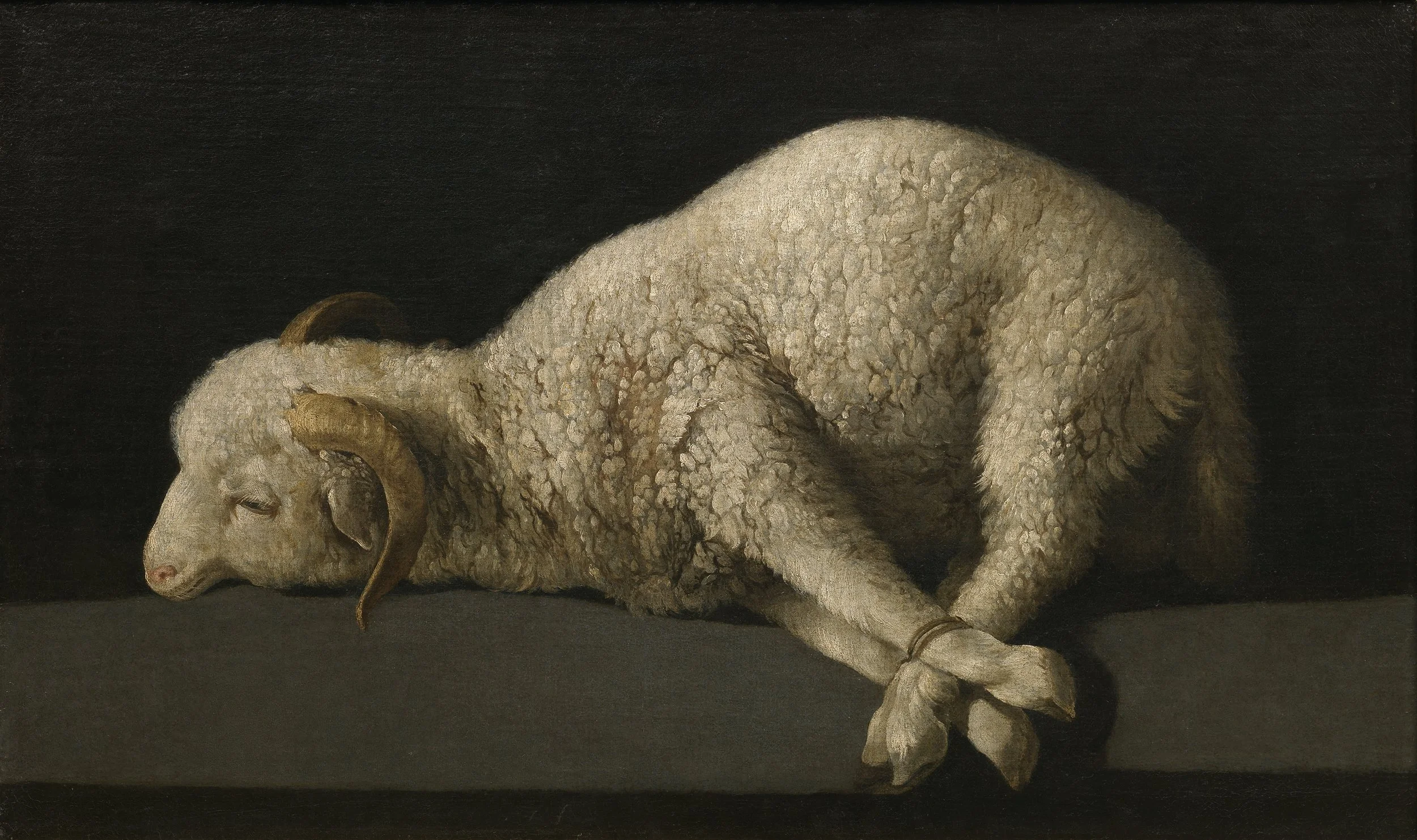
Francisco de Zurbarán’s Agnus Dei
Existentialism is one of the best-known schools of thought of the mid-twentieth century. Perhaps no other author so succulently explains the core beliefs of existentialism as well as Jean-Paul Sartre. In his address, Existentialism Is a Humanism, Sartre describes why existentialists feel “abandoned” and what they mean by “abandonment,” and he also examines how “existence precedes essence” (27). As his title states, Sartre argues that existentialism is not a rejection of humanism, but rather a radical embrace of the human condition. Sartre famously states, “I operate within a realm of possibilities,” clearly displaying his belief that man castes himself in whatever image he desires to take (35–40).
Against the atheistic self-making of Sartre’s existentialism stands René Girard, who converted to Catholicism as an adult. Defining Girard’s philosophy is a difficult task. His work encompasses multiple genres and disciplines, as his entry on the Internet Encyclopedia of Philosophy demonstrates, Girard was active in “Literary Criticism, Psychology, Anthropology, Sociology, History, Biblical Hermeneutics and Theology.” While his body of thought is complex, Girard’s masterful understanding of Friedrich Nietzsche and the French existentialists through the lens of faith can help Christians fully appreciate and understand these schools of thought.
Sartre himself acknowledges the various kinds of existentialism, such as “atheistic” and Christian existentialism (20). The one unifying belief of existentialists, according to Sartre, is that existence comes before essence. This is a radical reinterpretation of man’s being. In this paradigm, man does not begin as the creation of God; instead, man is simply a fact in and of himself and he is whatever he creates himself to be (21–25). It is from this self-definition that Sartre argues existentialism is a form of humanism, and that in “choosing himself” he “[chooses] man” (25). Here, Sartre universalizes action. Instead of one individual man being defined by his own choices, all of mankind is defined by the actions and choices of other men. He uses the example of deciding to get married and have children to explain this belief. In making such a decision, the individual is asserting that it is the proper end of men—it is good or necessary—for men to get married and have children, for the species to continue (24). Existentialism, according to Sartre, then is not a personal, independent system of thought—such a system does not exist—instead, humanity’s collective choices set up a precedent of expectations for humanity in the past, present, and future.
This process is true for every single person. Sartre takes the humanist axiom “man is the measure of all things” seriously, writing, “Everything happens to every man as if the entire human race were starting at him and measuring itself by what he does” (26). It is clear, then, that Sartre’s particular brand of humanism replaces God with man. While Sartre is an atheist, his atheism is a complicated rejection of God. When existentialists discuss the concept of abandonment, they “mean to say that God does not exist, and that we must bear the full consequences of that assertion.” Existentialists, in Sartre’s mind, do not want “to eliminate God as painlessly as possible” (27–28). He does not want a drastic change in conventional morality; Sartre wants to create a new structure, without God, which explains why values such as honesty and kindness are “a priori” and necessary to society. Through this project, he believes that morality without a religious framework will be possible, and God will become “an obsolete hypothesis that will die out quietly on its own” (28).
René Girard describes Sartre’s expression of atheism in his essay, “The Founding Murder in the Philosophy of Nietzsche.” Girard presents two types of atheism: “vulgar atheism” and “natural death of God” atheism (30–31). He defines the natural death of God atheism as the atheism that became popular during the Enlightenment. The philosophers of the Enlightenment thought that the idea of God would naturally die out as men learned more through science. Conversely, vulgar atheism is “that which consists in refusing the murder” (31). This comment refers to Nietzsche’s description of the death of God. While many readers take Aphorism 125 at face value, Girard explains that through “a sleight of hand,” Nietzsche describes a murder; and like Sartre, he does not glory in this death of God (22–27). Nietzsche, too, realizes that when God dies, a murder has taken place, leaving behind a murderer and a victim. In the death of God scenario, God is both the actual and perceived victim and man is indeed the murderer; however, man also becomes a victim in this ritual. Nietzsche’s mad man who yells to the crowd that God is dead realizes the gravity of the situation, and so does the crowd. According to Girard, the crowd’s initial silence in response to this proclamation is a recognition that they are in fact part of the group of murderers who slew a victim (26–30). The crowd is not only the guilty party but eventually becomes a victim because they have now lost their source of definition—the existence of their Creator.
It is this loss of definition that the existentialist feels deeply, and endeavors to answer with new understandings of meaning. Sartre writes, “Existentialists . . . find it extremely disturbing that God no longer exists, for along with his disappearance goes the possibility of finding values in an intelligible heaven” (28). In this statement, again, the murder of God is revealed, but not the natural death of the Enlightenment atheists. Like the Enlightenment philosophes, Sartre argues that once existentialists successfully redefine a priori morals under an atheistic system (i.e., as stemming from a source other than God), God will die. However, Sartre is also participating in the original act of violence—the very murder of God—that Girard ascribes to the vulgar atheism. Two key sentences from Girard’s argument help contextualize what Sartre is doing, even if he is doing so unknowingly: “The murder [of God] is commemorated to ‘comfort ourselves,’ the drama is replayed to render the memory of the event tolerable by transfiguring it. And suddenly, we have before us a new religion” (30). While existentialism is frequently thought of as an atheistic, twentieth-century phenomenon; in reality, it is another religion.
This new religion is not only the natural result of the death of God. It becomes necessary because the existentialist defines himself by “the other.” Sartre vividly notes that, “I cannot discover any truth whatsoever about myself except through the mediation of another” (41). When God—the greatest, highest Other—is removed, the existentialist must now define himself by other men. This explains Sartre’s previous comments about how one man’s actions define all his fellow men. Even though Sartre does not advocate explicitly for a new religion, when men define themselves apart from God, they make whatever else defines them—the being or thing which replaces God—their god.
Indeed, humanism divorced from Christianity becomes the idolatry of man. This element of existentialism, as conceived by Sartre, is extremely concerning because of where this self-definition leads. When men become the definition-makers, they can decide who does and does not have value. Sartre implies this when he writes, “It is in this world that man decides what he is and what others are” (42). Almost all of the twentieth century’s tragedies—indeed, most of history’s greatest tragedies—occurred because men viewed their fellow men as less than themselves. In Sartre’s system, therefore, not only is the individual unsure of his identity, but he is unsure about the identity of his fellows as well. While Sartre tries to argue for an “universal human condition,” ultimately there is a deep uncertainty because man exists within “perpetual construction” (42–43). Just as mankind lives in this half-way house of existence, Sartre affirms the “relativity of each era” (43). Since an era may be redefined—each era is in “perpetual construction”—then there is no constant or reliable definition for objective truths mankind may take from history.

Girard captures what the existentialists are doing in the following statement, “When in a radical mood, [the critic] attempts to substitute re-creation for interpretation” (49). Clearly, what Sartre represents as his interpretation of man’s reality is truly a recreation of things. Not only does God die in Sartre’s system, but Sartre must die as well. What Girard says about Nietzsche also applies to Sartre: “The ritual process does not take only the text as its victim. It rebounds onto the person of Nietzsche himself.” This system repeats itself; “There is nothing original about it” (32). While Sartre tries to uplift man, he actually leads to “the collective murder of arbitrary victims” (39). Girard honestly portrays the natural consequences not only of the Nietzschean death of God, but also the death of man as described by Sartre. Sartre’s existentialism is the humanism which says, “Man is the measure of all things,” and makes man a god in the process.
While it may seem Sartre is advocating for an atheistic system, a closer examination of this work reveals that his philosophy sets up man as its god. Girard’s commentary on Nietzsche applies to Sartre’s system and explains how these writers understand “the death of God” and what that means for mankind. Girard’s understanding of these immensely influential thinkers and their ideas helps Christians know how to respond to existentialism and what Girard calls the vulgar atheism.
Relevant Works
Andrade, Gabriel. “René Girard (1923–2015).” In Internet Encyclopedia of Philosophy: A Peer-Reviewed Academic Resource.” https://iep.utm.edu/girard/#H1.
Girard, René. “Existentialism and Criticism.” Yale French Studies, no. 16, Foray Through Existentialism (1955): 45–52. https://www.jstor.org/stable/2929147.
———. “The Founding Murder in the Philosophy of Nietzsche.” In All Desire is a Desire for Being, introduced and selected by Cynthia L. Haven, 21–40. London: Penguin Classics, 2023.
———. “Rupture and Literary Creation in Jean-Paul Sartre.” Contagion: Journal of Violence, Mimesis, and Culture, vol. 22 (Spring 2015): 1–16. https://www.jstor.org/stable/10.14321/contagion.22.1.0001.
Sartre, Jean-Paul. Existentialism Is a Humanism. New Haven: Yale University Press, 2007.