Pears, Pride, Repentance
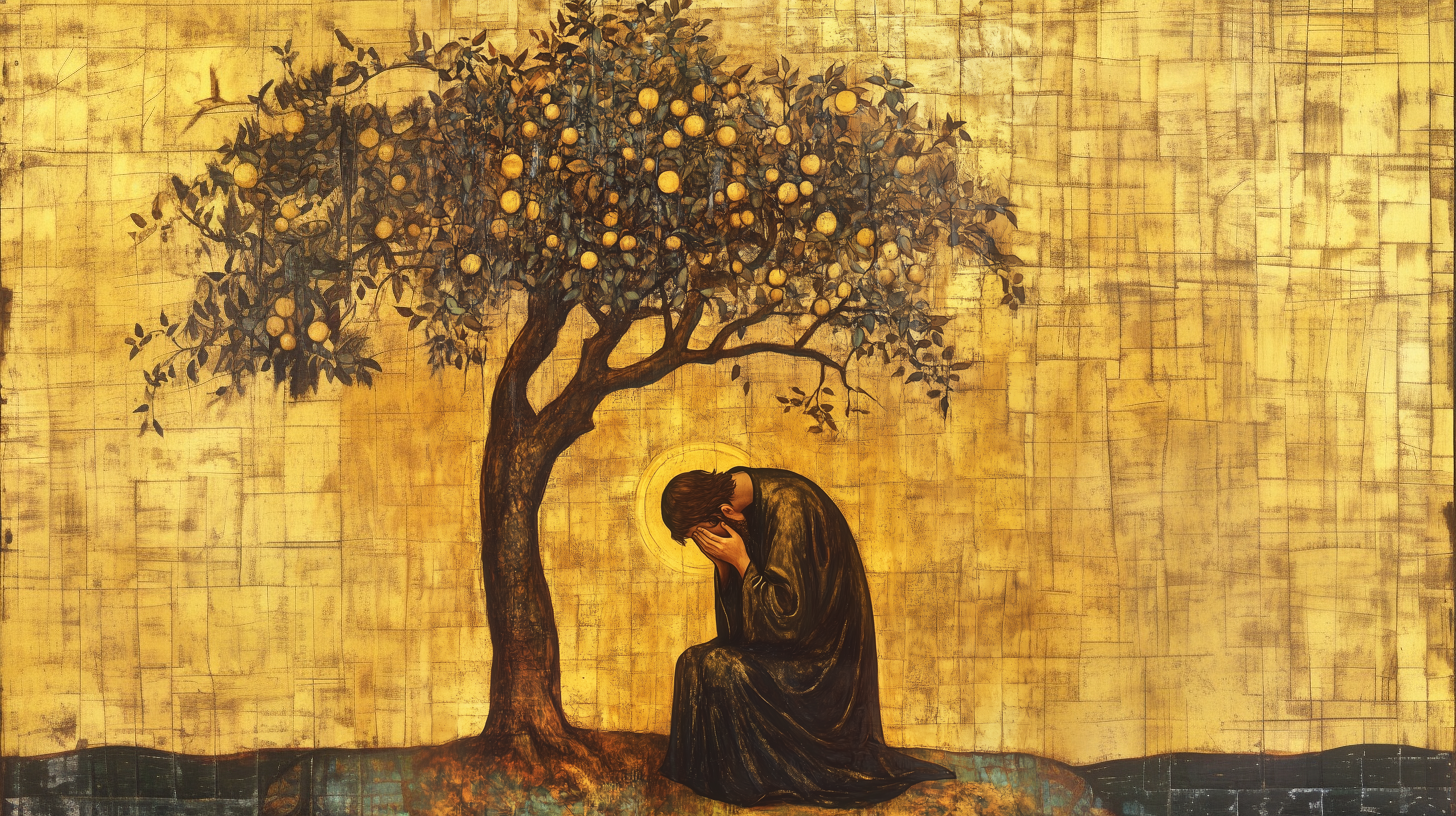
In what is, no doubt, the most famous passage from The Confessions, Augustine recounts how he, along with several friends, once stole pears from a vineyard. Though he admits that they “took enormous quantities” of the fruit, and even feasted on a few, it is clear that the significance of the act does not lie in the value of what was stolen. In fact, as it turns out, the true significance of the act lies precisely in its absurdity. For these adolescent truants, stealing the pears was worth something precisely because the pears were not. Augustine assures us: “We derived pleasure from the deed simply because it was forbidden.”1
This kind of misbehavior—the flailing attempt to prove that we are free by flouting the law—is so common and even natural to us that we must be reminded of its strangeness. Most of us can probably remember a similar crime in our own past. It didn’t take my memory long, anyway: I’m in college, and it’s spring break, but my friends and I have stayed on campus. Late one night, my friend comes to the dorm room and asks if I want to go hop in the pool at the Hilton downtown. “Of course!” I say, quieting the warning signal in my own head: Stop it, Christian. You’re not going to back out. You’re not going to be that guy. When we hop the fence and, to our dismay, find the pool unheated, we don’t head home. Instead, we immediately start looking around for the next possible misdemeanor, and this time, I am the one with all the bright ideas: “How about we climb up on the roof of the mall?” I suggest, pointing to where a ladder leads to the top of a nearby brick building. It’s settled. Despite the fact that I suggested the idea, I elect to climb the ladder last; as fate would have it, I will never get the chance. Just as I lift my foot to the first rung, a perfect caricature of a mall cop comes ambling around the corner, flashlight in hand.
What the hell were we doing? Why would we want to climb up on a nondescript brick building? The mall cop’s questions hit home as I sat, back to the wall, waiting for the police to arrive. What exactly had I been wanting from that experience? We were threatening our professional and educational futures—and for what? Was I really craving a dip in the Hilton pool, or a view of the parking lot from the roof of a mall?
Of course not. It’s true that some crimes amount to our better judgement being overcome by desire for some object or experience. To pull a phrase from Genesis, sometimes our eyes fall on forbidden fruit that is “a delight to the eyes,” and we fail to resist the power of temptation. However, as Genesis also reveals, even in crimes of passion there is often another motivation at play—namely, hubris, the desire to “be like God.” What makes the stealing of the pears so perverse, according to Augustine, is how little lust, and therefore how much pride, there was in it. He asks: “Was I, in truth a prisoner, trying to stimulate a crippled sort of freedom, attempting a shady parody of omnipotence by getting away with something forbidden?”2 The answer to the rhetorical question is a resounding yes. Augustine did not want the forbidden fruit; he wanted to do what was forbidden, and he wanted to do so in order to demonstrate his own power. “All those who wander far away and set themselves up against you are imitating you, but in a perverse way,” he writes in the same passage.3 Looking back, I have to admit that I was motivated by a similar pride. I wanted to experience the thrill of doing something wrong and getting away with it, so I climbed a roof. As we drove home in silence late that night, having escaped a night at the police station by the skin of our teeth, I swore I’d never play with the law again—but it’d be a lie to say I kept that promise to myself.
It is interesting that, after several paragraphs of claiming that he was motivated by hubris alone in stealing the pears, Augustine seems to backtrack, writing: “And yet, as I recall my state of mind at the time, I would not have done it alone.” He goes on to explain: “Since my pleasure did not lie in the pears, it must have been in the crime as committed in the company of others who shared in the sin.” Crucially, Augustine is not changing the story. He never claims that his motivation was anything other than sheer pride—he is not passing the blame, or even distributing the responsibility among others. Actually, that his taking of the forbidden fruit required the presence of others makes it all the more pathetic. His intention in carrying out this crime was to demonstrate a God-like freedom, and yet even that freedom was conditional, dependent upon the presence of others to embolden him.
And so he offers the following summary of his crime: “I was greedy for another person’s loss without any desire on my part to gain anything or to settle a score. Let the others only say, ‘Come on, let’s go and do it!’ and I am ashamed to hold back from the shameless act.”4 To hold back from committing the crime would be tantamount to admitting that he is not, in fact, God.
It is fascinating to notice how Augustine’s repentance and conversion later in the book serves as a perfect inversion of this crime. By the time he finds himself praying in the garden, with a violent conflict raging “within the house of [his] spirit,” he knows what he wants—in fact, what he wants, and his inability to get what he wants, is all he is certain of anymore. He writes: “All I knew was that I was going mad, but for the sake of sanity, and dying that I might live, aware of the evil that I was but unaware of the good I was soon to become.”5 Unlike in the incident with the pears, his object is clear to him, and it is truly desirable—he wants to walk in the footsteps of the two court officials he has been told about, who, having read The Life of Antony, immediately abandoned all worldly ambition and became monks, devoting themselves to Christ through prayer and suffering. Christ is his desire, and he knows that Christ is the infinitely desirable Way, Truth, and Life.
He is “going mad for the sake of sanity” because, for the first time in his life, he wants a fruit that is not forbidden—and yet, for once, he is unable to “taste and see that [it] is good.” He cannot reach out and take the fruit because, this time, the object of his desire—namely, humility—is truly divine. Whereas the Platonists believed that knowing the Good would be sufficient to move one to become good, Augustine knows better. He may value the humility of Christ, but he could not want it enough, or for long enough at one time, to learn “what [Christ’s] weakness had to teach.” Through his own strength, his mind could attain to a knowledge of That Which Is “in the flash of one tremulous glance,” but to maintain the pursuit of humility was, paradoxically, beyond his strength. Exactly at the moment that he began to learn something of eternal value, his heart would “covet a reputation for wisdom,” becoming “complacently puffed up with knowledge.”6

What Augustine needed was not intellectual clarity about the divine, but more time spent with the Divine One: “What I now longed for was not greater certainty about you,” he writes, “but a more steadfast abiding in you.”7 He was not wrong to think he needed more steadfast abiding with Christ, of course, but only wrong to think that such abiding would require him to become more steadfast. What Augustine needed, more than anything, was to admit that he was not steadfast, and therefore, that he was in desperate need of a savior who could be steadfast in his stead. What he would need to do is follow the urges of “the chaste, dignified figure of Continence,” who offered numerous examples of those who had traded their lusts for salvation: “Could any of them achieve it by their own strength, without the Lord their God? He it was, the Lord their God, who granted me to them. Why try to stand by yourself, only to lose your footing? Cast yourself on him and do not be afraid: he will not step back and let you fall. Cast yourself upon him trustfully; he will support and heal you.”8
And so it is only following his admission of helplessness that Augustine experiences the fulfillment of his former desires for divine freedom and camaraderie. Just as in his stealing of the pears, he desires to exercise a divine kind of freedom—only this time, he longs for the freedom to act in accordance with the divine will rather than accomplish his own. And just as in the case of his former crime, he is not free enough to act on his own. It will require Another to accompany him, providing a power and courage he could not sustain for himself. In an orchard, he stole what he did not want in order to prove he was powerful; in a garden, he will receive everything he could possibly desire by admitting he is powerless.