Between History and Now
The past is never dead. It’s not even past. All of us labor in webs spun long before we were born, webs of heredity and environment, of desire and consequence, of history and eternity.
— William Faulkner, Requiem for a Nun
In early March, 1991, the first Gulf War had ended with a ceasefire. My dad, sitting in his armchair in front of the TV news, marveled at how few American casualties there were. I mentioned a young soldier from the far end of our county who had been killed when his gunship helicopter was shot down. According to the local newspaper, he excelled at languages and hoped to go into the diplomatic corps.
He was “special,” I said. My dad’s Irish-blue eyes flared, and then gazed into some far, unknowable place. It took me half a heartbeat to grasp my error. I was forty-one, old enough to know better.
“They’re all special,” he muttered. He was a kind man with a fierce handshake. At one point in my late teens, he distilled his Catholic upbringing for my benefit: “Just be a decent human being.”
My dad, who died at ninety in 2007, had been a foot soldier through the worst of World War II in Europe. He rarely talked about the war, though it must have been a constant presence, like a cold draft through a chink in the nearest wall.
“Terrible, terrible,” he whispered on his deathbed.
“What is?” I asked, though I knew.
“The war.”
Statistics suggest a combat infantryman in World War II stood a one in six chance of being killed — essentially waking up every morning for a game of Russian roulette with a six-chambered revolver.
My dad came through. Too many American boys to the right and left of him did not. They were among the approximately 25 million soldiers and civilians the war in Europe killed. “The most extreme experience a human being can go through,” wrote historian Stephan Ambrose, “is being a combat infantryman.”

My parents traveled to many places over the years — mainly in the U.S., but also to the Caribbean, Mexico and the South Pacific. He refused to follow his boot steps back into France or Germany, though late in life my mother coaxed him to accompany her to Italy and Switzerland. Close enough. But not one step closer.
Among the things my parents left behind is a snapshot of my dad in France taken a month after the fighting in Europe stopped. On the back, written in blue ink: Lyon, June 1945. The cursive is elegant, drilled into an inelegant, working-class boy by the nuns in his Catholic grade school back in St. Louis — an early notice that he, too, could make something beautiful. The former altar boy entered the Army before Pearl Harbor to escape a difficult upbringing during the Great Depression. “Tenacity,” an Irish aunt who scrubbed marble floors in big St. Louis houses on her hands and knees informed him. “Tenacity is the key to this life.”
He got more than he signed up for. When it was all over, he crossed back over the Rhine into France and found himself passing through Lyon, the spacious city where the Rhone River meets the Saone and the magnificent, late nineteenth century Basilica of Notre-Dame de Fourviére looks down on it all.
In the picture, behind my dad, a white balustrade fronts the base of a column. The column is flanked by a couple of baroque statuettes which signal the grandiloquent style of public art found in almostevery city and village in France. Though the background is fragmentary — a balustrade, part of the column, a couple of hazy, sculpted figures — there seemed to be just enough showing to pin down the location. A few months before leaving on a trip to France, I emailed a PDF of the photo to the Lyon Tourist Office. “Place Carnot,” came the reply in English. “It’s a little changed, but we’re sure that’s where this is.”
In May 2025, one month short of eighty years after my dad’s picture was snapped, my wife and I traveled to France; Lyon and Place Carnot would be one of our stops. We had been to Europe numerous times, and had visited the Normandy American Cemetery above Omaha Beach and the Sicily-Rome American Cemetery on the edge of Nettuno, Italy, south of Rome. But this pilgrimage was different.
This trip came a couple of weeks before my seventy-fifth birthday. I was feeling intimations of my mortality, I expect. I wanted to stand in the place where my dad stood on that sunlit morning in June 1945 and have my wife take my picture. Corny, no doubt. But heartfelt in ways words can only partially explain. Above all, some forty-six hundred miles from St. Louis, his birthplace, I wanted to pay homage to a decent American who fought against fascism so that, as I believed growing up, there would be no more Anne Franks. In our unstable times, I also wanted to say a private “Thank you” for a stable homelife, and for the things he and my mother didn’t say as they witnessed my unsteady trek towards adulthood. Whatever sins I might bear on the journey toward quietus, I didn’t want to add “ingrate” to the list.
Around the time his photo was taken, my twenty-eight-year-old father, 5-feet-9 inches tall, weighed 120 pounds, according to his discharge papers. Before the war, and after, 145 pounds was his norm. Meanwhile, my twenty-year-old mother, with a month-old baby — my big brother — waited for his return to Bainbridge Island, eight miles west of Seattle.
Bainbridge is where she grew up and where she met my father on weekend leave from Fort Lawton in Seattle before heading for Europe. Bainbridge, “the Gem of Puget Sound,” as our local newspaper branded it, is where my siblings and I would grow up.
For my dad, Bainbridge would be a change of worlds, trading the slow, muddy waters of the Mississippi for the changing tides of Puget Sound. He would come to live the post-War, American Dream, rising through the ranks to become advertising manager at the Seattle Times, eventually building a waterfront home with a view of Seattle on a cove where my mother, a strong, cold-water swimmer, stroked far out over the depths. As a Midwestern city boy who never learned to swim, he admired her from shore.
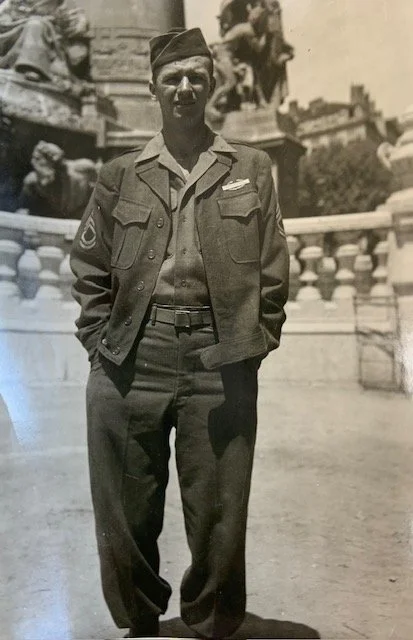
Technical Sergeant James Thomas Dillon.
In the photograph, his hands in his pockets — a stance I would come to know well — my dad faces east, squinting slightly into the morning sun. Along with his wedge-shaped, foldable garrison cap, he wears his “Ike” field jacket with his Technical Sergeant’s stripes over his clean and pressed dress shirt with winged collars. Lyon mornings are already warm in June, but my dad had lived through the coldest European winter in a century while being shot at; for the rest of his life he would recoil from the cold. For now, he keeps his jacket on.
Shining in the sun above my father’s left pocket is the Combat Infantry Badge, a horizontal bar with a silver musket on a blue field, backed by an oak wreath. Among his many campaign medals, it was the only one that he cared about. “It means you’ve actually been there,” he told me late in his life — “there” being the zone of actual fighting. The medal sits on my desk as I write this.
Over the years my wife and I had passed through Lyon several times on a train going south. This time we were going to stop. On a Saturday along Rue Victor Hugo the May afternoon was warm and crowded; its breezy consumerism looked and felt American. This was the France of the E.U., a synecdoche for the risen tide of European affluence. People were taller, healthier, and smoking less than when I first came to France fifty years earlier.
We passed a bagel shop, a poke cafe, a bubble tea window, a fried chicken outlet, an Asian “sweet food” restaurant and a window displaying racy lingerie. As we passed a big-box Monoprix store, where a young woman on sax noodled out “Bésame Mucho,” I could make out a large public space straight ahead
At the dawn of the Second Empire in the early 1850s, a monument of Napoleon I astraddle a horse was installed as Place Carnot’s focal point. With the fall of the Second Empire in 1870 the statue came down. In 1889 a tall column topped by a bronze Madame Liberty, officially known as The Statue of the Republic, replaced Napoleon I. Vintage photographs online show Madame Liberty holding out an olive branch, her right hand resting on a lion’s head. Six allegorical sculptures exemplifying Republican virtues circled Madame Liberty’s pedestal: Liberty, Equality, Fraternity, the City of Lyon, The Rhone, and the Soane.
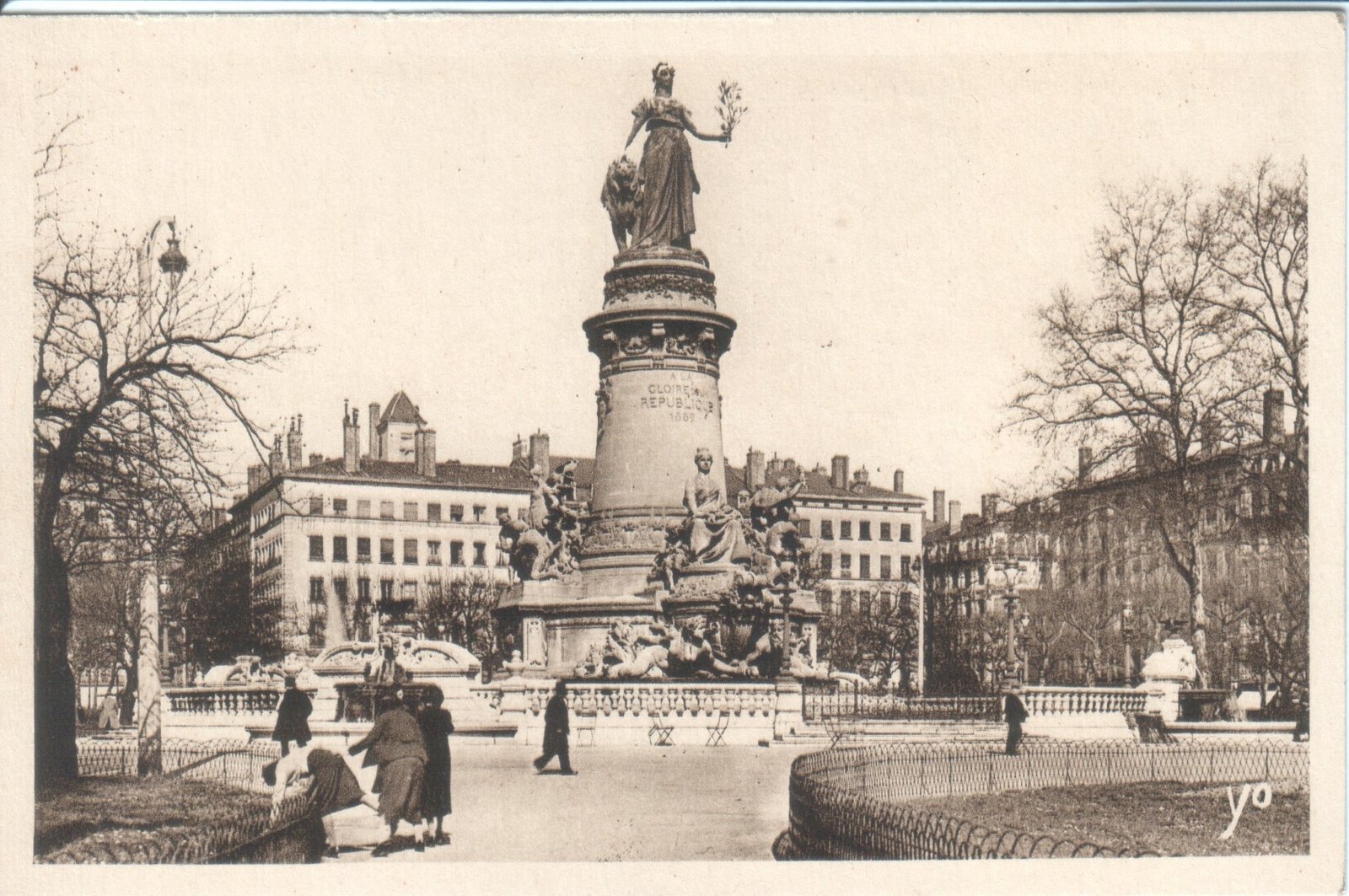
Place Carnot
We entered Place Carnot, where a mix of cypress and plane trees and holly oaks provided shade. Pockets of elderly ladies — older than seventy-five, that is — occupied benches in the mild sun. Several young boys traded kicks with a soccer ball. Prams and families passed through.
I didn’t see Madame Liberty anywhere.
“This can’t be it,” I said to my wife, an artist who notices things. “It’s not here.”
“It is. Over there.”
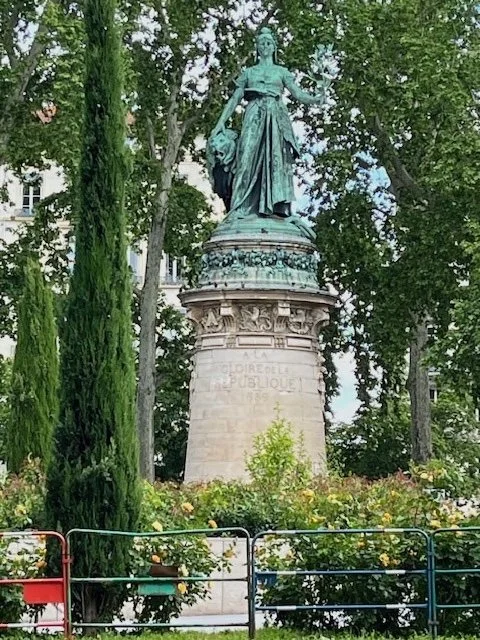
Madame Liberty, facing “The Rails of Memory.” Photo by Sydni Sterling.
Madame Liberty, still poised on her tall column, stood to our left among a green cluster of trees. Shorn of her six allegories and white balustrade, she’d been moved.
Urban planning, I would learn, had uprooted Madame Liberty to the wings in 1975. Two allegories were removed to another park in the city; the allegory of the Soane came to rest on the other side of the park. The remaining three were destroyed.
Stripped of her supporting cast, bumped from her central position, now a grassy area, Madame Liberty had become a Place Carnot wallflower, an also-ran. I posed beneath her anyway; my wife took my picture. But it was no good. There was no standing in the exact place with Madame Liberty behind me. The past had not stood still.
Opposite Madame Liberty, fewer than one-hundred yards away, something obviously new caught our attention: the city of Lyon’s Shoah Memorial, “The Rails of Memory.” The rectangular installation, evoking the shape of a long boxcar, was finished in January 2025 after a couple of decades of planning. Reclaimed rails were interwoven — 1173 of them, representing the 1173 kilometers to the Auschwitz-Birkenau camp in Poland — to evoke the cold efficiency of industrial-scale murder. There’s a reason the memorial is sited here: the Perrache train station, within view, is where Jewish men, women and children from the region were transported to their deaths during the war.
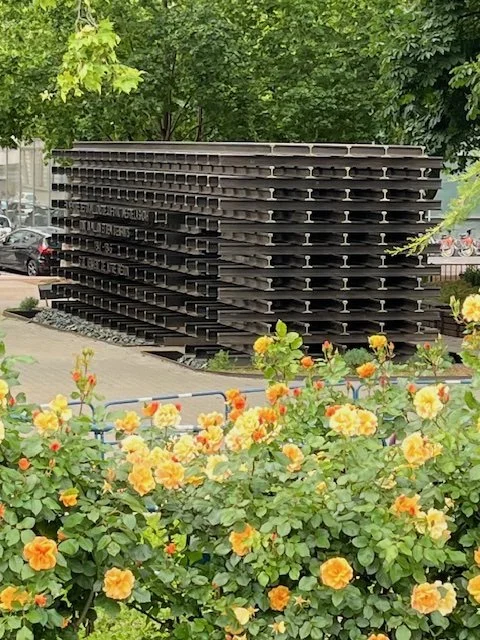
“The Rails of Memory.” Photo by Sydni Sterling.
The effect is understated and emotionally powerful — a curt, modernist corrective to the nineteenth century, public-art grandiosity a la Madame Liberty. The dedication of the long-planned installation had come at the right time: anti-Semitism, and the hoary tropes of rhetorical hatred, have risen in Europe and in our own country — the dark forces my dad and some three million GIs fought against in Europe.
I had figured Place Carnot would be as it was, that not even the passage of time would mess with such a formidable paragon of French patriotic art. But the admonition, “Just be a decent human being,” came back to me, words more durable than any column or statue. Or some exact spot where I might stand to count coup with the past.
I took a last look at Madame Liberty, then turned and walked towards “The Rails of Memory.” My wife and I looked at it in silence — a haunting incarnation of steel that speaks with a clear voice to our own unsettled times.
I uttered a silent prayer of thanks to my dad, to the American boys who never made it home, and to the better angels of human decency that stand up to darkness. I hadn’t known it, but this is what I came for.
After half a minute, my wife took a picture of “The Rails of Memory.”
I am not in it.