
Friday Links
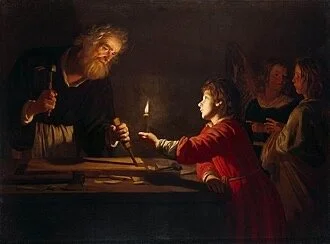
Childhood of Christ, Gerrit van Honthorst (Wikicommons)
May 1, 2026
The Angelic Painter
Finding the Blue Hour
How Occultists Remade the World
Wendy Cope: why I won’t stop reading Philip Larkin
Robert Penn Warren’s “All the King’s Men”: The Agony of Will
The Angelic Painter
When it comes to providing hints and glimpses of Heaven that feel somehow true, perhaps only Botticelli approaches Fra Angelico. Botticelli’s air of holiness was hard won. Like his master Filippo Lippi, he sometimes struggled to harness his various urges. He was obviously a sensualist; purity did not come naturally to him. Yet he and Fra Angelico are among the only artists in history who could paint convincing angels. This is related to a peculiar inability that is not necessarily a weakness: They could not successfully imagine devils, or demons, or dragons, or anything evil. Nor did they understand how to depict eternal damnation.
Finding the Blue Hour
Nic Rowan on trying to find some peace and quiet:
It is not as if the search is getting any easier. The world has become a significantly louder place in the last thirty years. City life has expanded into suburbs and exurbs. There are more cars on the road and more planes in the sky. Telephones and computers no longer hang from kitchen walls or await our discrete queries on study desks; in their combined form, they follow us into every imaginable space. Phone conversations are shared at full volume on the street, in grocery stores, and even, I have noticed, on airplanes. Muzak, once confined to department stores and chain restaurants, plays in nearly everywhere. And don’t get me started on the video ads at the gas pump.
How Occultists Remade the World
The supernatural, it would appear, is on the move, and popes and priests aren’t the only ones who have noticed. In 2018, Pew published a report claiming that practitioners of Wicca and neopaganism had begun to outnumber mainline Presbyterians in America. In 2021, Pew claimed that roughly 33 percent of American Christians believe in reincarnation. By 2025, it was estimated that 30 percent of all Americans, Christians or otherwise, were practicing astrology, tarot, or other forms of divination, and that 62 percent believed in one or more New Age ideas, be it psychics, crystals, spiritual energies, “positive thinking,” or the “law of attraction.” Popular religiosity appears to be shifting, and it’s not hard to see where it is headed.
Wendy Cope: why I won’t stop reading Philip Larkin
H/T to A.M. Juster for this oldie but goodie:
Larkin’s poem haunts me in spring and early summer, the lines I’ve quoted proving especially memorable. One way to judge a poet is by how many of their lines are often quoted. Nobody can beat Shakespeare in that competition but Larkin scores pretty well. There is, of course, the one about your mum and dad messing you up, which includes a word that The Daily Telegraph might prefer not to include. Two friends of mine wrote their own benign version, beginning: “They tuck you up, your mum and dad”. A couple more examples: “Why should I let the toad work/ Squat on my life?”. And “Sexual intercourse began/ In nineteen sixty-three”.
Robert Penn Warren’s “All the King’s Men”: The Agony of Will
I’m re-reading this novel and am reminded (once again) that RPW is a great, great writer.
It’s as if Robert Penn Warren (1905-1989) wrote this classic American tale principally for college and university students. With a solid foundation in the liberal arts, they will recognize the philosophical and psychological theories that a central character, Jack Burden, has in mind when he transforms them into excuses for his morally questionable behavior—in fact, as rationalistic covers for his flights from personal responsibility. Through this novel, not only will readers gain a sense of what to avoid; they will also receive insights into what to affirm: personal agency and individual responsibility, hallmarks of conservative thought and practice.
