What gets lost in Emerald Fennell’s “Wuthering Heights”
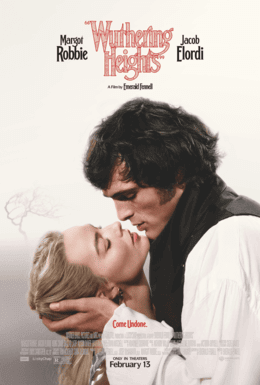
For many readers, both Catholic and non-Catholic alike, reading Emily Brontë’s 1847 novel Wuthering Heights for the first time was a poignant, even formative literary experience. So, when director Emerald Fennell announced that she would be releasing her adaptation on February 13, 2026, there was international excitement and a renewed interest in the classic novel. But, tellingly, Fennell placed her film title in quotes, as if warning viewers from the outset that “Wuthering Heights” wouldn’t exactly be Wuthering Heights.
The film does stay true to the novel in certain ways. Catherine Earnshaw and Heathcliff grow up together. They fall in love, but because Heathcliff is poor and of low social standing, Catherine marries her neighbor, Edgar Linton, choosing a life of riches over love. Heathcliff is violent and sadistic; Catherine is petulant and vengeful, and she meets a similar tragic fate in both the novel and film alike. But aside from these elements, Fennell’s film departs sharply from the classic novel. First, the characters themselves: Brontë envisioned Heathcliff as "dark-skinned," a "gipsy," or a "Lascar," a term for sailors typically from Southeast Asia, and Catherine as a brunette with dark eyes and a beautiful smile. Instead, in the film, Heathcliff is played by Jacob Elordi, a white, Australian actor, while Catherine is played by Margot Robbie, a blonde, blue-eyed actress; the beautiful smile remains the same. But more dramatically, Fennell omits the entire second half of the novel, thus cutting out the progeny of Heathcliff and of Catherine and Linton. Instead, Fennell’s film focuses solely on the romance, and a deeply sexual portrait of that romance, showing Heathcliff and Catherine entwined in scenes of intimacy, consummated after she has become pregnant with Linton’s child. Catherine’s ghostly hauntings of Heathcliff never make it into the film. In fact, there are no ghosts at all.
There is no crime in Fennell’s decision to create a unique interpretation of Wuthering Heights. After all, no filmmaker could possibly produce a faithful rendering of the novel in a reasonable runtime. But Fennell’s choice to stray from the text had consequences. She doubled down to create a hypersexual narrative that focuses singularly on romance, but—divorced from virtually all other aspects of the tale—the passion rings so hollow that it works against itself. Brontë’s Catherine and Heathcliff do not consummate their relationship; instead, they self-destruct under the weight of frustrated passions, cast amidst the cold isolation of the craggy, wind-whipped landscape, a perfect pathetic fallacy for Catherine and Heathcliff’s obsessions. And in the novel, Heathcliff, fixated on revenge, forces Catherine’s daughter, Cathy, to marry his son via the child he sired with Linton’s sister. This new generation does not exist in Fennell’s adaptation, and so there is no opportunity to see the generational damage wrought by Heathcliff and Catherine.
Brontë’s novel was considered a Gothic masterpiece, and it’s quite likely that she herself didn’t perceive her work as a romance. Instead, it’s a metaphysical exploration of obsession, revenge, and madness. Its moody richness offered little gratification. Heathcliff and Catherine didn’t fully unite until their spirits roamed the desolate moorlands together as ghosts. Fennell omits the ghostly element, favoring instead the flesh. As Catholics, this rich interpretation of life after death is sorely missed, and the fact that Fennell’s adaptation omits the spirits in favor of a passionate, if doomed, and increasingly debauched adulterous affair is a loss for the film. The ghosts are what made Wuthering Heights so distinct. Instead, Fennell stuffs her movie full of zero-calorie gratification from lust and marital infidelity, wrongly pitched as excusable because of the supposed uncontrollable passion between the two main characters, which we try hard to believe in but never quite buy.
How the film strays from its canonical text of origin also raises other interesting issues for Catholic viewers. For while Catholics, of course, do not have exclusive claims on classic literature, it is true that classic literature does occupy a particularly rich place within the tradition of the faith. There is a long history in Catholicism of cherishing the great works of literature as revered bridges to understanding life, morality, and grace. This very publication, Dappled Things, takes its name from the poem by the English poet Gerard Manley Hopkins. With a novel as profound as Wuthering Heights, many readers will already have a close bond with the text and likely feel protective over Brontë’s work, understanding her novel as a form of art that offers truth, goodness, and beauty. This is not to say that Brontë’s novel is all sweetness and light. Indeed, its very unloveliness is why it’s so profound. Her dark story offers a painful lesson in what selfishness and obsession can do to an entire generation. She brings the reader along for a tragic story of human frailty, racism and class strife, madness, generational trauma, and the supernatural. After all, what is the fun of fiction without a few ghosts?
Fennell’s film, while ambitious and thoughtful, focuses so heavily on the isolated love story that everything else drops away. The two main characters (and actors) are left to stage an unrelenting and exhausting fever pitch of longing within an over-stylized world. The almost surreal production design works against the passion of the story by losing touch with the larger social context in which this story takes place. Ultimately, the film feels as if it takes place nowhere. Perhaps it is intended to suggest it is a love story that transcends time, but without the social, racial, moral, and economic complexities that gave the love story of the novel such depth, we are left with a film that spends its energy on anachronistic set designs and sensational gowns. However, the film’s soundtrack did elevate the overall production. The soundtrack was created by singer Charli XCX, while Anthony Willis composed the score. Charli’s song “House” (featuring Welsh musician John Cale) is memorable, as is her song “Always Everywhere.” Like the set design, the music has a slightly anachronistic feel, which isn’t surprising since Charli’s style is typically described as “brat-goth.” The orchestration did much of the heavy lifting, but, overall, the music did lend a moody, haunting element to the film that enhanced the experience. In this light, the soundtrack is the most Gothic part of the movie.
Brontë understood that Catherine and Heathcliff’s love was metaphysical rather than physical, which is why they didn’t end up together until death; their spirits united rather than their flesh. This is part of Brontë’s mastery; amid this tortured, Gothic tale that included a larger social order, she was able to weave a love story, but one that wasn’t quickly gratifying. For Fennell, the loss of the supernatural, the loss of life after death, makes her love story all flesh, all carnal, and there is little else left. Catherine dies; the movie ends, and “Wuthering Heights” becomes only a small fragment of what Wuthering Heights really was.