
The Spiritual Richness of Babette’s Feast

I have long heard that Babette’s Feast should be viewed as a metaphor for the Eucharistic sacrifice consecrated at every Catholic Mass, and I admit to initially watching the movie intently for a strong Catholic message. After all, it’s listed under the Vatican’s 15 films of religious value. Also, several trusted movie lovers have told me about its rich Catholic message. Wasn’t it my duty to connect the Catholic dots? But thankfully—it’s not healthy criticism to watch a movie simply to confirm one’s preexisting worldview—as the movie’s magic began to unfold, my interpretive anxieties were swept away. I stopped taking notes and just experienced the movie. And as the days passed, and long after the movie’s start-to-finish charm had sprinkled its fairy dust over me, I realized what a profound movie of the spirit it truly is, a movie with something to say to us all, Christians and pagans alike.

The film opens onto a small, dreary, seaside Danish village in the mid 19th century. A web of grey mist forever clings to the village’s buildings and homes and trees. Here we meet two older sisters, Martine and Philippa. Dutifully, they perform menial tasks each day for themselves and the villagers, including feeding citizens too frail to feed themselves. Are they widowed? Do they have any other family? For answers, a pleasant female voice, the movie’s fairy-tale-esque narrator, tells us that the sisters have tried to take the role of their father, an austere Lutheran pastor who passed away years ago. Indeed, the narrator tells us that the father was feared by many, respected by most, and considered a prophet by some. To carry on his legacy minus his austerity, the sisters perform small acts of charity. They also attend church each Sunday and hold a weekly Bible study, though the discipleship, the narrator informs us, is dwindling. What’s worse, as the viewer will find out later in the film, is that even the few that attend the Bible reading are less concerned with Scriptural wisdom and more concerned with gossiping and slandering their fellow villagers. Maintaining dad’s more rigorous and demanding form of Lutheran Christianity has proven difficult. Nevertheless, the sisters continue to carry out their admirable but thankless daily tasks.
Of course, if the viewer sat through an entire movie this somber, Babette’s Feast would quickly have been forgotten after its initial debut in 1987. However, Gabriel Axel, the movie’s writer and director, has other plans. Quickly after these opening scenes of exposition, we will watch two flashbacks, each one centering on a different one of the aforementioned sisters. In the flashbacks, each sister is radiant of her former loveliness, and each scene offers the viewer a glimpse of how the sister’s lives could have been very different.
At this point, you may be wondering about the movie’s titular character: Babette. Well, the flashbacks will also be important in foreshadowing how the sisters current dreary lives might be transformed.
In the first flashback, we met a young, handsome Danish soldier named Lorens. He is, however, living a life of dissipation. His privileged life has afforded him many of life’s creaturely comforts, but his overindulgence has only produced gambling debts and existential malaise. To punish him and hopefully rattle him out of his apathy, Loren’s father sends him to his elderly aunt’s home for three months, a home with no visitors and no parties and no gambling parlors. But the home is close to the two sisters’ Danish village. On an otherwise dull visit to the village with his aunt, Lorens spots one of the young sisters, Martine. Smitten by her beauty, he begins to court her. To do so, he must eat dinner with her and her other sister and her pastor father, whose austere physical presence—-he says little dialogue—-matches the intense austerity of his photographs that haunt the opening scenes. Nevertheless, Lorens continues to visit, hoping against hope for a higher life of love with Martine, but to no avail. Martine’s father commands too much commitment from his daughters, so Lorens is forced to abandon his love for Martine and return to the upper crust of Danish society where, pained by his failure to win Martine, he laments that “life is cruel and hard…in this world things are impossible.” He vows to now embrace the pain he feels in order to sting and spur himself to worldly success: “I will cut a big figure in the world.” And as the viewer will see later, he does just that, but that doesn’t bring him happiness either.
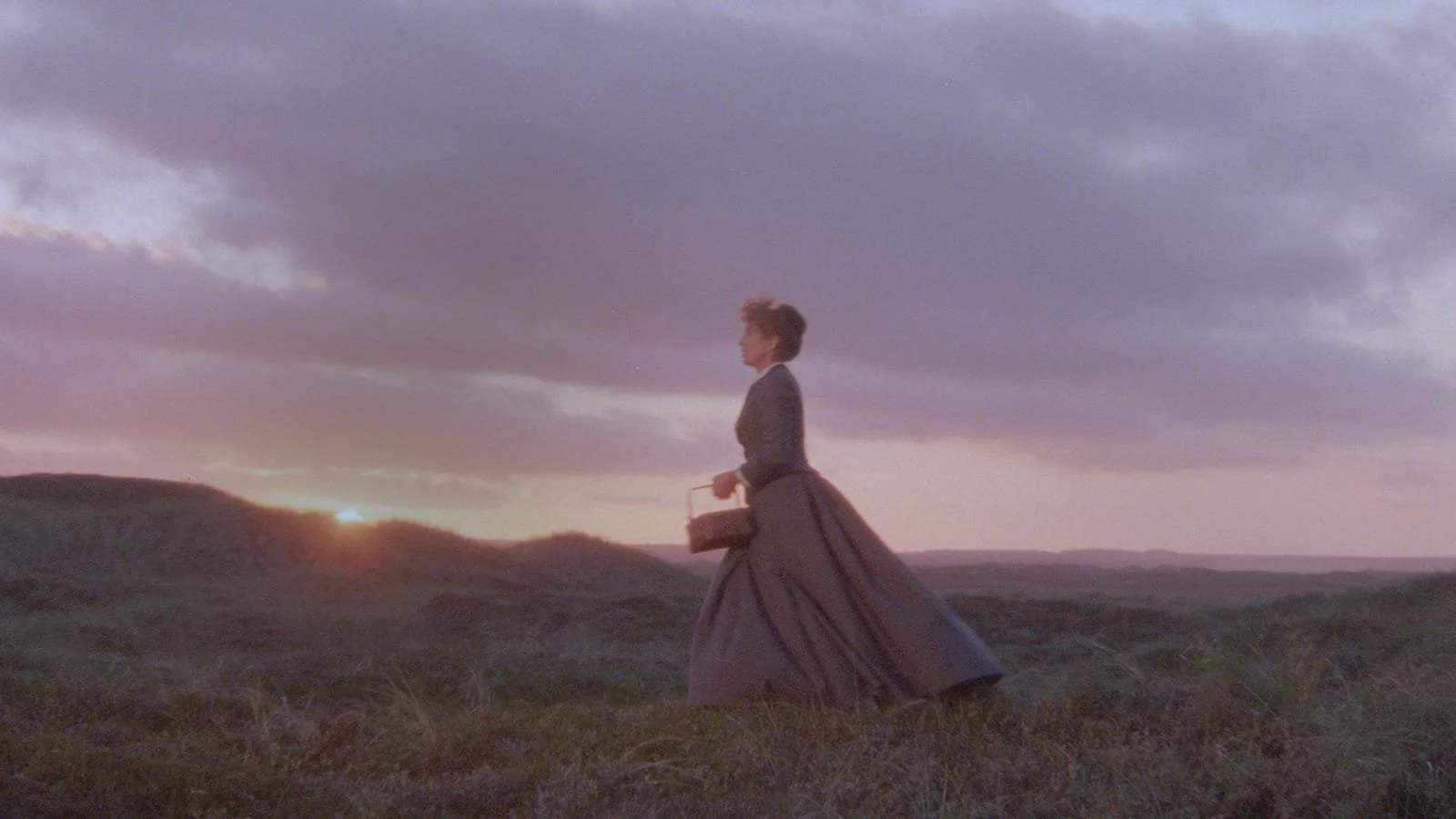
In the second flashback, we meet the suitor of the other sister, Philippa. A Frenchman, Achille Papin is a famous Parisian opera singer. Like Lorens, however, his worldly success has led to a deep malaise. In fact, tired of the empty flattery of the Parisian elite, he longs for solitude and momentarily abandons his career to wander the world in his gloom. Eventually he solemnly enters our Danish village and finds himself sitting in its Lutheran church during a service where, true to its traditions, many hymns are sung. Papin listens listlessly before noticing the beautiful voice of the beautiful Philippa, which astounds him so much that after the service, he knocks on the father’s door, tells the pastor who he is, and asks if he can provide singing lessons for the promising Philippa—-a brief but amusing scene ensues where the Lutheran pastor asks Papin if he is a Catholic, and the actors’ expressions provide the amusement better than words could.
Interestingly, the father agrees, and in one of the early scenes of magic in this magical movie, Papin teaches Philippa the seduction duet from Mozart’s opera, Don Giovanni. In wonderful contrast, the Lutheran pastor sits silently with his other daughter in a shadowed living room while Papin and Philippa sing the seduction duet masterfully and intensely in a room bathed in the sunshine pouring through the windows. Papin is in love. However, his love is not so much for Philippa herself, but for her talent. As he says to her, “you have talent enough to distract the rich from their riches and console the poor.” He wants to take her to Paris and make her a famous opera star. But their sensual musical duet in a practice room will be all the father can stand. Papin is forced to leave Philippa behind and return to Paris alone, his hopes of creating a new star dashed by the daughters’ duty to their father.
The viewer now flashes forward to the present, where our sisters have transformed back into their elderly selves, wrinkled and grey but with traces of their spring verdure still peeping through the winter snow. And now “many years later,” as the narrator informs us, Philippa receives a letter from an even more elderly Papin. He is dying but not in despair: “I believe death is not the end,” yet he has an urgent request for the two sisters, the only two he can trust outside a now fractioned and fighting Parisian community. Papin knows a woman, Babette, who has lost her husband and son in the recent political upheavals in France. Babette’s life is now in danger, so Papin asks if the two sisters can shelter her from harm in their quiet Danish village, where Babette can be a valuable housemaid for the two women. And after agreeing, the rising action of the film starts with the arrival of the mysterious Babette.
At this point, you can probably guess some of the spiritual themes the film explores: what is the nature of human happiness? How do we achieve it and maintain it? Where do we turn when faced with existential dread? The characters’ answers to these questions can be inferred from their choices. Papin and Lorens initially strive for happiness in the city of man, the sisters in the city of God, albeit in their father’s particular kind of Lutheran Christian fashion. Babette’s appearance, however, begins to lengthen the spiritual ladder further to the heavens. Not that the transformation happens instantaneously. At first, Babette is taught the mundane tasks the sisters want her to help them carry out each day. For instance, the main meal all citizens eat is a fish soup, one with a plain brown broth with dead fish heads plopped in. No one eats to savor. No one eats for pleasure. Each day is a series of tasks to finish on the short journey to death. Nevertheless, Babette performs her tasks dutifully—-the narrator tells us that she did so without complaint and with mutual love for and from the sisters for fourteen years.
As the years trickle by, the attendance at church continues to dwindle, and the Bible studies become more and more about village schisms and gossip and slander. Two events, however, coincide to spark the movie to its unforgettable final scenes.
First, the sisters recognize that the 100th anniversary of their father’s birth is approaching, so they want to throw a modest supper in his honor. At the same time, Babette receives a letter from a relative. The relative has been renewing a lottery ticket in her name each year, and good news: she’s finally won a jackpot: 10,000 francs, which she could use to finally return to France. However, to the scandal of the village, she decides instead to use all the money to create a lavish French dinner in honor of the pastor and the village.

At this point, I don’t want to reveal too much for the would-be viewer about the scenes that follow, scenes of great humor and charm. A couple important plot elements will suffice. First, we discover that Babette is a former five-star chef from Paris. A nephew brings the elaborate ingredients—including a large, live turtle—by boat from France. The lavishness humorously scandalizes the villagers, who are used to eating the aforementioned fish-head soup.
Seeing Babette’s daily and elaborate preparations, a villager fears that Babette will turn the pastor’s anniversary dinner into a “witches brew.” Martine, one of the sisters, has a nightmare about what might happen at the sensual French feast they have somehow agreed to. Nevertheless, with fears at their height, the feast planning continues. In a delightful plot twist, Lorens, a now elderly soldier who has made a name for himself yet remains unhappy, finds himself able to attend the dinner, with the hope of seeing Martine once again.
Again, I want the viewer to experience the feast, but as you can probably guess, Babette’s artistic culinary prowess eases fears, thaws frozen hearts, and transforms cold and grey to warmth and color.
But what about the interpretation, the aesthetic or moral or spiritual value of the movie? To be honest, I noted a few possible interpretations from various schools of thought. For instance, I am sure that somewhere in the abandoned piles of 20th century Freudian film criticism, a churlish critic rebelled against any spiritual interpretation and noted that after the artistic and abundant feast, an elderly couple who earlier had been antagonistic towards each other, now embrace and kiss. And according to the Freudian, this proves that art can help unrepress our sexual desires, or something like that. I bring up this point not to poke fun—well, maybe a little—but to show that a variety of interpretations are plausible, some bad, some good. For sure, Catholic themes exist, but so do general Christian ones, psychological and aesthetic ones, broadly spiritual ones, etc. However, as I meditated on the movie’s charms for a few days, one edit from the movie continued to appear in my memory, make me smile, and help me see a spiritual value from the movie that could resonate with both the religious and nonreligious person.
In the scene, the camera slowly zooms into a picture of Jesus in heaven praying with a host of angels. As the camera fades into this picture a quick edit cuts to a wheelbarrow filled with the bloody entrails and severed head of a cow, part of Babette’s necessary preparations for the feast. The edit makes me smile because it is funny, yes, but it is also a rich symbol of the incarnational reality of our Catholic faith. The villagers are used to thinking that their happiness will only be attained in a spiritual reality after this life, hence the picture of Jesus I just mentioned. To be sure, the Catholic understanding is also that we are pilgrims on a journey from this life to the next one, but Babette and her cooking also represent the sacredness of creation. The physical world, for instance, can help foreshadow the heavenly reality—-our sacraments, after all, are physical things: bread, water, oil, etc. The astute viewer will recognize these sacramental themes as Babette transforms her messy physical ingredients into an exquisite banquet. Of course, I also think the feast can be spiritually powerful for the nonbeliever as well.
For example, the richness of the meal transforms all the guests, helps them to see the world fresh and new. I am reminded of a poem by Wallace Stevens in which he tries to help the reader understand the very magic of reality that we—both the villagers in the movie and us moviegoers—often take for granted:
There were ghosts that returned to earth to hear his phrases…
They were those from the wilderness of stars that had expected more.
There were those that returned to hear him read from the poem of life,
Of the pans above the stove, the pots on the table, the tulips among them.
They were those who would have wept to step barefoot into reality,
That would have wept and been happy, have shivered in the frost
And cried out to feel it again, have run fingers over leaves
And against the most coiled thorn, have seized on what was ugly
And laughed…
Wallace Stevens and Babette’s Feast attempt to rekindle our awe at the magic of the everyday. The villagers in the movie, like the characters in Stevens’ poem, momentarily leave the abstract and purely spiritual to make contact with the magical powers of the physical world, which is a spiritual and an aesthetic value we can all embrace. But is the transformative power of art alone enough to make a life meaningful? Does Babette’s Feast want us to embrace the meaning of our lives through the power of art or of religion or of both? Again, I will leave it up to the viewer to decide, but because of the gift of grace, I agree with Saint Augustine of Hippo, who reminds us that our bodies and souls, the physical world and the spiritual world, are connected intimately because of the fact of the Incarnation and the Resurrection: “The human consists of body and soul, and when God redeems us, he does so in our integrity. The Savior assumed our humanity in its integrity, so deigning to redeem in us the totality he created.”
Amen.
