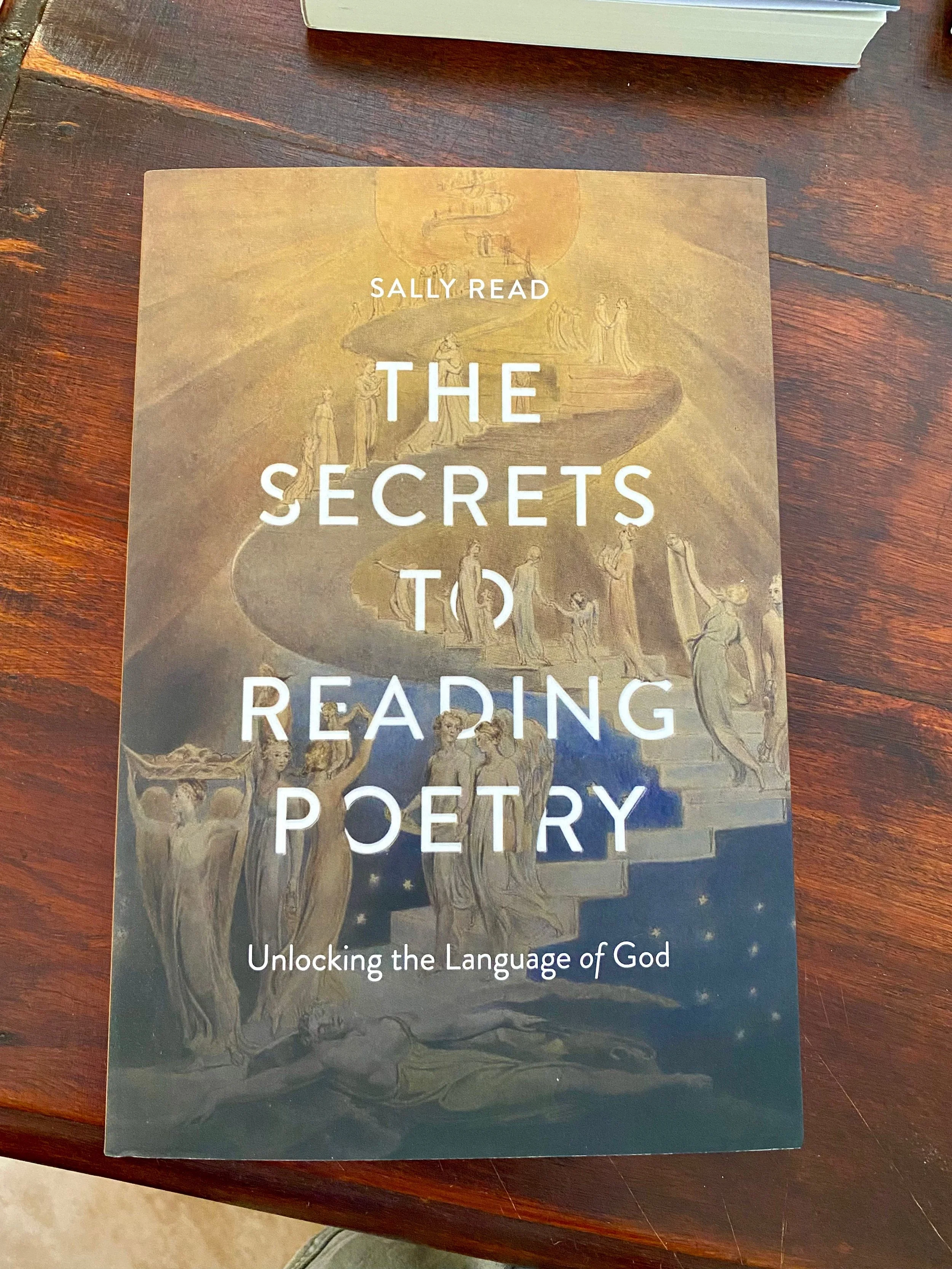
I lifted this image from Sally Read’s substack
The first time I read the poem “At the Fishhouses,” by Elizabeth Bishop, I felt a deep sense of companionship. Here was a poet who was able to express something directly out of my own soul that I had previously though inexpressible. I never knew the poet. I don’t even know very much about her. And yet, I feel like we have a connection, as if she sees me. This is what good poetry does; it tells a truth you always knew but could never figure out how to communicate. Not even to yourself.
Pondus Meum Amor Meus is a reader-supported publication. To receive new posts and support my work, consider becoming a free or paid subscriber.
In “Fishhouses”, Bishop describes water as, “Cold dark deep and absolutely clear...bearable to no mortal.” This is water so icy cold that, “If you should dip your hand in, / your wrist would ache immediately…” Your hand so chilled it would feel like fire, almost as if the elements themselves have unified against you so that cold and heat indistinguishable, and if you were to taste that water, “it would first taste bitter…” Then it would begin to burn on your tongue in another melding of elements, this time the unification of salt and heat. The elements are transmuted into a shared being that lurks somewhere under the physical surfaces. There’s a unity that underlies all of the different phenomena present to our senses. “It is like what we imagine knowledge to be,” writes Bishop, “dark, salt, clear, moving, utterly free, / drawn from the cold hard mouth / of the world…”
It is impossible for me to explain what these words and poetic images did to me when I first encountered them. All I can say is that the poem named some mystery that had been hidden within me, a yearning for “transmutation to fire,” that I have sought all my life.
I have chased these hints and glimpses to the door of the tabernacle, to the lowest rung of Jacob’s ladder, up mountain slopes, through my own writing career and priestly ministry at the altar and walks into autumnal Missouri forests. I have suffered nostalgia for a home I’ve not yet visited and sat in quiet desperation that the novel I so dearly loved has arrived to a final, blank page. I have simultaneously rejoiced and wept as my children have grown up and left home.
My imagination is a fever. I have participated in liturgies so long that time lost all meaning and the sound of chant and smell of incense carried eternity. Divine beauty is cold dark deep and absolutely clear. Unbearable if you dive in, the waters of baptism salted with flame. The person who gets wet is not the same person as before. The old has passed away, victim to the cold dark deep and absolutely clear. Burned away. Finally, the real self, known and loved, seen.
In her new book The Secrets to Reading Poetry, Sally Read begins by discussing the ways that poetry is a divine language that cuts to the heart. Through it, we are able to connect deeply with sacred knowledge. God is lurking in the depths and he made all this for us. He desires a relationship with us and the reality of his love is beyond words. The words of a poem (or the unfolding of any beauty) reach into the silence beyond them and communicate more than the words. This is the magic of poetry and why the poetic is the language of God.
Further, poetry is a way for us to look back, the veil by which we tip-toe right up to threshold of the Holy of Holies. It opens up our vision to see the world as if through the eyes of God. In this sense, reading poetry is a spiritual act. It places us on a journey.
It is all too easy to drift through life senseless and unseen, lonely and numb. Ironically, modernity has wandered into this deadening isolation precisely because modernity has sought to limit our vision in the name of being more realistic and avoiding the suffering of living in a symbolic cosmos charged with divine presence. Modernity reduces the world to a collection of physical objects, but those objects are dead. They reveal nothing. Reality has slipped away and only surfaces remain, disconnected and uncaring.
To be seen by God, to make empathetic connections with other persons, to yearn for beauty and search it out, this is the sort of activity that is marked by suffering. Suffering is a condition of love. It is a nostalgic arrow to the heart for a reality we cannot yet fully inhabit. Beauty calls us out of ourselves and makes demands. It’s a call well worth pursuing. The struggle is revelatory.
This is why Read organizes the third part of her book under the heading of “Slaying the Dragon.” Beauty isn’t a sentimental denial that dragons exist. Rather, it’s the bravery to look directly at the monster and start wrestling. The answer to the disconnecting isolation of modernity isn’t shying away from the fight, it is engaging in it fully. Poetic beauty is absolutely vital to recovering ourselves because only beauty is capable of pushing through the veil into the heart of reality. Heal the imagination and we’ll go a long way towards healing the cosmos.

To this end, Read walks us through a number of poems, teaching her readers as we examine them together what it feels like to be seen, to see, and how to follow the difficult call of beauty. Her treatment of “Fishhouses”, for instance, opened up new aspects of the writing that I’d never thought about before. I’ve loved the poem for a long time, but yet here I am, confronted by fresh insight. I love this, because it indicates the power of poetic language and the infinite ability of beauty to deepen our encounter with reality. I suspect that I’ll always be working through new insights from “Fishhouses” and I’m very pleased about this. I hope some day to be a very old man reading this poem and feel like my tongue has been set on fire and my wrists are numb and I can hardly breath because I’ve been plunged, yet again, into deep dark cold water.
I don’t want this book recommendation to drag on too long, so suffice it to say that I truly appreciate this book and I’ll be thinking through Sally Read’s poetic meditations for a long time. I’ll return to them again and again like a fisherman who cannot help but dip his hand into the baptismal depths, trying to touch the mystery even as it is flowing through my fingers.
This essay is cross-posted at my substack.