
Rome, Open City
During the Holy Triduum this past year, on Holy Saturday morning, I attended a special service common to the era of the church fathers. The inside of the church was pitch black, symbolizing the darkness of Christ’s death before the Easter resurrection. No lights. No candles. The stations of the cross, the altar, the tabernacle, and all images were covered in cloth. The service was brief. The priest, for about ten minutes, read from an ancient text, one from within the first two centuries after Christ. The author is unknown, but the text describes in great imaginative detail a pugnacious Christ’s descent into hell on Holy Saturday to defeat Satan and free the imprisoned holy ones, people like Adam, Eve, Abraham, Moses, etc. The lively reading entertained and awoke the ten-or-so parishioners present at 7 in the morning. But after the service ended, instead of thinking of Christ’s eventual victory, I wanted to think more about the disciples’ defeat. I sat in the dark church a little longer to meditate on the state of the disciples during the original holy Saturday, one that must not have seemed holy at all. In fact, it must have seemed as dark as the church I sat in that morning. The disciples had abandoned their master, watched him suffer excruciating torture, and fled for their own lives. Afterwards, they all must have hid in fear. If discovered by Roman authorities, they might be brutally executed themselves. They also must have suffered the bleakest despair. Their leader was gone. Their movement banished forever. Life was meaningless and absent any Providential care. I sat in the pew brooding on all these facts, and it reminded me of a movie that powerfully illustrates a despair similar to what the disciples must have felt the day before the resurrection.
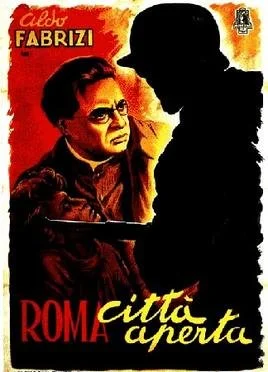
The film is titled Rome, Open City, and it is listed under the “values” category of the Vatican’s 45 important films.

The setting of the film is the city of Rome during its Nazi occupation. In fact, the director, Roberto Rosellini, shot the movie in the city of Rome only a few months after World War II ended. And not only did Rosellini live through the Nazi occupation of Rome, but the screenwriters, Sergio Amidei and a young Federico Fellini, did too. Perhaps their experience, as well as the shared experience between the rest of the crew, helps contribute to the realistic quality of the movie. Indeed, in certain shots, you can see bombed out buildings still crumbling from the impact of World War II.
In this realistic setting, the Nazis control the city and its citizens. They enforce strict curfews and march ominously through the streets. Fear for the Italians is common, but the story follows the subversive actions of three heroes: a pregnant woman about to be married, an exemplary Catholic priest, and an Italian Communist.
We see the subversive Italian Communist (Giorgio) first. In the opening scenes of the movie, he is pursued by the Nazis as Italian citizens try to hide him. Later he is seen scrambling to the top of an apartment’s roof before narrowly escaping arrest. During this scene and many after, notice that in order to portray the heightened sense of fear for all the citizens, the director, Roberto Rosellini, does something subtle from start to finish: doors are constantly being opened and closed. This occurs when Nazis search for the subversives, but it also occurs in scenes without a Nazi threat. People seem to be constantly bursting through doors, and as a viewer, you are always on alert: who will be coming through the door next, a hero or a villain?
And to create more anxiety and fear, Rosellini uses sound expertly in the film. For instance, when we first meet the key villain, an alpha-Nazi named Major Fritz, he is in his office listening to a fellow villain. Suddenly a moan of anguish, barely human, interrupts the conversation. Major Fritz, annoyed at the inconvenience, pushes a button at his desk. A Nazi soldier enters a side door and apologizes for the loud squeals of their latest torture victim. We don’t see the torture victim, but the sound of his anguish, and the sounds of other victims throughout the movie, haunts the soundtrack.
Besides these skillful moves from the director, the script is engaging and concise. If you are someone who abhors older movies and black-and-white movies, I suggest giving Rome, Open City a try. Each scene follows a traditional story arc, as does the story as a whole, which helps create engagement from start to finish. Of course, a traditional story arc is fine, but the details matter if the story is to be truly memorable. For me, two details in particular stand out in the script: its characterization and its unsentimental touches.
For example, another major character is a Femme Fatale: Marina. She is an actress who craves luxury to cope with her anxieties about the uncertain outcome of the Nazi occupation. In an early scene, we watch her alone in her dressing room applying makeup in front of a mirror. She seems to stare at herself uncertainly yet vainly. We also watch her drink opium from a vial, all of which makes the viewer suspicious of her motives. Everything about her, in fact, her expensive clothes, the expensive items in her possession, her speeches about the importance of acquiring things to escape childhood poverty, flush out her character and prepare the viewer for her tragic betrayal at the end of the film. And besides Marina, every character of the film fits his or her role perfectly.
I also appreciate the unsentimental touches throughout the story. One way the film avoids sentimentality is through contrast. For example, exemplary holiness is contrasted with superstitious religion. The film’s priest, Don Pietro, is a holy man and heroic in his efforts to aid the resistance. He is also a great priest. He listens thoughtfully and patiently to his parishioners. For instance, two times we witness people condescendingly tell the priest he couldn’t possibly understand their questionable decisions. Pina, a fellow resistance hero, tells the priest he won’t understand why she got pregnant out of wedlock—how could he possibly understand her intense feelings for this man she would soon marry? The priest also listens to a young boy tell him he couldn’t possibly understand why the boy and some other young boys are creating explosives to resist the Nazis. The priest listens to these people with patience and understanding before offering sound advice, but if all the Catholic actions in the movie were piously perfect, the film could quickly become false and sentimental. The screenwriters, aware of this, add small elements that contrast with the heroic priest’s actions. For instance, in a scene where hungry Italian citizens storm a bakery for bread, a thief and scoundrel, just before going to steal as much bread for himself as possible, stands in the foreground of the shot in a close up and superstitiously makes the sign of the cross, superstitious because he hopes it will somehow make him innocent of his thieving. The contrast between the heroic priest and the selfish thief, both Catholic, helps illustrate Don Pietro’s heroism and a famous truth about the Catholic Church: it’s a hospital for sinners, not a hotel for saints.
But let me get back, unfortunately, to the bleakness. Our heroes, Don Pietro, Giorgino, and Pina—played with brilliant motherly intensity by Anna Magnani—all suffer tragic defeat (I don’t want to spoil anything by being too specific). A brilliant scene at the end of the movie, however, can illustrate the movie’s power and tragedy.

Giorgio and Don Pietro (The priest) are captured by the Nazis. We know they will be tortured for information about the resistance efforts. Giorgio goes first, and again, we hear more than we see—though we do see a little bit of the suffering this time. Giorgio heroically never confesses. As his torture becomes more painful though, the priest is brought in to watch. As you witness this scene, notice carefully how under these extreme circumstances, the priest answers his evil interlocutors with sound Catholic teaching and often with the very words of Christ in the Gospels. Major Fritz, the cruelest Nazi in the film, can’t understand why the priest would help a communist and an atheist, and the priest’s response is not just correct to Catholic teaching, but it is also inspiring: how wonderful to watch on film a Christian man heroically accept his suffering without sacrificing his charity? Still, a contrast exists between our heroes and the indifference of their Nazi counterparts.
For example, the torture room is next to Major Fritz’s office, but in a brilliant set piece of the film, the door opposite the torture room opens to a lavish cocktail party with music and elegant food/drink. Fritz goes there sometimes for a drink to mingle with his fellow soldiers even as our priest and Giorgino suffer immense torture. I am reminded of a recent film, one I believe every movie lover should see at least once: The Zone of Interest. In that film, we watch a Nazi officer and his wife raise their family in a beautiful home that happens to be walled in. What is on the other side of the wall? The Auschwitz concentration camp the Nazi soldier is helping to run efficiently. Like Rome, Open City, disturbing human evil is evoked more by what the viewer hears and infers than by what is seen, but in both films, an almost apotheosis of human indifference to suffering is powerfully illustrated.
That brings me back, finally, to the bleakness and despair that seemingly ends Rome, Open City. Our heroes are defeated, and the Nazis appear to be the victors. So it seems, and so it must have seemed at times to the Italian citizens living under Nazi occupation, and so it must have seemed to the disciples the day before Christ’s resurrection, and so must it seem to many people today who live under the rule of what St. Paul calls the “powers and principalities” of this world. The movie understands despair well, and since it is a great movie, it does not resolve the problem with a simple and didactic ending. You, the viewer, must come to grips with the ending yourself.
Can I offer some advice? As you watch the last thirty minutes of the movie, pay close attention to the actions and words of the priest, Don Pietro. They might remind you of the actions and words of our Lord at the original Good Friday, a day when it seemed that the powers and principalities had won yet again.
But that was not, of course, the end of the story.
