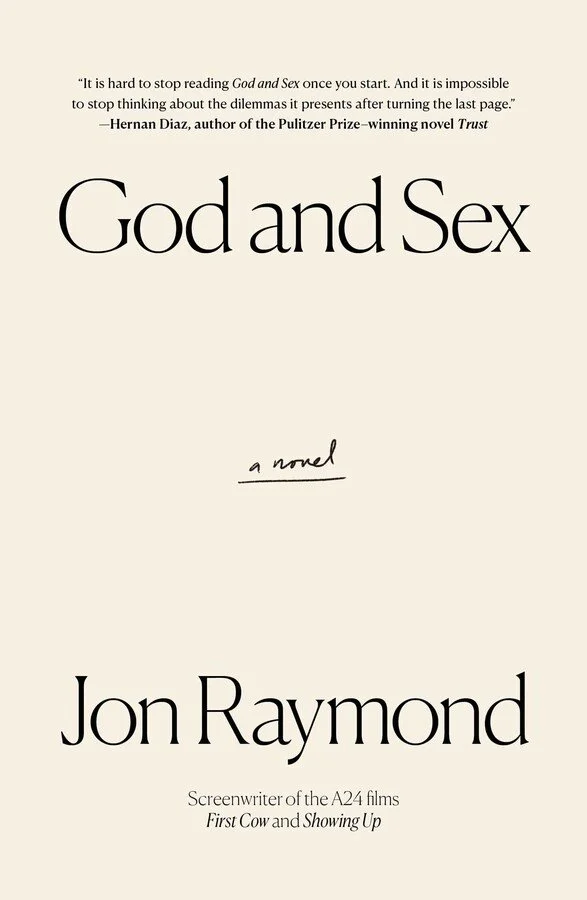
On Jon Raymond’s book God and Sex
Prayer almost never functions cleanly in contemporary fiction. Or rather: it functions too easily, in the wrong register. It becomes metaphor, therapy, irony, atmosphere—anything but an act that might matter beyond the mind of the person performing it. When characters pray in novels now, the reader is rarely invited to consider whether the prayer could be answered. We’re encouraged to read prayer as longing or trauma, not as petition—something spoken with the expectation, however tentative, of response.
Jon Raymond’s God and Sex occupies this uncomfortable territory with unusual seriousness. It is not a religious novel in any conventional sense. It does not explain belief, defend it, or resolve it. What it does—quietly, insistently—is allow prayer to remain something other than symbol.
Arthur, the novel’s narrator, is an unlikely vehicle for such questions. He is “paunchy, balding, papery”—an uncelebrated writer whose last meandering book was a compendium of theories about light through the ages. It did not do well. Now he is trying to write a book about trees.
While researching, he befriends Phil, a professor. He spots Phil’s wife Sarah waiting outside in a raincoat. “That’s the moment I first encountered Phil’s wife,” he recalls. From there, the novel plunges into their affair—grassy fields, empty classrooms, Sarah’s living room floor. The book carries the heat of illicit infatuation without becoming bawdy. Arthur, Sarah, and poor oblivious Phil have the grit and foibles of real people fumbling through it together.
The affair is rendered without the usual explanatory net. Raymond does not frame desire as symptom, coping mechanism, or expression of power. It is treated as fact—irreducible, destabilizing, morally charged. Characters act from desire without the narrative stepping in to translate those actions into therapeutic terms. There is no scaffolding erected to make us feel in command of what we’re witnessing. Sex retains its opacity, its capacity to reveal without clarifying. The novel never flatters the affair as liberation; it lets its costs accumulate quietly. It exposes the self not merely to another person but to consequence.
Then Sarah leaves for a retreat on Mount Hood. A forest fire breaks out.
Raymond, who has written climate fiction before, renders the disaster with harrowing precision: the sounds trees make as they’re consumed, the sting of acrid smoke, flames that “blurred between orange and yellow and blue, bending into delicate new forms with every riffle of wind.” When Arthur cannot reach Sarah, he rushes into the inferno.
This is where the novel’s title earns itself.

At one point, Arthur’s mother tells him what a doctor said after treating her sister during a severe breakdown decades earlier. For women, the doctor observed, these episodes were “always about the body.” For men, “it was always about God”—a brush with transcendence. “God and sex,” the doctor added. “Those were the ways people communed with the divine. Or the way the mind broke.”
The line hangs over everything that follows. Arthur in the burning forest is not praying in any formal sense. But he is doing what prayer does: admitting that his desires exceed his agency, asking for intervention without leverage. The fire strips away performance. What remains is petition—tentative, desperate, spoken into smoke and heat with no guarantee of answer.
That choice is brave. To let petition stand as petition is to refuse the reader the usual exit ramps: irony, diagnosis, mere symbolism. Raymond permits the possibility of response without clarifying its source, its intention, or its justice.
The result is an ambiguity that feels earned rather than evasive. The novel does not claim that prayer “works.” It claims something more unsettling: that prayer places the one who prays in a position of moral exposure. To pray is to ask without control over the answer. What follows is not reassurance but consequence—and consequence, if it is to mean anything, must be lived with rather than interpreted into safety.
Raymond’s prose matches this posture. It is restrained to the point of austerity. Events unfold without overt moral framing. The reader is not told how to feel. Scenes end without closure. Dialogue carries weight without explanation. Form becomes a kind of moral discipline: a refusal to overstate, to rescue, to turn dread into a lesson.
This restraint places the burden of judgment where it belongs: with the reader. We are not asked to believe in Arthur’s prayer. We are asked to take seriously the fact that it was made—and to sit with what follows.
God and Sex will frustrate readers looking for clarity. It offers none. It will frustrate readers looking for transgression or affirmation. It offers neither. What it offers is risk: the risk of letting actions matter without knowing, in the modern way, exactly what they “mean.”
In a literary culture adept at describing longing but wary of petition, Raymond allows both sex and prayer to remain what they have always been: acts that expose us to judgment we cannot control. The novel does not tell us what to make of this exposure.
It simply refuses to deny it.