Notes from the children’s section of the library
When I was a child, my mother took me often to the Robert E. Smith Library in Lakeview, the part of New Orleans where I grew up. Like everything else in the neighborhood, the library was ruined in Hurricane Katrina and subsequently rebuilt, but the memory of the old place is to me the model of all libraries, with pale sunshine falling into the atrium, with long tables and deep chairs, with brown the prevailing color, and with an encompassing sense that knowledge is no neat thing to be brought cleanly to hand but rather a matter of long searching, of brushing off and dusting and indulging over long hot summer afternoons and winter nights chill with the humors of the river.
One day, as a boy of seven or so, I was browsing the science stacks, looking for books on paleontology. I was deep in the throes of the Marsh and Cope rivalry and eager to hear more. And as I looked, an old woman came up to me and said, kindly, I think, if a little officiously, that the children’s section was over there, indicating the way, like the Ghost of Christmas Yet To Come, with an outstretched hand.
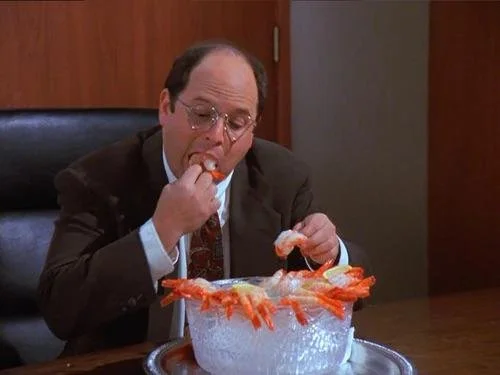
I do not think I said anything to her. I think I simply walked away. But in later hours of reflection, like George Costanza realizing too late the possible comebacks to his colleague’s jibe that “the ocean called; they’re running out of shrimp,” I would think of what I should have said to her. “Ma’am, I’m a very advanced reader.” “Gee, thanks, the granny section’s over there.” (I would never, of course, say such a thing, and I would never propose it now except by way of Seinfeldian foolishness.) Nor do I think that the woman meant anything other than to help a child find his way, but what struck me in the moment was that she seemed to think I was in the wrong place, that a child shouldn’t have been among the grown-up books, that I was too young.
In her recent essay “Teaching Greek to Children in a Dumbed-Down World,” at Hearth and Field, Dr. Nadya Williams explores the way that, as a culture, we tend to silo ourselves, and our children, into supposedly appropriate intellectual spheres. The expression “It’s all Greek to me,” she points out, suggests that there are a great many things, Greek among them, that I simply have no business knowing. (If the expression is from Shakespeare, it is likely not employed as such by most who use it, though indeed a whole ironic aesthetics of its usage could be developed in view of the fact that educated Romans of the time would indeed have been speaking Greek, including Julius Caesar, whose Shakespearean “Et tu, Brute” was more likely “Kai su teknon?”). Shakespeare aside, for the moment, most of us tend to adopt just such a fixed mindset—there are certain things we’re cut out for, whether intellectually, artistically, or spiritually, and to go beyond those limitations is neither advisable nor practicable.
The implications of such thinking can be especially bleak in the realm of education. For years, teachers have been asking themselves (I number among them) how to get students to read. The proposed solutions often involve things like dumbing down the selected texts or choosing excerpts rather than whole books, on the assumption that students today simply can’t read as we would like them to. They haven’t the attention. They haven’t the will. They haven’t the practice. So let’s send them to the children’s department.
To be clear, there are a great many wonderful things to be found in any good children’s department. I myself like few things more than to sit down with a glass of bourbon and a copy of Burt Dow or One Morning in Maine or Bread and Jam for Frances. My children delight in these books, even without the savor of Kentucky. But I have also found that such pleasures as dwell in these texts tend to whet the appetite for further and deeper ones. The loves I discovered in the children’s department as a young boy sent me on to the grownups’ department, and I have observed the same development in my own children.
By what follows, I do not wish to claim any kind of prodigy for my children, who range in age from nine down to one and who differ widely in tastes and aptitudes. (Growth mindset or not, people do have talents and penchants and tendencies, and education ought to be mindful of these and to prune and nurture them as needed.) But their capacity for good things is vastly higher than our culture would suppose it to be.
My eldest daughter was the first of our children to range beyond the children’s department. Several years ago, in a stroke of fortune which did everything to exacerbate my book lust, my school decided to give away all of the remaining copies of texts purchased for classes but never claimed by students. Gleefully, avariciously, I filled boxes with plays and novels and poetry collections and all manner of delicious, uncreased delights. Therese, then six, chose several of her own, including a few Folger Shakespeares. That evening, she took A Midsummer Night’s Dream to bed with her. An hour later she came out to say she was going to sleep. “How’s Shakespeare, baby?” I asked, assuming she’d flipped through the pages and then turned to some other amusement. “It’s good,” she said. “Titania just got there.”
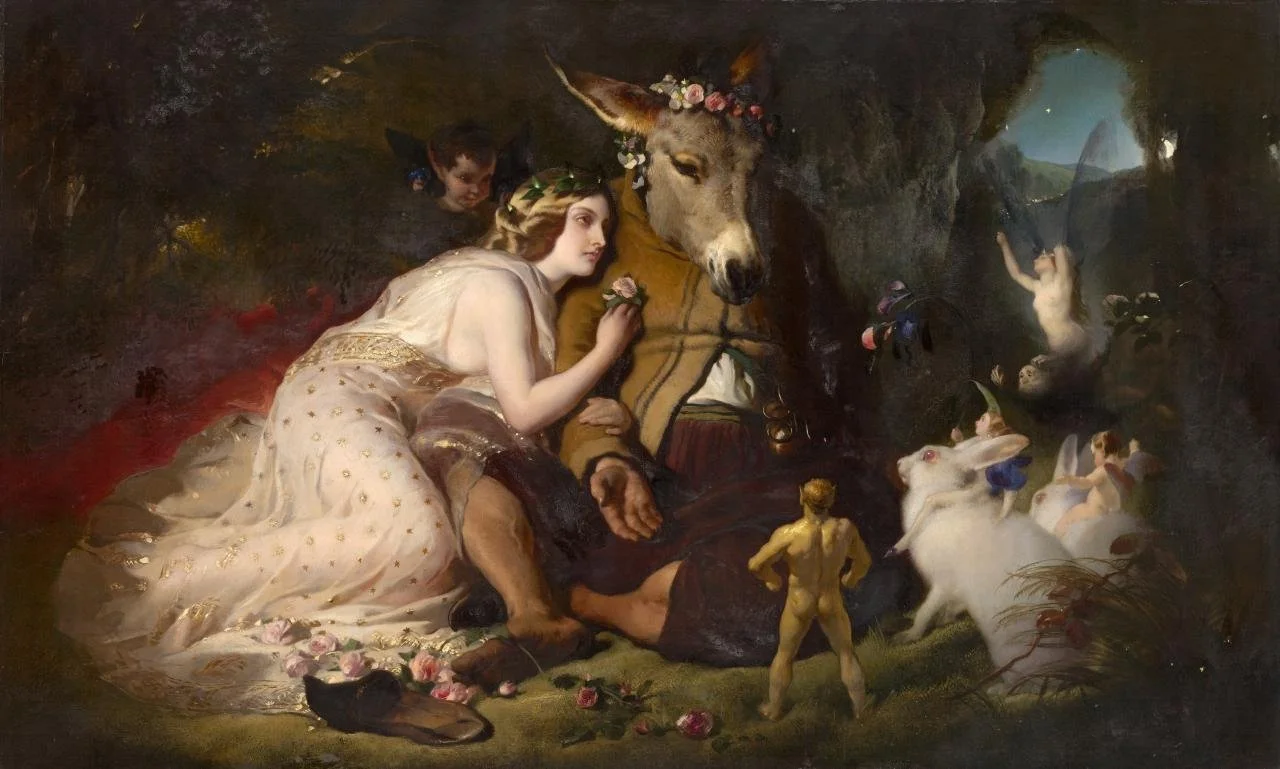
Edwin Landseer’s depiction of Titania
Again, none of my children have demonstrated any extraordinary genius. But I have found that all of them are capable of enjoying–and absorbing–a great deal of material that the world would say is not for them. Therese is a very gifted reader, but as a family we’ve all shared the experience of watching and delighting in movie versions of Shakespeare plays. Ken Branagh’s Much Ado, and Conrad’s “You are an ass!” are a favorite film and line. At our weekly family movie night, we’ve certainly seen Cars and Encanto and Coco, but the kids also enjoy the Marx brothers and the Thin Man series and Some Like It Hot. My six-year-old son regularly requests Audrey Hepburn’s How To Steal a Million. People assume such things, things that are old, things played out in black and white, would bore them. And they might, if anyone had told them old movies (by which many of my students mean anything made before 2000) are boring.
My wife’s father would put his five children to bed by reading to them every night. Particularly sleepless children induced him to take up the Federalist Papers. And while I have known him to read a stirring Caps for Sale or ‘Twas the Night Before Christmas, the bedtime reading that has loomed largest in my wife’s mind has been that of the Iliad or, most of all, Moby-Dick, which she heard for the first time at the age of five. It was in a class that included Melville’s masterpiece that my wife and I would later, during our undergraduate years at the University of Dallas, become especially matey, and it is along such lines that I most profoundly thank my father-in-law. But it was also with his example in my mind that we made my attendance at a Melville seminar in New Bedford, MA, in the summer of 2024 a family affair, bringing the four children, including the newborn, on a 27-day road trip across 15 states in quest of the white whale—i.e. being or nothingness or the essence of becoming, according to your favorite Ahabian discourse.
To such endeavors, people say things like, Wow, you’re brave, while their eyes say things like, Are you insane? The answer, of course, is yes. It takes a certain derangement to carry a two year old down into the blubber room of the world’s last floating traditional whaling ship or to saddle up the family for a six-hour round trip to the berkshires for a thirty-second glimpse of the view from Melville’s writing desk. Such endeavors are not without their desperate moments. But their issue, more often than not, is joy in a shared memory which goes deeper than an experience of the present moment but plunges into the shared story of a people, a nation, a whole tradition reaching back toward the origin of all words in the Word himself. We gazed off the beaches of Provincetown, we stood on the old North Bridge in Concord, and we walked the streets of Cambridge and gazed on Jefferson’s Monticello and felt again the story at the heart of America.
In our own evening reading, my children and I have read The Chronicles of Narnia and The Hobbit and The Wind in the Willows. We have just read Sir Gawain and the Green Knight even as we course through Lord of the Rings, wherein we find ourselves now in Meduseld, before Theoden king and Wormtongue. Therese never wants to stop. Not, of course, that she or her siblings understand all that transpires every evening. Indeed, the younger ones have usually fallen asleep by the time I leave off. But it gladdens me to watch them at their play in the morning, to hear them choosing the roles of Gandalf and Aragorn and Arwen as they set about shaping their own small daily festival.

Still scene from The Lion, the Witch, and the Wardrobe
Here, with millennia of tradition at our backs, it is tempting to say that we are all too little. Busy as we are, how can we hope to take up the tradition, much less pass it down to our children? We are too small in the scope of the ages, and we are tempted to say, with Jeremiah, “I am too young!” But as Aristotle saw, wisdom is not a matter of years but of rational action in accord with virtue, and so it belongs to us to follow not our passions or insecurities or the fashion of the time but to listen rather to the Lord who tells us not to say that we are too young. It is ours to follow where he calls and to take to heart his words, whether we find them in the children’s section or in the endless passages of beauty to which a child’s love of learning leads.