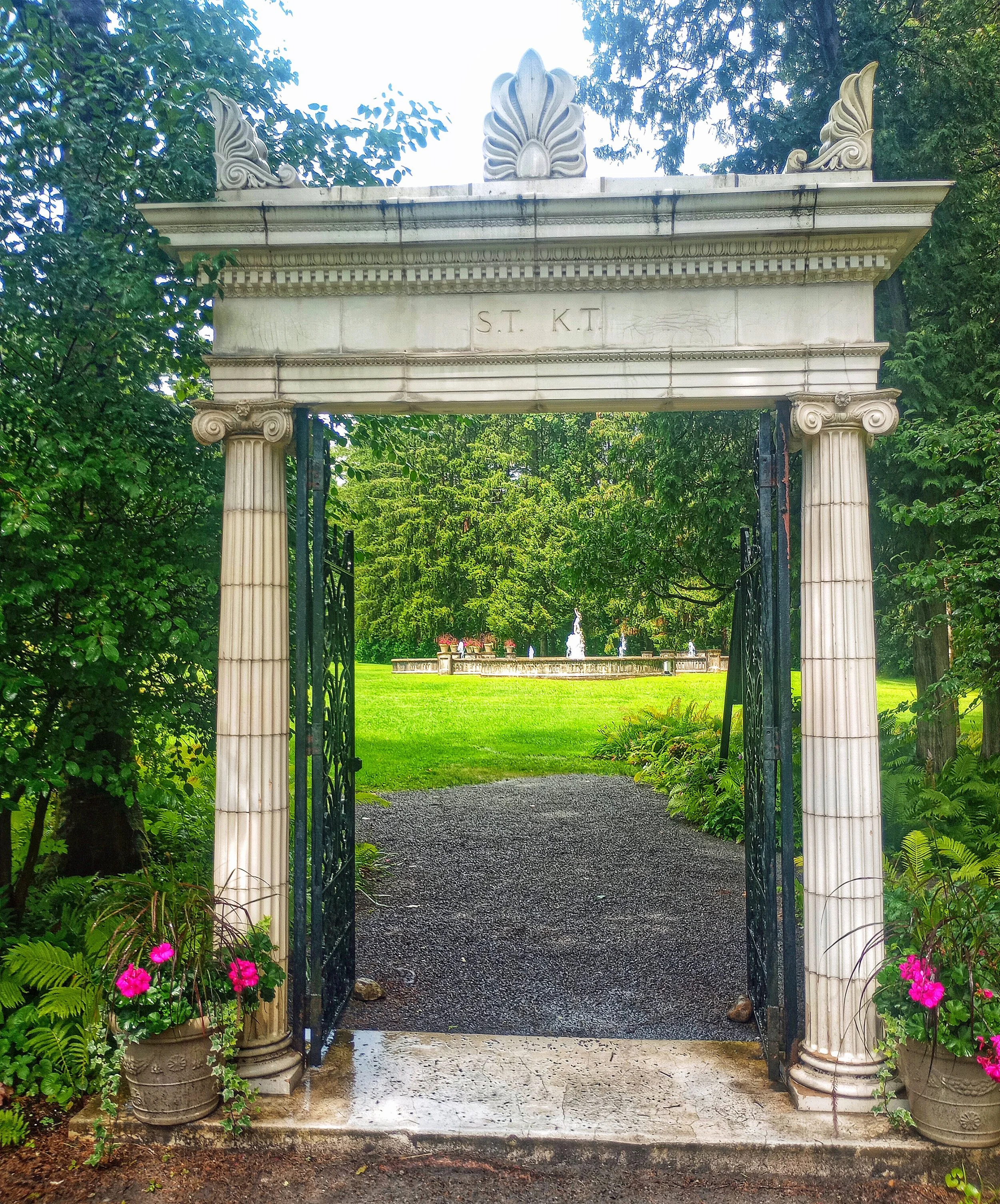
It is raining when I arrive at Yaddo for the beginning of my literary pilgrimage into the world of Flannery O’Connor in Saratoga Springs, New York. It’s here that O’Connor began writing her debut novel, Wise Blood, while living in the prestigious artists’ colony in 1949. Her stay quickly became a place where beauty and rumor, rose gardens and secrets seemed to grow together.
Saratoga Springs has a layered history. The Battle of Saratoga that ended the English hold on America in 1777 was fought and won here. It’s also the home of the famed Travers Stakes Horse Race, where even the most victorious mounts tremble at the starting gate. It seems O’Connor fought her own battle in this Adirondack Mountain area, grappling with alleged communist spies during her Yaddo stay.
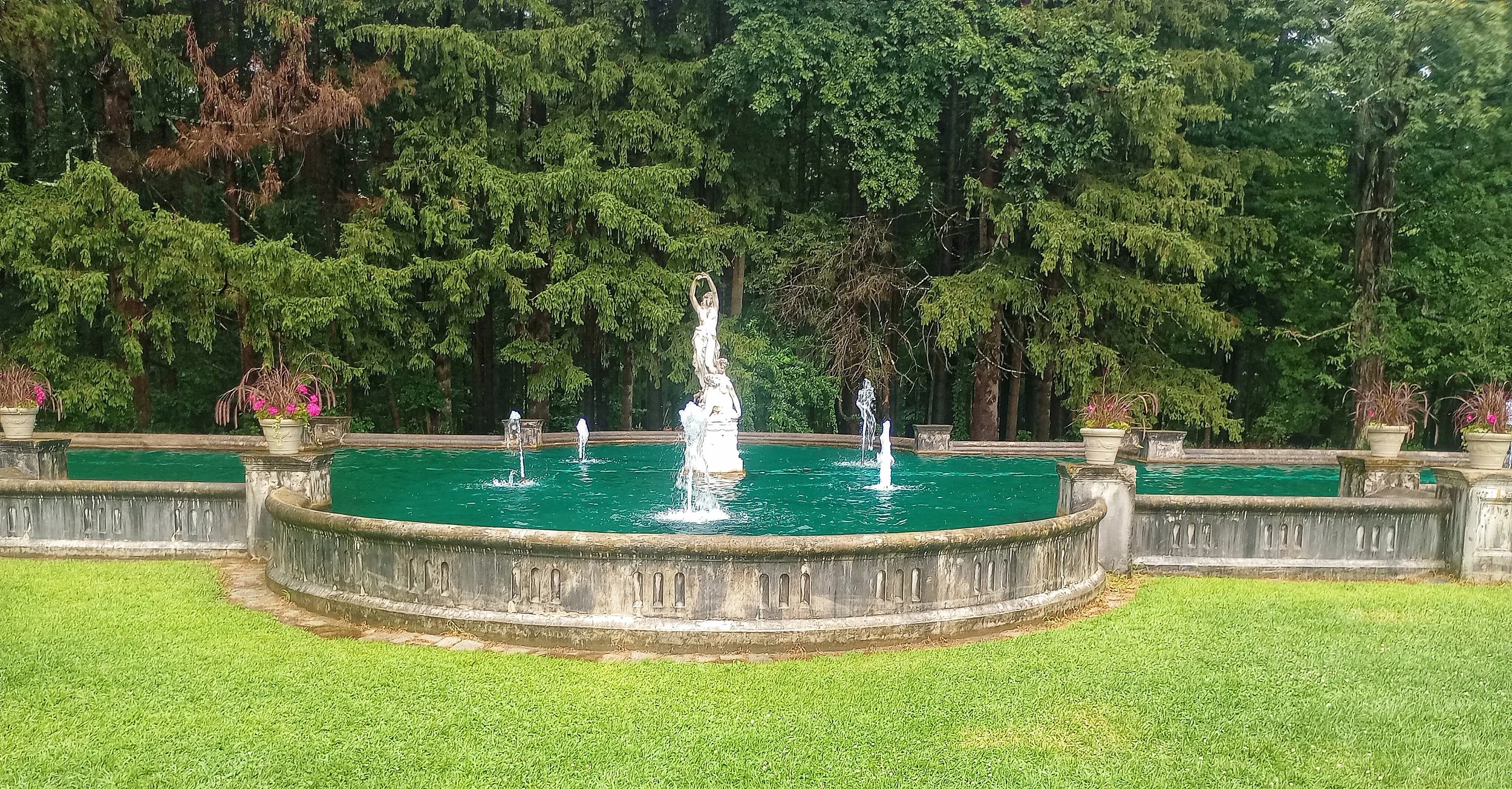
I huddle under my umbrella as rain droplets mingle in a pristine fountain that greets you on a wide expanse of manicured lawn. Beyond it is the grand manor house—a 29,000 square-foot mansion modeled after a medieval English estate. Its heft is balanced by 400 acres of grounds. It’s here that O’Connor had to look out at these same drenched gardens that I am walking toward.
As I step through the iron gate the rose’s leaves glisten like wet emeralds, and the day is becoming humid. I expect to see a poet writing under the trellis. The grounds are open to the public, though the residence is closed – a boundary between curiosity and artistic privacy. I marvel at O’Connor writing the often called ‘grotesque novel,” of Wise Blood among such allurements. The roses, the marble statues, the fountains are all gestures toward beauty that stand in stark contrast to the dark humor and violence of Wise Blood, which John Huston made into a film by the same name fifteen years after O’Connor’s death.
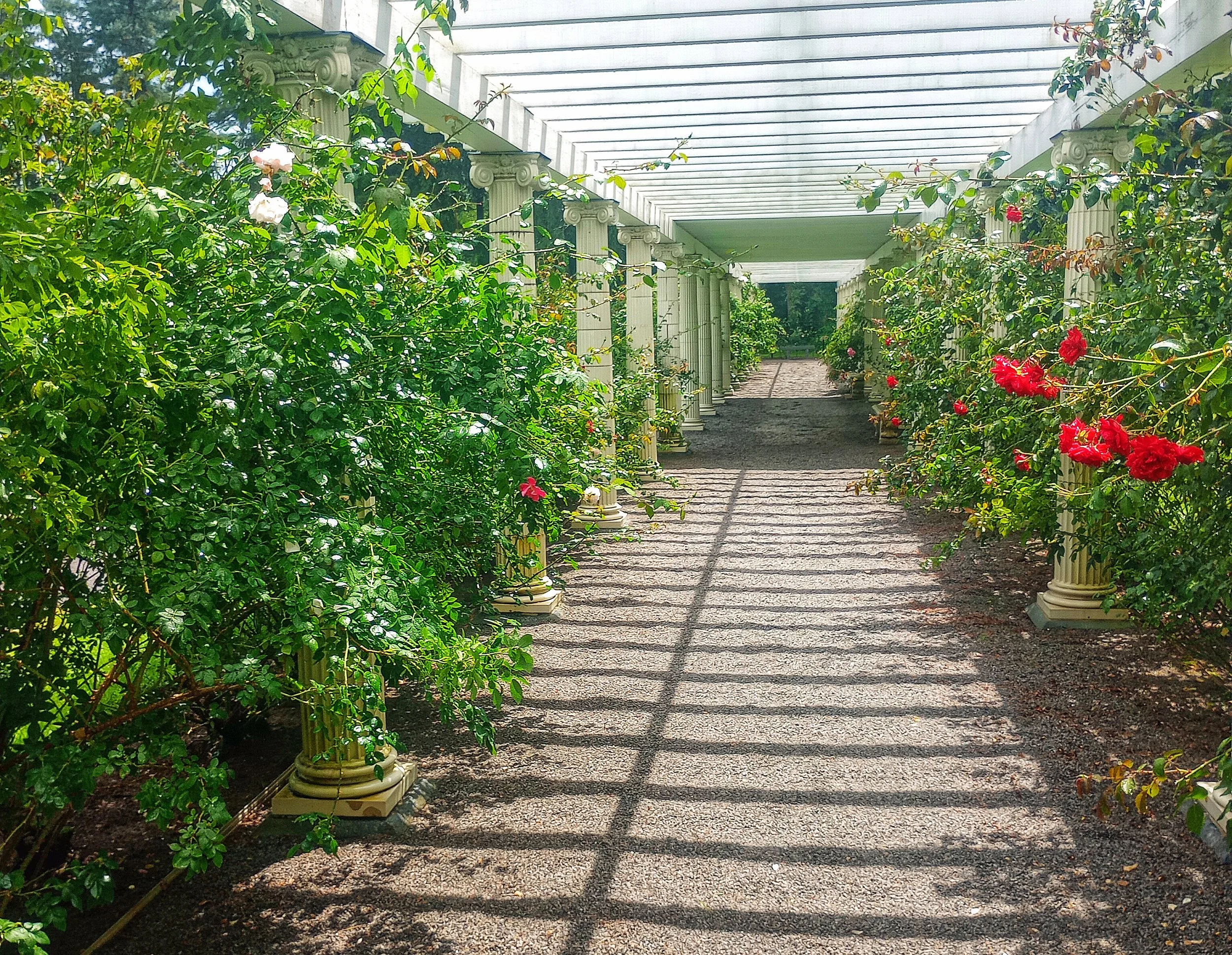
I have also visited O’Connor’s childhood home in Savannah, Georgia, next to the soaring Catholic cathedral whose bells must have marked her earliest sense of grace and beauty. This visit to Yaddo expands my geography of her faith and Catholic imagination as we marked her hundredth birthday this year. Yaddo holds keys to O’Connor’s sensibilities and her historic writing timeline. In the charm of Yaddo, O’Connor began to nurture her novel about the itinerant street preacher, Hazel Motes, who blinds himself. In the book, he is called Haze for short --before he uses lye to put out his eyes – a sublime premonition of how he sees the world. O'Connor might have stared at these beautiful roses, but she gave her character Motes the edge of thorns and used him to illustrate a philosophy of turning beauty into shallowness with his Church of no Christ.
O’Connor was a master of paradox – grace blooming through ruin. She readily admitted it.
“In my stories,” she confessed in On Her Own Work, “a reader will find that the devil accomplishes a good deal of groundwork that seems to be necessary before grace is effective.” At Yaddo, she began to perfect this. I wonder as I walk the paths of Yaddo if O’Connor thought of the Virgin Mary – the woman crowned with roses, for whom the faithful string their prayers like petals at her feet. The rosary is considered a garland of roses. Did O’Connor look upon these rose beds and imagine the grotesque inversion of that image – Sabbath Lily Hawks cradling a shrunken mummy like a child, the blanket draped over its head like the Virgin’s veil in Wise Blood? Her fiction, so rooted in Catholic vision, is never dull. It ravishes you as it stings you. It takes you into realms that you’d rather stay away from, but ones that end up proclaiming salvation at its end.
As I look up at the massive Yaddo residence, it strikes me that roses were not the only thorn bearers in her time here. While O'Connor was writing about Hazel Motes trying to erase Jesus in a typical American town, communism was trying to do the same in the world. It was two years after World War II, and the Cold War had just begun with America’s escalating tensions with Russia and fears of nuclear destruction.
A New York Times article dated February 11, 1949, accused long-time Yaddo resident, Agnes Smedley of being a communist spy. The director of Yaddo, Elizabeth Ames, was under investigation by the FBI wondering if Yaddo had been used to hide Smedley’s political agenda. O’Connor found herself in the midst of scandal, alongside Robert Lowell, Edward Maisel, and Elizabeth Hardwick—who would later marry Lowell.
Lowell’s influence was formidable; he had won the Pulitzer Prize for Poetry in 1947 and would win it again decades later. He was O’Connor’s mentor and friend, his letters to her spanning the years until her death. When he raised suspicions about Yaddo’s leadership the world and the press were listening.
After two hearings conducted by the Yaddo board Ames was found innocent of any wrongdoing. However, O'Connor and Lowell left Yaddo. Leaving the beauty of Yaddo must have been a sorrow. As I wander through the gardens, I picture O’Connor musing at the sundial pondering her time here before heading to the fountains to dip her fingers into the water as she thought about the strange relationship between grace and grotesque. At Yaddo, she found herself inside one of her own parables of the coexistence of holiness and scandal.

She would continue to write Wise Blood elsewhere – first on a friend’s Connecticut farm, and later at her family home, Andalusia, in Milledgeville, Georgia, where peacocks would replace roses as her muses. Like Hazel Motes, who says on the train, “You might as well go one place as another,” O’Connor, moved toward an inevitable end. Her stories, and life, show us that we are all travelers on a road lined with choices to seek grace or destruction.
At Yaddo, the rain stops. It is time to go. As I walk away, I think of the destinations that O’Connor mapped for her readers: places of sorrow, grotesque revelation, and the hidden heart of God that cradles us all as we work out our salvation in ‘fear and trembling.” (Philippians 2:12).