Mr Blue, the Holy Fool
All citations from the novel, Mr. Blue, are from the Cluny Media, 2016, version originally published in 1928
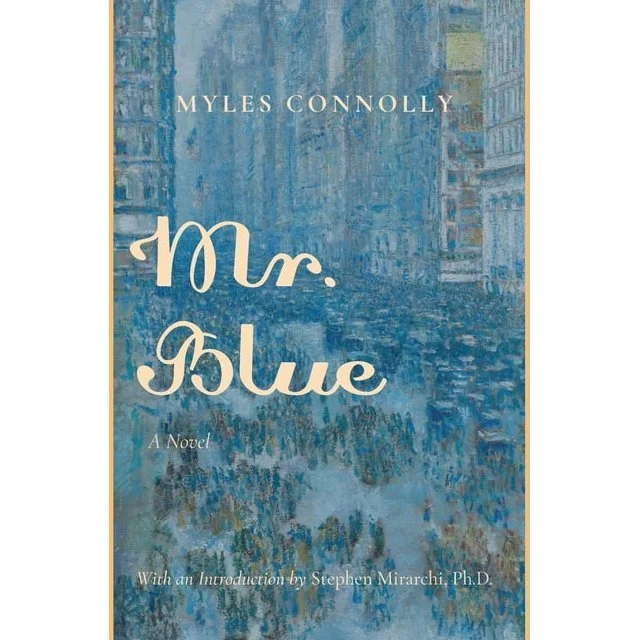
Love is the foolishness of man and the wit of God - Victor Hugo, Les Miserables, book V, chapter 4
“I am looking for a man of virtue!” This was the response of Diogenes when he was asked why he carried a lantern as he walked the streets of Athens. This should not necessarily strike you as odd behavior until you learn that he made a point of this exhibition during the day. Known in the history of philosophy as “the Cynic,” Diogenes is also famous for giving us an early example of the argumentum ad absurdum in response to Socrates' overly simplistic definition of “man.”
These two stories established Diogenes as a sort of pre-Christian “holy fool” figure for ability and willingness to act strangely in order to highlight inconsistencies or absurdities of conventional wisdom. If poetry and the humanities reflect society, then the holy fool holds up a funhouse mirror. He is distorted, but it is our distortion. We do not like how we look, but we must confront what is true about the image. They convict us.
There were prophets in the Old Testament who played the prophetic role of the holy fool as well. Isaiah walked “naked and barefoot for three years” to show God’s people the folly of their “boast” and “hope” in things other than God will leave them “dismayed and ashamed” (Isaiah 20:2-5). Jeremiah lived literally under a yoke to symbolize the coming oppression of the Babylonian exile, replacing the wooden for the iron to further symbolize Hannaniah’s intransigence (Jeremiah 27:2-28:13). Hosea lived out God’s faithfulness, and Israel’s unfaithfulness to God, by marrying a prostitute (Hosea 1:2). Ezekiel endured the posture of lying on his left side for 390 days straight, then on his right side for 40 days straight to symbolize the years of exile the Israel and Judah would endure because of their sin (Ezekiel 4:4-6). All of these extreme and provocative actions were meant to evoke a stronger reaction than even the most emotional and fiery preaching.
While we see the Scriptural roots of this important figure, and one can point to figures like St. Francis of Assisi or St. Joseph Benedict Labre in Western Christendom, the “holy fool” archetype has not taken hold of the Western imagination the same way it has in the East. One can speculate as to why this might be: perhaps the ancient Roman emphasis on order, the British rules of gentlemanly behavior, or the post-Enlightenment conquering of our “base” instincts. Regardless, one rarely finds a holy fool presented at all, much less presented with respectability.
Then Myles Connolly introduced us to Mr. Blue.
To say that J. Blue is a, “Unique figure,” the first words Connolly uses to describe him, is an understatement (3). So many statements given to us by Blue are downright Chestertonian in their paradox, except that they are not just aphorisms but lived out in the very character himself as Blue expresses a desire to be “the troubadour of the poorhouse” (5). The narrator, conflicted by this enigmatic figure, describes both “the folly of his haphazard life” (6) but then later admires Blue as having “the boyishness of the true mystic” (11).
Connolly seems to point readers to Blue as a fool as, “There were those who thought him crazy” (11), even having the narrator, Blue’s friend, say, “He had many of the marks of insanity” (14). However, this foolishness lacked no holiness as it “somehow gave you the impression that we were all crazy and he alone was sane” (14). Here is where the picture of Blue as a holy fool begins to take shape as it is precisely in this insanity that observers started to see the deeper confusion in themselves.
Harkening directly to St. Francis, Blue sees the unlikely inheritance of “millions” of dollars as “a trial set me by my Lady Poverty” (14). It was in his throwing away of this wealth, bespeaking madness to any self-respecting member of society and another act connecting Blue to St. Francis, that made Blue “so happy he’s almost crazy” as he was described (19). Not surprisingly, some “thought him mad” for this and “Others…maintain [Blue] was crazy” (19, 65). The narrator would admit, “It was madness, of course. But Blue made one believe almost anything was possible” (36). This is what the actions of the holy fool are supposed to inspire. This is why St. Francis continues to follow the mystical command of Christ he heard in that broken down chapel and “rebuild” the Church.

What inspired this behavior, and this outlook in Blue is the same thing that inspired the holy fools of the Bible and Christian history. As I’ve written elsewhere, enthusiasm, especially the enthusiasm of the pious is often, “so foolishly thought madness” (67). This enthusiasm is fueled by a special kind of faith that the narrator attributes to Blue, saying it “did not transform things: it made him see things” (67). When this faith shows you a world that few else can see, you notice things that strike many as “uncommon,” “strange” or “crazy” (43, 94, 118). When one’s version is enlightened by this faith, one’s heart is full with this enthusiasm and it overflows into one’s entire life. This is why, “Others can be sober and restrained, but not one who is made with the loveliness of life” (70).
Love, when it rises in intensity, becomes zeal according to St. Thomas Aquinas (ST I-II. Q 28. A 4). Blue’s zeal brought an abundance of life. The narrator described how, “There was never anyone more alive than Blue,” and this was because, “He was a stranger to almost all I hold sane (66). However, as the narrator also realized, this zeal, this enthusiasm, recognized a deeper facet of reality that the “sober and restrained” mind were not illuminated enough to see, which is why he followed by saying, he had “never known a saner man in all my life” (66). This is the paradox of sanctity recognized by few, desired by some, but captivating to all.
When G.K. Chesterton wrote that the world “can sometimes be more clearly and freshly seen if it is seen upside down,” it was in the writing of his biography on St. Francis of Assisi. Chesterton recognized that the holy fool, one such as St. Francis, had to imitate, really to incarnate, the absurdities of the world wholeheartedly in order to reveal them to us in a way we would recognize. Blue, who similarly embraced “Lady Poverty” like St. Francis, also showed a detachment to this world that scandalized the narrator. However, like St. Francis found companionship in those who were similarly detached, the outcasts, the lepers, animals, Blue found companionship in the sick, infirm and rejected in his final convalescence near the end of the novel. Other patients, nurses, visitors, found their way around him as he tried to show them a little of what he saw and share some of the life that was rapidly leaving him.
In nearly the final conversation between our narrator and Blue, they again discuss the apparent insanity of Blue’s decisions throughout the story that led him to this premature demise. It ends, fittingly, with Blue’s laughter and his final dismissal of the “old friend, Mr. Compromiser,” to which the narrator defends by renaming him “Your old friend, Reason,” or “At any rate, your old friend Sanity” (110). The narrator still does not quite see what Blue sees. It is not until it ends that our narrator is given a new faith. Like the Roman centurion of Matthew 27:54, who finally, “truly,” recognized Jesus as “the Son of God” in his death, so too does our narrator recognize in Blue for who he is when he declared that, “You can’t make me believe that Blue is dead” (125). Death was too normal, too conventional for someone who never fit into the box in which sin seeks to place humanity. The narrator finally knew that, like Christ, death could not contain Blue because it could not contain the love of Christ that had poured out of Blue his entire life. That is the sanity of the holy fool.