Liturgies of the wild
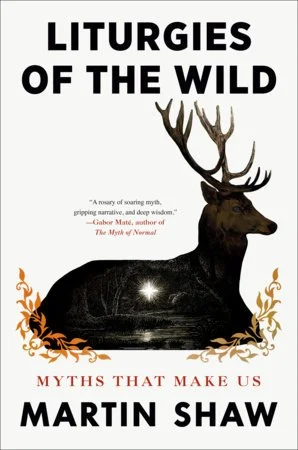
In the beginning of his new book Liturgies of the Wild, Martin Shaw recounts a dream in which he encountered a figure of light. Love emanated from the figure. The love was of such power that it was “devastating,” and he felt it encompass the entire range of his experiences, such that “everything I’d ever loved was in this holding…” The figure told him to watch the sun rise as often as he could. “Since then,” Shaw writes, “I’ve slept in a room facing east.”
It seems to me that dreams are often prophetic in this way. Mine are more often waking reverie that leave me in a condition I can only describe as reeling. Gaston Bachelard muses that reverie is a state that awakens the senses and searches out the underlying harmony. Poetic reverie attends to the polyphony of senses and, later, attempts to communicate the experience of glimpsing the shimmer of unitive love lingering beneath the surfaces. This poetic reality is precisely what Shaw is looking for when he explains the myths which, as he says, “make us.” We discover ourselves in the story, which serves as a sort of mirror doubling back a glorified reality.
Attempting to live directly in the reality would destroy us. We’re not ready for such glory. So we search it out in beauty, story, reverie. We participate via grace, and can only pray the grace itself won’t overwhelm, for even here grace demands a death-to-self. There’s a cost to looking at the reflection. The waters part and we plunge into the baptismal waters.
Dreams are signs that manifest apocalyptic expectation. God is revealed in the rising sun in the east, the Maker who will return in overwhelming force to wrench his Kingdom away from darkness and into eternal life. That same Maker is already, even now, holding us in his devastating embrace. Contact with the divine can only have one outcome for us – death. The question is, will we rise again?
The answer, such as it is, can only arrive in the darkness of faith.
To be human is to have questions. We’re in the uncomfortable position of asking questions that are far beyond our ken. For us, successful living isn’t mere survival, where we will next sleep or what we will eat. No, we want to know what divine chariot pulls the sun over the horizon every morning, why riches are unsatisfying, and what compels mankind to such heights and depths. I want to know how that song I turned up loud on the radio when I was driving home one night showed me eternity, why the road stretched before me into the darkness like a sacred path, where my melancholy spills over to when my nerves tremble and I flinch at the altar of my faith, and how time and memory compel me back to ritual repetitions, into that “extra” day of the medieval poets.
Because the knowledge of faith is darkness, the answer to our questions about what it means to live and die as a human and why our souls don’t seem to fit into this world can only be answered by delving into the darkness itself. Ritual is a kind of darkness, a way of sneaking up on the truth and, for those who are gifted and attentive storytellers, to recount the experience in slanted, poetic language. Myth, liturgy, art, these are truth-tellers. But don’t be fooled. These liturgies and their attendant dark truths are not tame. Not at all. In fact, Shaw insists, to really participate in them, we must be ready to open ourselves up to the wild.
Shaw tells the story of the first time he attended Divine Worship in an Orthodox church;
For two hours I enter a kind of Christian Dreaming that is so deep it is without beginning of end. Every ten minutes seems another door to another century. I am in a participation mystique...Most of what has happened I don’t understand, not intellectually. But my soul has set out on divine waters. Almost none of the modern tick lists for spirituality were supplied: no checking in with the attendees, no slide projector and uplifting gospel worship, no turning to your neighbor and saying hello. The Orthodox priest rarely seems to look much in our direction at all.
But something is happening. On the exterior what we witness is the repetition of very old words, swinging bowls of incense, the occasional kissing of an icon. But this is just the outside.
What he encounters in liturgy is a repetitive ritual that is ever-new. It speaks a language that exceeds human words to contain. The symbols are simultaneously not-enough and too-much because somewhere in the depth of the communication a connection is made. The Logos pours into his people. The repetition of the ritual creates stability for the story folded inside to take wing, like a rock (or an altar) that anchors a heavenly ladder. Without the liturgical stability of the symbols, the ascending grace would never arrive. Faith, a dark virtue by which we seek the hidden God, uses ritual as its primary language.
Ritual is a language that reflects its originator. It speaks as God speaks. This is why ritual operates at a level above human comprehension. To speak about and for an endless God, the symbols themselves must open up into into a space with no limit. The symbols are in a precarious position, saturated beyond limit. But, of course, to be comprehensible at all, they also very much must have that limit. Like an enclosed garden, the fragrance gathers strength by virtue of the boundaries. Thus, the paradox of poetic, or symbolic language. Shaw captures this magnificently when he describes driving home from participating in his first liturgy; “I drive through a red light on the way home, shouting and hooting drivers that I’ve been to church and have no idea what is happening!”
It we want to understand anything of what is happening in this life we are living, we must cease our attempts at understanding. At least, in the usual way. Shaw recommends (following Yeats) complete surrender to the uncontrollable mystery. The old stories and myths which seem so simple are actually revelations of mystery, and the simplicity is connected to the humility required to tell tales of such depth.
The correct response to uncertainty is mythmaking. Shaw notes; “It’s a way of navigating the mystery, pushing through the veil, situating our condition as travelers into a narrative. If we know that we are in a story, we can explore the origins of the story, what the ending might be, and so place ourselves, our past and future steps on the path, into perspective. Christianity is nothing if not...a true story breathed on us from the lips of the Logos, stirred up from the ancient formless deep, the prima materia. The story is of how we are rescued from ourselves. Our sinful condition reduces us to a quivering, depressive animal creature, wondering how we got here, why we do the things we do, and what is it that has gone haywire inside us (at least, this was always my experience). The story is about the restoration of the Good, the fluttering wing of beauty that lifts us from drowning waters and places us onto the path of mediating beauty, a beauty which is a direct participation in the Beauty himself, the dying Savior, the rising God, and how we spend our lives marching into and out of tombs.”
The story makes us magnificent, says Shaw. When we attend to it, we are compelled to take up the adventure. We follow Our Lord and it no longer matters if the trace leads through deep water or dark valley, no longer matters if it leads to and through the Cross. We follow. The Logos tells the Story and we join it.
We join it over and over again. We invite it into our memory where it pulses and aches. The story is the otherworld. It beckons at the threshold. The ritual isn’t vain repetition or lack of energy. It’s creative. Every time we circle back around, we’re higher up the mountain.
This is why we offer the Holy Sacrifice of the Mass over and over again. It’s a solemn dance that circles into a pattern. The repetition traces out the still point at the turning of the world. Not that we’re guaranteed anything. The liturgy remains wild. In the end, Shaw’s advice is to embrace the wildness. Participate in the story, and with humility and attentiveness wait to see what Ancient Goodness might arrive.
This essay is cross-posted from Father Rennier’s substack.