Life, death, and mushrooms
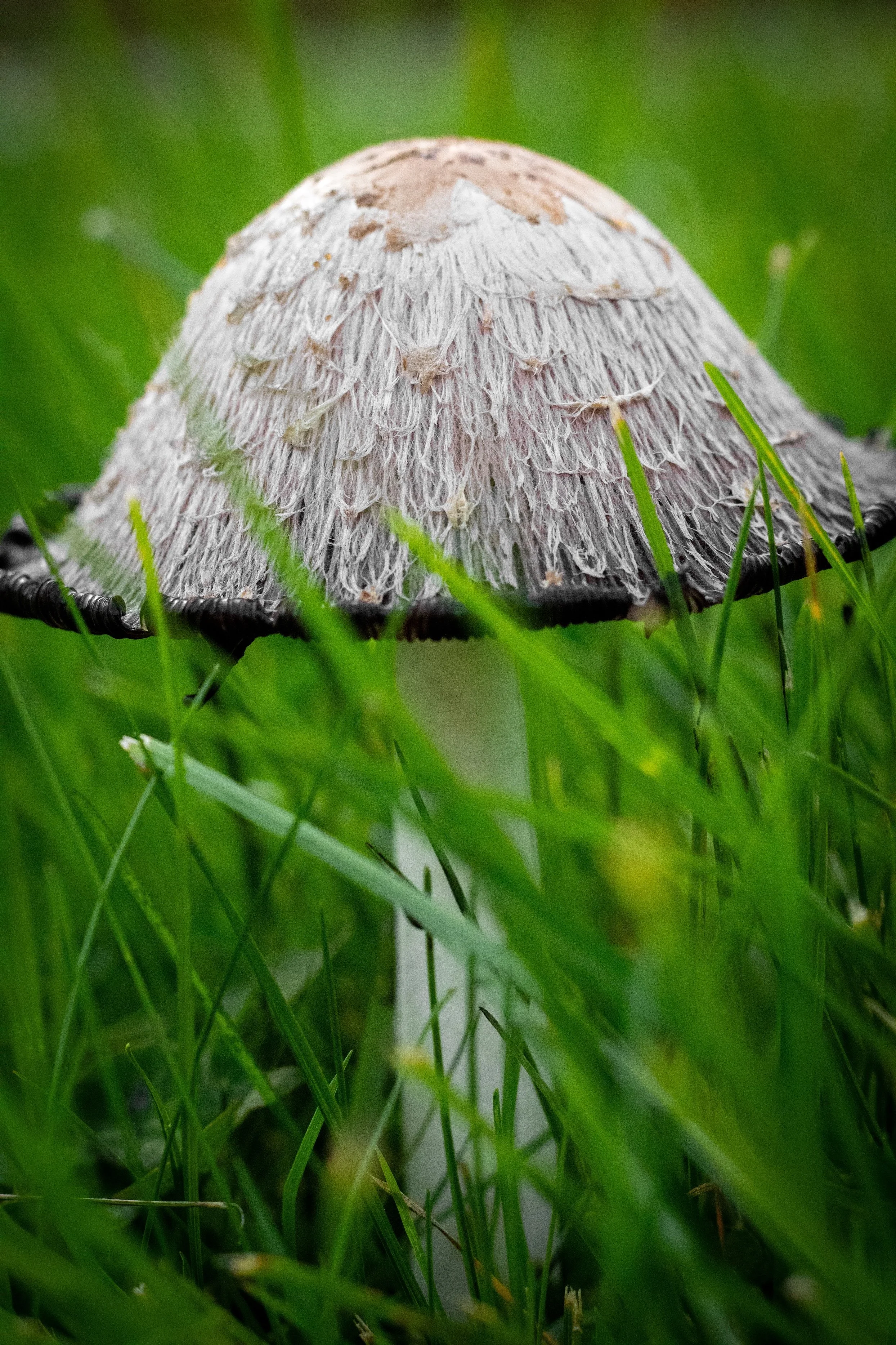
Shaggy Mane
There was a mushroom on my ice cream.
I had finished dinner with my family at East Side Mario’s — I had probably eaten chicken fingers because I liked the rowboat-shaped dish they were served in. The kids’ menu items came with a dessert, and I excitedly watched the waiter carry over an ice cream holder with three tiny cones of bubblegum-pastel coloured ice cream.
“What is that?”
There was a slimy grey… thing on top of one of the cones.
We picked it off and showed it to the waiter, who apologized. I wondered how a mushroom flew across the kitchen from the pizza preparation area to land on an ice cream cone of all places.
Mushrooms never entered my house because neither of my parents liked them, so it was years after the ice cream incident that I first remember intentionally eating a mushroom. I was in grade nine at my Christian high school. Our Bible study club was meeting at lunch in the music room, eating cafeteria pizza together. Curious, I took a lukewarm slice of either “Canadian” or “Vegetable” pizza with a mushroom on it. After eating the pizza, I decided I didn't like the jiggly, slippery texture of mushrooms, but I liked the earthy taste.

Mushrooms don’t fit the traditional classifications of flora and fauna—though, until the 1950s, they were classified as plants. We now know mushrooms are actually more closely related to animals.
The kingdom “fungi” includes mushrooms as well as organisms like moulds, mildews, and even yeasts — so even if someone doesn’t like eating mushrooms, they probably still like foods that are made with fungi if they’ve ever had bread or beer. All fungi start as spores which, when they find ideal environments, grow into strands called hyphae which eventually develop into a complex root-like mycelium network. What we know of as mushrooms are just the fruiting bodies of some species of fungi, only a small part of the entire organism often hidden underground.
What appears to be a few scattered clumps of mushrooms on a walk in the forest may in fact be one enormous fungi, connected by hidden mycelium weaving together the trees. One of the world’s largest living organisms is actually a mushroom — a beige-coloured, rather innocuous-looking honey mushroom (Armillaria ostoyae) in an Oregon forest covers 9 square kilometres and is estimated to be more than 2400 years old.
Things on this earth are more interconnected than we might think.
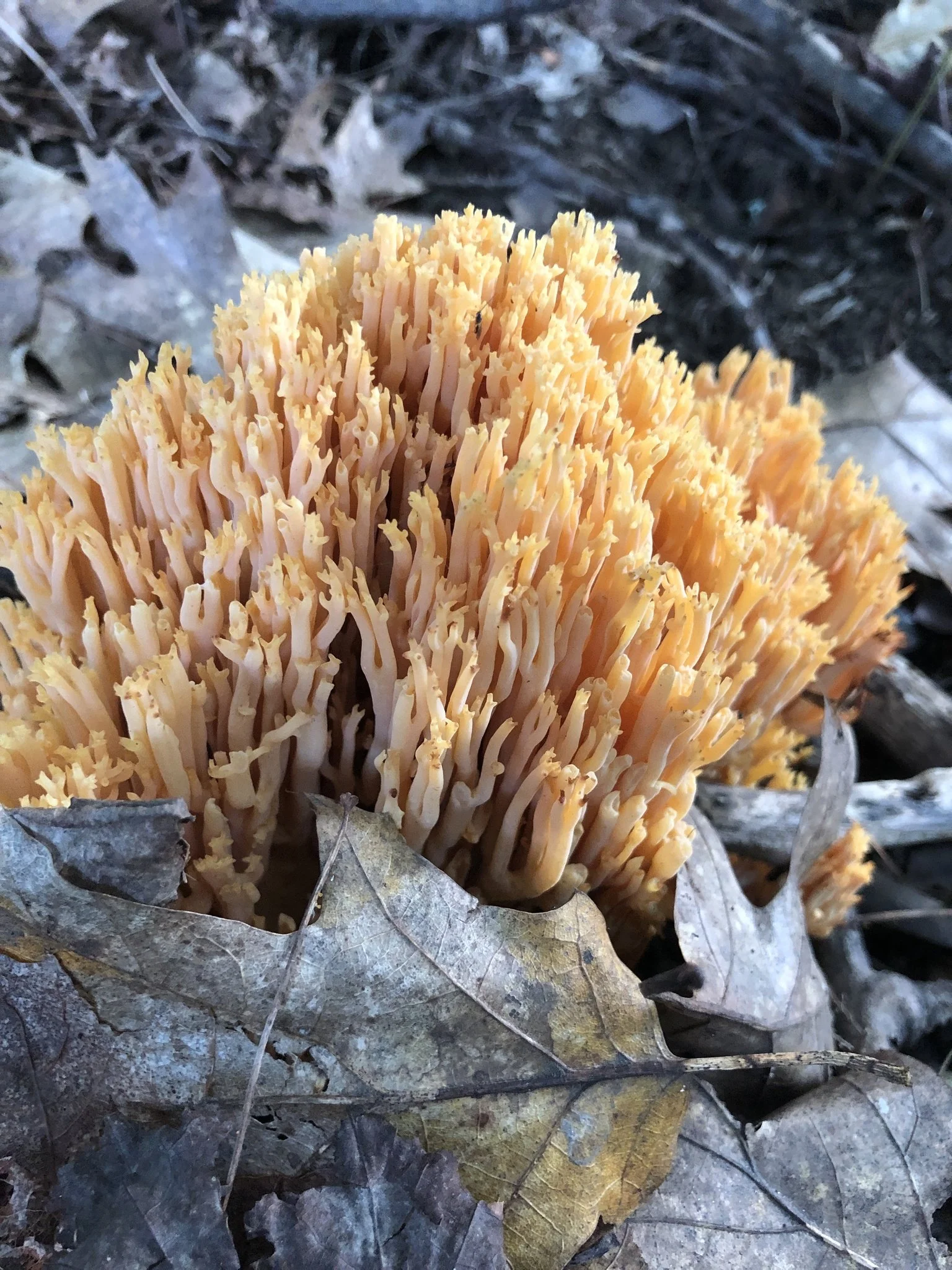
Coral Fungi
In early 2023 some nature-loving friends introduced me to the app iNaturalist, an online biodiversity program for documenting living things around the world. I was already extremely active on eBird, a similar program dedicated to birdwatching, and was curious to learn more about other nature in my area. Within days of creating an account, I was hopelessly hyperfixated for the next year, particularly on fungi. I submitted observations of colourful lichens on trees in my neighbourhood at home, of bracket fungi in the gardens at Redeemer University, and, most of all, of mushrooms I found during my summer working at Muskoka Bible Centre.
While others on staff that summer complained about having to walk down the often wet, mosquito-infested Widjiitiwin road to our weekly chapel, I felt a thrill of excitement on Friday evenings — it was time to look for mushrooms at the edge of the surrounding forest, from enormous boletes to vibrant amanitas to tiny red waxcaps.
I sat in the sound booth at Muskoka Bible Centre during my break — which happened to be in the middle of a pastor’s morning sermon. I checked my iNaturalist notifications and saw a new comment on an observation of a cauliflower-sized coral fungi I had found in the trailer park. Very few coral fungi in Eastern North America are classified to species level and my fungi could very well have been a mushroom undocumented to science. The iNaturalist user recommended submitting dried specimens for DNA sequencing at a lab.
My heart raced and I felt trapped in the clean, air-conditioned chapel. I wanted to run out into the forest in my crisp black uniform to refind the mushroom, but I had no way to dry mushrooms in my little dorm room, and I most certainly had no idea how to prepare a specimen. The iNaturalist comment faded into obscurity on my account. I still wonder what might have happened if I had been an expert—if I had gotten all the equipment I needed, sent the samples out, and received confirmation for discovering a new species. Would that fungi have been named after me, memorializing my family’s name in history?
Two wooden carvings top the shelf on my desk at home: one of a patch of fat-stemmed mushrooms surrounded by pinecones on a piece of bark, and the other of a sculpted tree stump with a cluster of mushrooms at its base and an axe-shaped pen on top.
A year ago, I was at my Baba’s house with my mom and saw these pieces hidden on the bottom shelf of a little table in her hall. They were covered with dust so thick that it made clumps like cotton.
I can’t remember whether I asked Baba directly or Mom spoke up when she noticed my eyes darting to the shadowed sculptures under the table.
Mom explained, “Abby’s really interested in mushrooms right now.”
As I was stealing glances, I had classified the bark mushrooms as a type of bolete mushroom. While the others on the stump were too vaguely mushroom-shaped to say for sure, they reminded me of the orange scalycaps I found growing off a tree in my first year of university.
I lifted the carvings into the light and Baba told me about them.
They were made by a family member, I think her brother, when they were living in Poland. Baba’s brother carved the two sculptures as gifts — for what or for whom, I don’t remember. I could see faint Ukrainian patterns on the handle of the axe pencil and chipped paint on the caps of the boletes. Seeing my fascination, Baba encouraged me to take the two sculptures since they were just collecting dust in her house.
I thanked her repeatedly and took them back to my dorm, where I spent a good amount of time cleaning them with various cloths and wipes.
I couldn’t get all the dust out of the crevices. They’re still collecting dust.
Dust that has been gathering for more than 70 years.
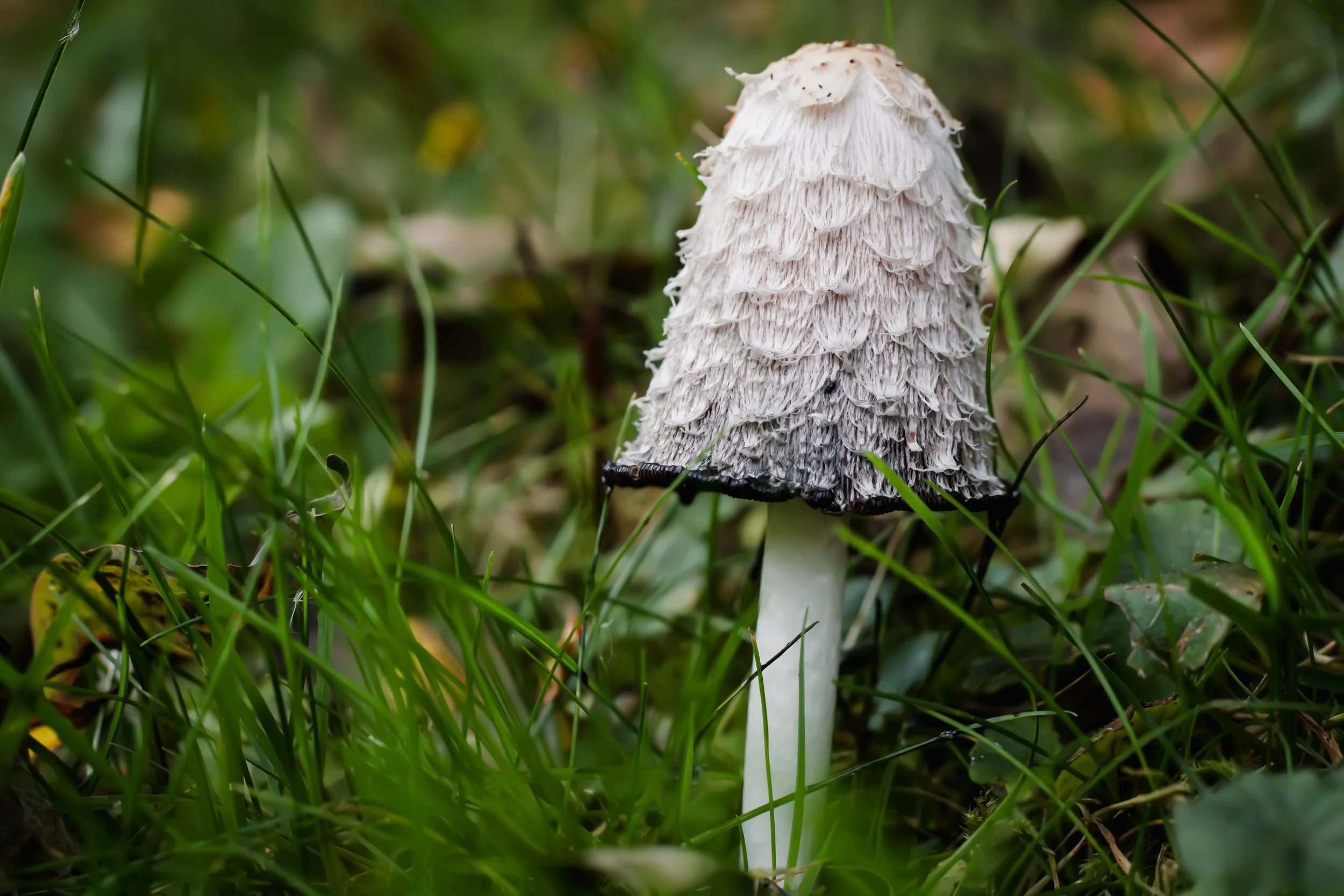
Shaggy Mane
Coprinus comatus, Shaggy mane, was the first species I could confidently identify and the first species I harvested. Suspended in a jar like an embalmed museum specimen, I photographed them for a still-life photography project. At the advice of a friend, I saved the caps of the mushrooms and they dissolved into a putrid black ink that stunk up my house even after I doused it in citrus essential oils. I dipped a brush into the fungi goo and painted simple landscapes of the university grounds where I found the mushrooms. The “ink” was clumpy and I had to put the paintings in the garage to dry while promising my family that I wouldn’t do something like that inside the house again. The little jar of mushroom ink is still hidden on a shelf in my garage at home a year later — I fear what it might smell like now — and the little paintings still hold the faint odour of orange and rot.
My high school biology teacher used to gush about the adorable bird’s nest fungi that sprung up in the garden beds behind our school, looking like a little fairy world. But no matter how many times I checked, I never saw them.
On a November morning, I was cutting through the Redeemer University parking lot on the way to class when I saw some light-coloured specks in the dyed mulch of a garden. I kneeled and gasped. Tiny mushrooms smaller than my pinky fingernail dotted the garden, and I knew what they were right away, despite having never seen them before. They were like tiny bowls filled with flattened oval eggs. Bird’s nests.
I have found even smaller mushrooms since, but I had to go looking for them. By turning over rotting logs in a forest near my house, I found one with a cap smaller than a millimetre in diameter.
I never did find the bird’s nest fungi when I was in high school. Now I realized that maybe I wasn’t looking hard enough.
In October this year, while on a morning walk around Redeemer University’s campus, I spotted on a tree a strange round fungus with an exterior like dried mud. I poked it and a black cloud puffed out. I gasped and texted my sister a picture.
What did we call these at Brantford Christian School? Smoke puffs?
Yes! Smoke puffs! In grade six, someone found one the size of a soccer ball and the archery winner got to shoot it with their arrows.
My memory flashed back to my years playing during recess in the forest behind my elementary school where I’d build forts with other students and collect what we called “smoke puffs,” squishing them to make smokelike dust puff out. I now know these as earthball fungi (genus Scleroderma).
Thinking back on those private Christian elementary school days, I don’t think any other school would have let us play with poisonous fungi, let alone teach us how to make bows and arrows and use the fungi as targets — my previous public school in Mississauga would punish us if we even picked up sticks.
Mycelium continues to connect my life in unexpected ways.
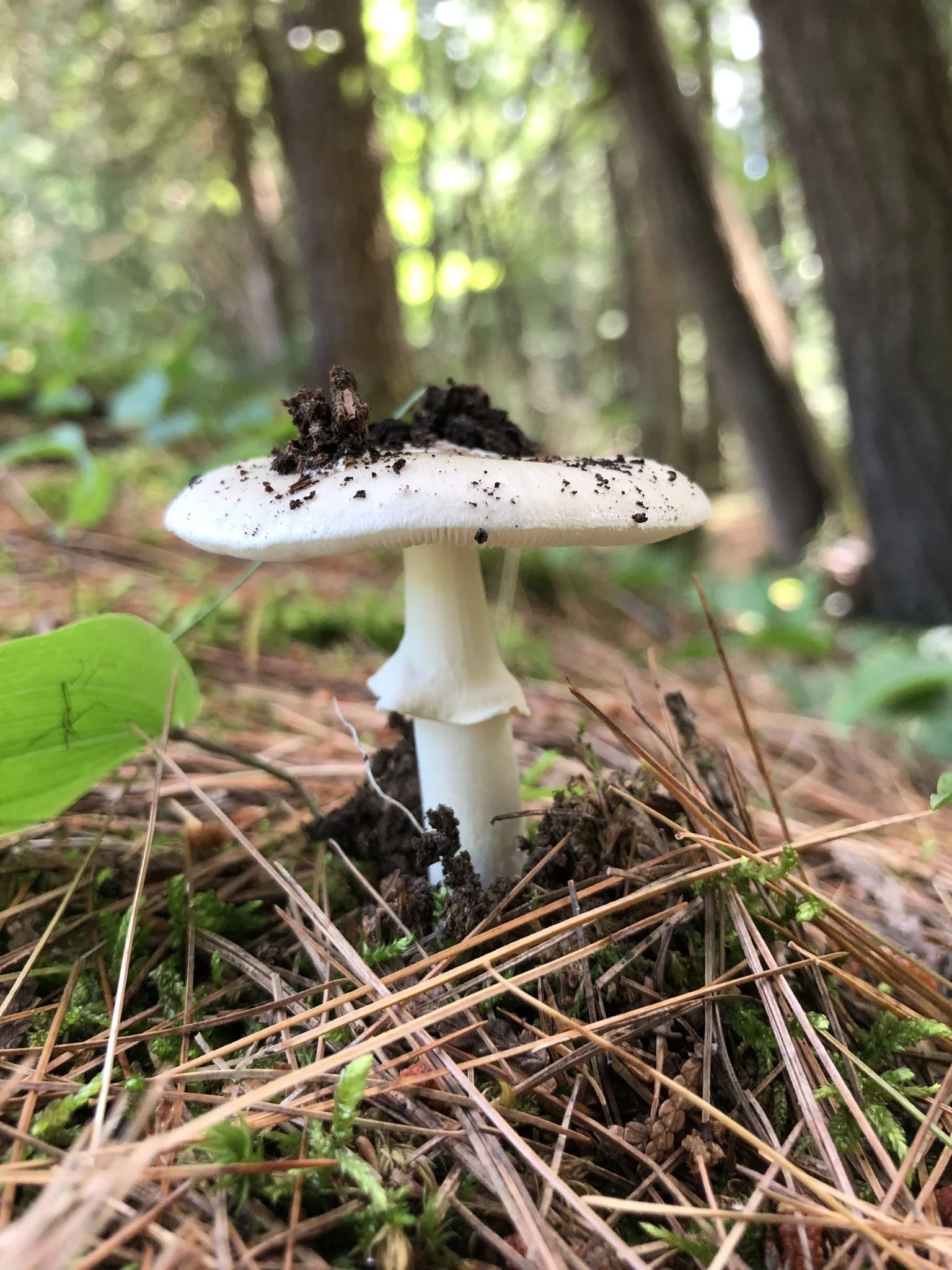
Amanita
On a hike at Wilson’s Falls in Bracebridge with coworkers from Muskoka Bible Centre this past summer, I stopped to take a few pictures of a white mushroom in a pine grove. Its cap was still topped with loose soil, and it had white gills and a little ring on its stalk. A foreboding thought lingered in the back of my mind, but I pushed it away and hurried to keep up with the group. When I got back to my dorm, I looked on iNaturalist and my suspicions about the mushroom were correct. It was part of the genus Amanita, which contains some of the world’s most famous and most dangerous mushrooms, including the hallucinogenic and poisonous Amanita muscaria (fly agaric), the white-spotted red mushroom of fairy tales. The mushroom I had spotted on the hike was likely Amanita bisporigera, the Eastern North American Destroying Angel, one of the deadliest mushrooms in the world. Eating one cap can kill a person. But these mushrooms, to the ordinary person, would look identical to the ones at the grocery store.
This past summer, I had a conversation with a hardcore young earth creationist about mushrooms. I agreed that there wasn't animal death before the fall—if God notices every sparrow that falls, I can’t imagine him ever calling the death of one of his animals “good.” But I thought there could have been plant death.
“We can’t eat a lot of plants without killing them,” I explained. “And mushrooms need dead things to live off of.”
He disagreed, it wasn’t a possibility because any kind of death is bad.
As much as nonreligious scientists try to say that death is part of life, it does feel wrong that things can’t last forever — that we lose the people we love to sickness. That pets who had comforted us through hard times die in freak accidents. I even felt sad when a favourite tree in a forest near my house, which had branches like dancing arms, fell down during a storm.
But if every plant was for our eating, then some plants die when we harvest them, like carrots or onions. And through the changing of seasons in countries like Canada, other plants die in the cold or wither in the heat.
Were there no seasons before the fall? Did we not make it long enough without sin to know the seasons would happen or find the plants that die when we harvested them? What if the fall into sin occurred in actual “fall,” the season of autumn as I know it where I live in Canada when leaves suddenly drop and mushrooms spring up? Did Adam and Eve suddenly see all of Eden mourning, leaves burning with colour and dying?
Mushrooms aren't mentioned at all in the Bible, but when mould and mildew are mentioned, they’re associated with uncleanliness, and yeast is often used as a way to symbolize sin and the spreading of corruption. Maybe that’s why Christians throughout history associated mushrooms with evil.
But yeast is also used as an illustration of the kingdom of God. A small amount of tiny single-celled fungi grows throughout the dough, filling the bread with life, which fills us with life. While some fungi are diseases that infect and kill, from mildews that drain life from crops to the “brain-controlling” Cordyceps fungi that zombifies ants in tropical forests, others clean up the mess of death, like fungi that revive the soil of forests ravaged by fires or mushrooms that break down plastic. Like the arteries of the environment, mycelium transports life into places ravaged by decay and brokenness, restoring the foundations of our earth.
If Jesus says that a seed must fall to the ground and die in order to grow, maybe there is good in some kinds of death — in the death that leads to life.
A bibliography for the curious
“A brief cultural history of the mushroom.” DW, October 17, 2022. https://www.dw.com/en/a-brief-cultural-history-of-the-mushroom/a 63461380#:~:text=The%20mushroom%20in%20the%20Middle,Witches%27%20Butter%20or%20Satan%27s%20bolete.
Alexopoulos, Constantine John, Vernon Ahmadjian, and David Moore. "Fungus." Encyclopedia
Britannica, October 7, 2024. https://www.britannica.com/science/fungus.
Banerjee, Neellohit. “Life From Death Are What Fungi Are All About.” Wildlife SOS,
November 8, 2022.https://wildlifesos.org/conservation-awarness/life-from-death-are-
what-fungi-are-all-about/.
“Coral Fungi (Genus Ramaria).” iNaturalist comment by @martinax, observation by Abby
Ciona, August 11, 2023, accessed October 24, 2024.
https://www.inaturalist.org/observations/177897872.
Delbert, Caroline. “You Should Know About This Chernobyl Fungus That Eats Radiation.”
Popular Mechanics, February 5, 2020.
https://www.popularmechanics.com/science/a30784690/chernobyl-fungus/
Greene, Trevor. “The Untapped Potential of the Amazon’s Plastic-Eating Mushroom.”
Earth.Org, September 7, 2022. https://earth.org/plastic-eating-mushroom-of-the-amazon
-and-ecuadors-development-dilemma/.
Johnston, Eddie. “What in earth? Understanding what fungi really are.” Kew Gardens, October
7, 2022. https://www.kew.org/read-and-watch/whats-a-fungi.
Navasiolava, Tanya. “Mushrooms are the darling of sustainability.” The Washington Post,
October 1, 2024. https://www.washingtonpost.com/business/interactive/2024/
mushroom-mycelium-sustainability-leather-shoes/.
Newell, Sarah. “Fungi for the Future.” BBC Earth, accessed October 23, 2024.
https://www.bbcearth.com/news/fungi-for-the-future.
Wilson, Andrew. “Like a Phoenix: Fungi That Arise from the Ashes of Forest Fires.” Denver
Botanic Gardens, March 10, 2021.
https://www.botanicgardens.org/blog/phoenix-fungi-arise-ashes-forest-fires.