Joan of Arc and the Meaning of Life
For the Austrian psychologist and Holocaust survivor, Viktor Frankl, finding the “meaning of life” was something specific to each person, not something general or abstract. Yet, young adults today have become so alienated from themselves and their communities, and so out of practice at listening that they find it incredibly difficult to discover what they are made to do.
Numerous headlines in recent years, such as those from Psychology Today, Harvard’s School of Education, and the Pew Research Center, have reported that “today’s young adults doubt their own character, struggle with finding a sense of purpose, and hunger for meaningful, high-quality relationships” and that “over half of young adults (58%) said they had experienced little or no purpose or meaning in their lives.”
But at age nineteen, in the year 1431, a young woman knew so keenly what her purpose was and what she was meant to do with her life that she was willing to die for it. And she did –by burning at the stake.
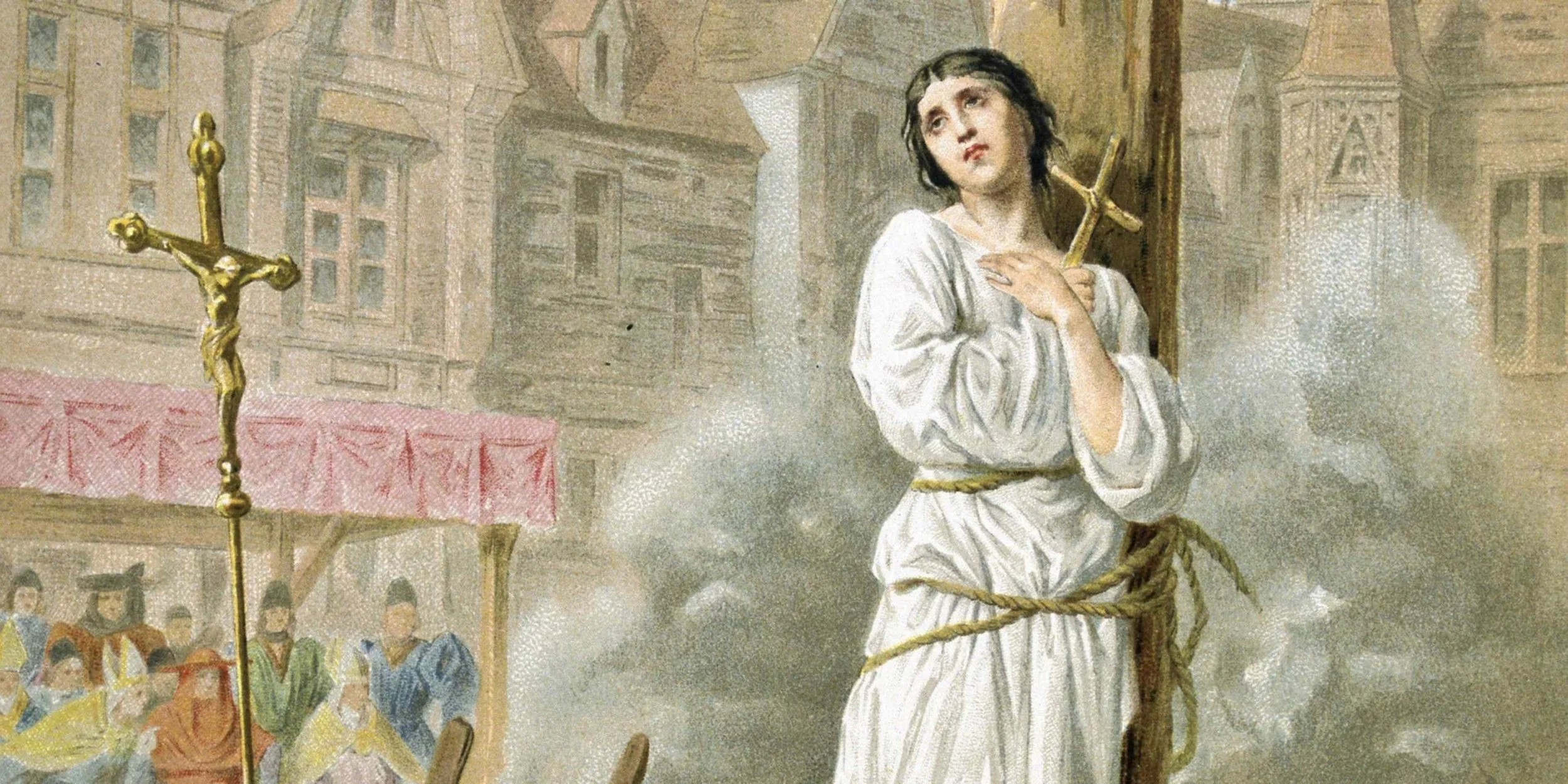
The story of Joan of Arc has always held a special fascination for writers, among them Voltaire, Mark Twain, Friedrich Schiller, and George Bernard Shaw. There are several film adaptations of her life, including the Hollywood epic “Joan of Arc,” (1948) starring Ingrid Bergman. Giuseppe Verdi and Pyotr Tchaikovsky wrote operas about her. Carl Theodor Dreyer’s “The Passion of Joan of Arc” (1928), is a classic of the silent film era and widely considered one of the greatest films ever made (and supposedly, it’s the perfect film to watch for Holy Week). The paintings depicting Joan are also various, ranging from Peter Paul Rubens and Paul Gaugin; one of my favorites is by Jules Bastien-Lepage. It shows a clear-eyed Joan gazing up in a garden with the saints who spoke to her behind her.
Jean Ganet, a French novelist, playwright, and poet, once said he was interested in only four women: the Holy Virgin, Joan of Arc, Marie-Antoinette, and Madame Curie. And G. K. Chesterton declared that, “Joan of Arc was not stuck at the cross-roads, either by rejecting all the paths like Tolstoy or by accepting them all like Nietzsche. She chose a path, and went down it like a thunderbolt […]. Tolstoy only praised the peasant; she was the peasant. Nietzsche only praised the warrior; she was the warrior. She beat them both at their own antagonistic ideals; she was more gentle than the one, more violent than the other.”
If all that were not enough, production in expected to start later this year for “Jehanne d’Arc,” a Warner Brothers film directed by Baz Luhrmann, who is teaming up with “Schindler’s List” author Tom Keneally to bring the story of Joan of Arc to the screen. The project will be based on Keneally’s 1974 novel Blood Red, Sister Rose, a deeply intimate retelling of the French saint’s final years.
Clearly, something about this young woman’s life has fascinated people for hundreds of years. And she is exactly the saint needed in our times, for her courage, her confidence, and her fidelity. Joan inspires for her bravery, her faith, and her mission-driven life, but also because she was able to convince royalty, soldiers, and commoners of her cause, which she knew to be something outside of herself. She demonstrates total surrender and sacrifice’ commitment to a cause and to God, above all else.
When Joan (b. 1412) grew up in Domrémy, France, the territory was under British rule and the future King of France doubted his own claim to the throne. This time period is known as the Hundred Years’ War (1337-1453) and involved constant warfare between France and England. At age thirteen, Joan began hearing voices—which she attributed to Saint Michael the Archangel, Saint Catherine of Alexandria, and Saint Margaret of Antioch—telling her of her mission to save France.
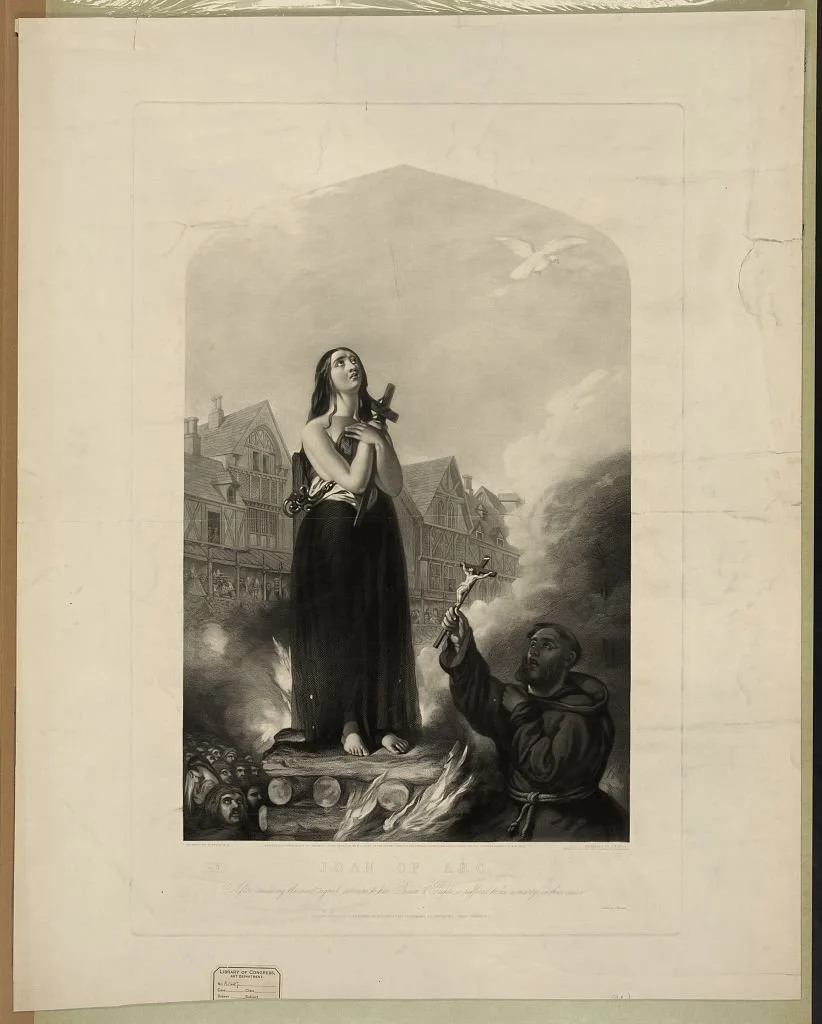
Remarkably, at age seventeen, she got herself a personal meeting with King Charles and—though she was illiterate and had no military experience—she convinced him to let her cut her hair, wear armor, and lead an army of men into battle to recapture the city of Orléans. This ultimately led Charles to be crowned King Charles VII at Reims, but it also led to Joan being captured, tried, accused of being a heretic and a witch, and burned at the stake by the British.
Published in 2025, Kenneth Maitland’s novella, Joan of Domrémy, with an audiobook version narrated by Gabrielle de Cuir, aims to capture Joan’s daringness and to bring together many of the depictions of Joan in art. In Maitland’s book, Joan is accused of being ambitious, to which she replies, “Obedient. […] I’m a soldier. I do as I’m told.” Her courage and confidence come from God, not from herself. In fact, when the word “confidence” is broken down to its original Latin, it means “with faith.” “Courage” comes from “heart.” Joan acted with faith and with heart.
In another scene from Maitland’s book, the maid of Orléans is told she should send a man to be her representative to speak to the Dauphin and she exclaims, “I am that representative, and do not presume to speak for Him Who sends me, but to carry His Will to realization.” When asked what it is she wants, she says, “To do in accordance with. To act on what’s been revealed to me.” Her purpose and her identity have been revealed. And this revelation came from listening to God and the voices of his messengers.
For Joan, leading the soldiers into triumph was God‘s victory; her victory was simply listening to God. Her sainthood was born of her total surrender. And in sacrificing herself for her mission, she was truly free. One of the quotes most often attributed to her, emblazoned on stickers stuck to water bottles and laptop covers, is “I am not afraid; I was born to do this!”
How many people today could speak with such conviction and clarity? How many feel that they know what they were born to do? This confusion and restlessness seem to be what ails may of those young adults surveyed in the reports from Psychology Today, Harvard’s School of Education, and the Pew Research Center.
Although Shakespeare wrote Joan into Henry VI, Part 1 as a falsely pious witch put to death, the American writer Mark Twain could not have been more admiring of her when he wrote, “Whatever thing men call great, look for it in Joan of Arc, and there you will find it. It took six thousand years to produce her; her like will not be seen in the earth again in fifty thousand. She is easily and by far the most extraordinary person the human race has ever produced.”
Between 1841 and 1849, Joan’s trial of condemnation and the trial of nullification were edited and published for the first time in their entirety by Jules Quicherat. Twain read the translation of his account and became fascinated by Joan, spending more than a decade researching and writing his historical novel, Personal Recollections of Joan of Arc, which was serialized by Harper’s Magazine in 1895 and published as a book a year later. Although it is not well-known today, Twain thought his novel about Joan of Arc was better than Tom Sawyer or Huckleberry Finn. He expressed, “I like Joan of Arc best of all my books… It furnished me seven times the pleasure afforded me by any of the others; twelve years of preparation, and two years of writing. The others needed no preparation and got none.” Joan’s story, it seems, is stranger and better than any fiction even one of the great American novelists could conjure. The confidence and surrender she showed during her trial especially captured Twain, and continues to capture people today, as it remains remarkable.

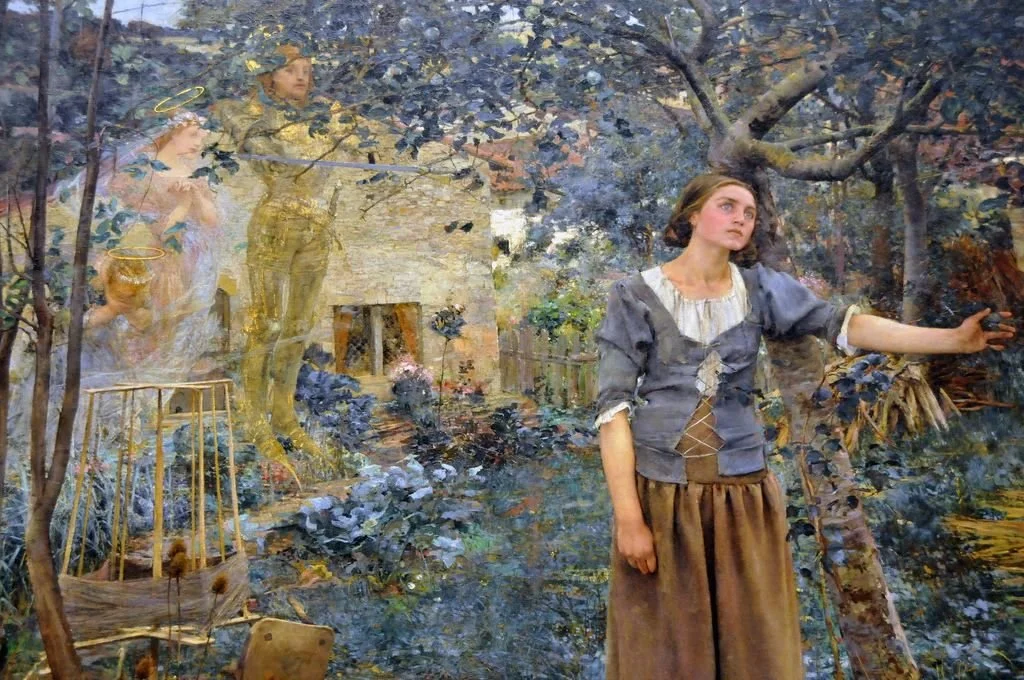
Whenever the term “a sacrifice of praise” comes up, I usually skip past it, unsure exactly what it means. But studying Joan’s life in art, in literature, in music, in film, I begin to see what it means. It is a sacrifice to praise God when one is belittled, tortured, betrayed, and ultimately led to death. To praise God when everyone and everything has turned against you? To praise him for your demise? For your humiliation and defeat? It’s unthinkable. It is extraordinary. It derives its strength from courage and confidence, from listening, from knowing that the meaning of life is the meaning of each life, given a unique purpose. That kind of sacrifice could save us.
As he wrote in Man’s Search for Meaning, Frankl himself was saved – and saved others – by seeing that the meaning of his life was his. It was unique. Joan shows us this, too. The purpose of any person’s life cannot be removed from his or her particular community, but must be found within it. Joan responded to the needs of her community in Orléans and to the voices of the saints, who she understood to be messengers from God. Then, she obeyed. Her confidence in her calling gave her the courage to act as she did. Her example reminds us that all of us are made to live a life of purpose, which we find within the circumstances of our own lives. We don’t have to search far and wide or fight a battle like Joan did. We simply have to listen, as she did, and respond with obedience, fidelity, and humility. Then, we can say with Joan, “I am not afraid. I was born to do this!”