In these last days
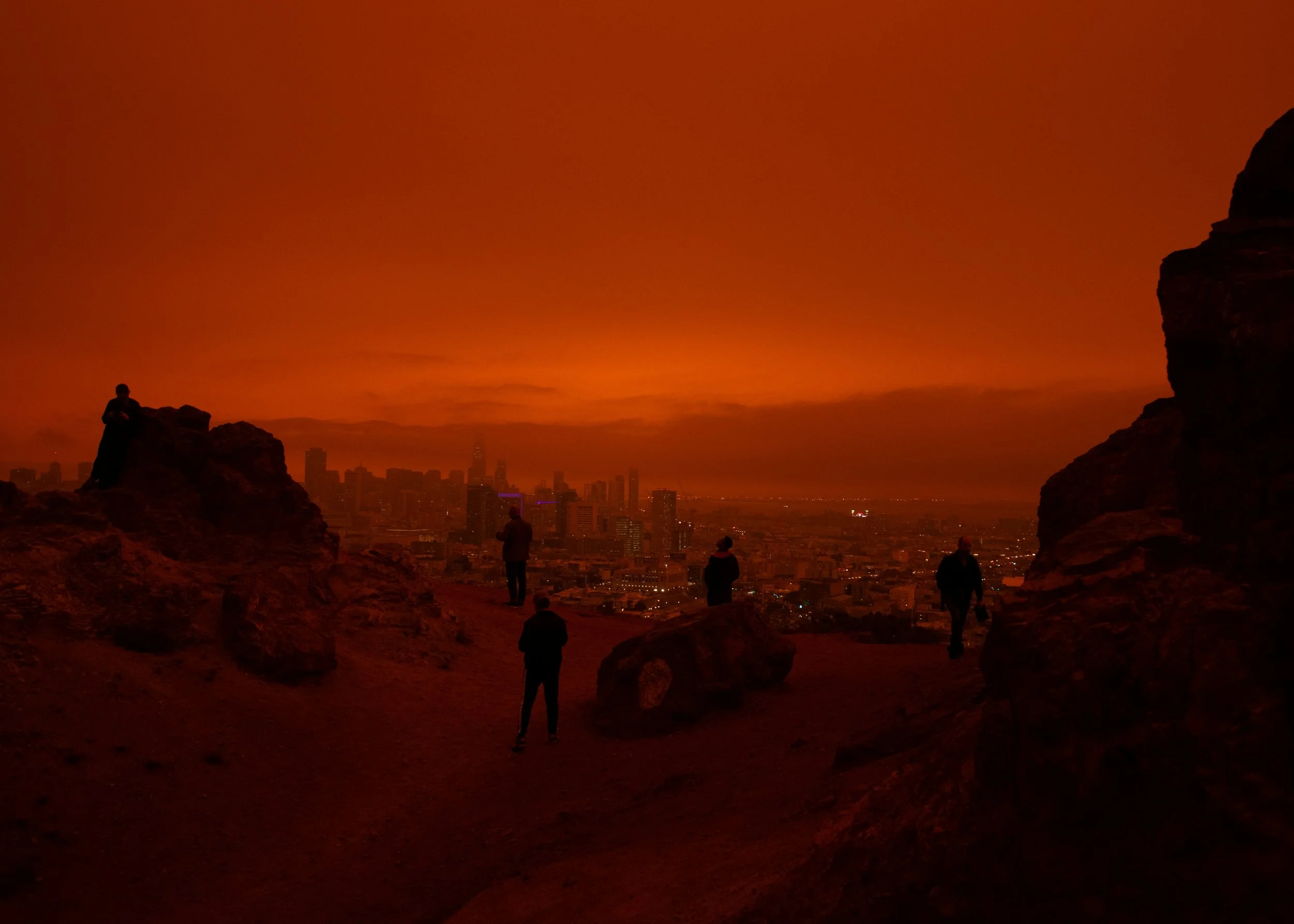
Photo by Patrick Perkins on Unsplash
I don’t know if you have noticed but apparently things have not been going well lately. It is, yet again, the end of the world as we know it. While the combination of natural and human disasters is not really new to history, what may be somewhat unique to the last one hundred years is our human response in the way we process these imminence sources of danger. It is one thing to say society is going to “hell in a handbasket” and another thing entirely to say society is the hell itself.
It is to the point of cliche that one hears wails and laments of “times like these” on social and entertainment media. Both ironically and sincerely are comparisons made to end-of-the-world and dystopian scenarios. What if, instead of merely complaining about them, we looked to examples and asked what they could teach us about our Catholic Faith and what our Catholic Faith could teach us about navigating these trying times? Some apocalyptic and dystopian scenarios can actually, in a surprising way, highlight themes of Catholic teaching to help us live in similar, albeit less dramatic, circumstances.
There have always been tyrants and despots. Oppressive rulers, and those brave enough to satirize them, have always been a part of human civilization. What sets the dystopian novel apart is that the society itself is the problem, though it may still be governed by an oppressive regime of some kind. It is a play on the concept of utopia, which is inspired by the desire of a return to Edenic innocence that exists in every human. The utopian myth can be traced back at least to Atlantis in Plato’s Timaeus and, if one is willing to reconcile the mythic language of the opening chapter of Genesis, it could be a genre that includes the Eden story of Genesis 1-3.
The dystopian genre as distinct from utopian could be dated as far back as 1516 with St. Thomas More’s aptly named, Utopia, the great work of political satire. Despite being named utopia, the apparently idealistic environment actually was a guise for current social commentary, so the dystopian undertones are implied. Some also include Jonathan Swift’s 1726 Gulliver’s Travels in the dystopian category. Even if these constitute the first of their kind, and then a handful of others appearing in the 1800s, dystopian fiction did not explode as a genre until the 20th century and has only grown ever since. It is not groundbreaking to note that this exponential climb in the literature follows the late Industrial Revolution and urbanization of society as well as correspond to the technological revolutions and rise of totalitarian regimes of the early to mid 1900s.
But what is a Christian to make of all this? What does our Christian literature, which includes many apocalyptic references, have to tell us about this relatively new cultural phenomenon? Interestingly, there are some of the prominent “last days” language found in the New Testament worth noting. For example, in Acts 2:17 after St. Peter has just received the Holy Spirit at Pentecost, proclaims to his hearers that this outpouring is the fulfillment of the Old Testament prophet Joel for “the last days.” Essentially, the Church has recognized these past 2,000 years as “last days,” and yet we are still here. St. Paul also makes a similar warning using “the last days” language in 2 Timothy 3:1-5, yet describes a time that most people since him could identify as their own. Finally, Hebrews 1:2 describes the Incarnation of Jesus as that which brought about “these” apocalyptic-sounding “last days.”
If Salvation History is meant to be viewed as a story beginning with Creation and the Fall of humanity, then Jesus bringing it to its climactic fulfillment, then Christians are to understand everything after Jesus as the “resolution” of the story of salvation despite whatever challenges any particular time period might bring. This shows that even in apocalyptic and dystopian scenarios, even dramatic fictional ones, there is no reason for Christians to despair or lose hope.
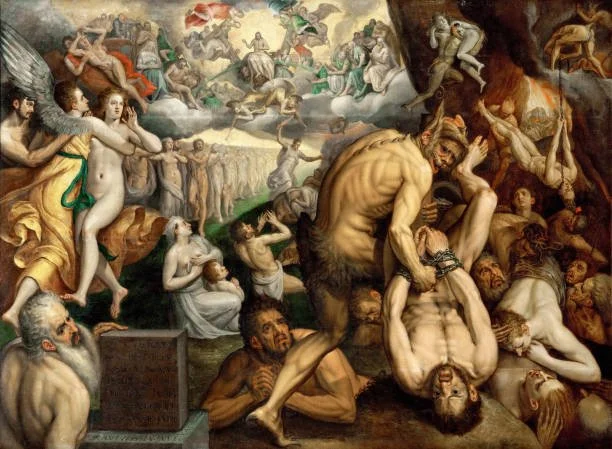
The Last Judgment
This hope is why Christians in every age since Pentecost have been able to stand up to totalitarian governments that resemble many modern dystopian societies. What is unique about more recent instantiations is that they reflect less the “hard totalitarianism,” which is imposed by tyrannical governments similar to Big Brother of George Orwell’s 1984, and more the “soft totalitarianism,” which is self-imposed by the people reminiscent of Aldous Huxely’s Brave New World. In both cases, though it looks different in either one, it is the Church’s responsibility to echo the Apostles who said, “We must obey God rather than men” (Acts 5:29).
Arguably an inspiration for the violence of dystopian, totalitarian novels comes from the Reign of Terror from the French Revolution. The motto of this same revolution was "Liberty, Equality, Fraternity,” which was meant to destroy the aristocratic French society. Ironically, it only created its own shadow class system to replace the established one. One finds a parallel in many dystopian novels that superficially emphasize equality among its citizens. Both Brave New World and the Divergent series take place in worlds where society has been flattened out and yet the divisions that exist reinforce the same class structure. Only in Christianity does one find the balance between a hierarchical order descending from God through all of Creation as well as the equal dignity of every person made in God’s image and likeness (Gen. 1:28).

It is well established in many dystopian novels that one of the most powerful weapons that the tyrannical suppressors have over their subjects is communication. However, it is equally established that communication often tends to be one of the most powerful weapons in the overthrow of oppressive regimes. For example, it is established early on in The Hunger Games series that the disjointed districts of Pan Em, the nation existing over the geographical body once known as the United States, has extremely restrictive borders within the country itself so that there is little to no communication between members of each district beyond what is sanctioned and purely functional for the upkeep of the State. While the continued existence of Pan Em, especially its central Capitol, relies heavily on resources from every district, there can be no cooperation between citizens of any district. This divide and conquer mentality is by no means new in the subjugation of peoples. One finds as The Hunger Games series moves forward, which involves a revolution to overthrow the Capitol, that it is dependent upon increased inter-district communication. Early Christians relied upon secret communication and transport during their own revolution under Roman rule. Their use of symbols and secret meetings for worship followed a similar model that helped them grow in community, strengthening their faith. These secret symbols became a clandestine language for Christians. Language would prove an important formator for Christian theology as well.
It is the scolding of Jonas, the protagonist of Lois Lowry’s The Giver, that awakens many young readers to the relationship between the control of language and thought. This resonates with many children who have been made to feel wrong for intrusive thoughts they are not sure how yet to process. It carries even more weight when one knows the thought and word Jonas uses. He asks if his parents “love” him and his mother reminds him to be precise in language- that love is an old, ambiguous word not fit for their community. One of the most popular dystopian novels of the last century described this control of thought and language as newspeak (1984) and illustrated the role that language plays in the formation of culture. Christian theology and evangelization has also recognized this connection in its own formation as well as its formation of the wider culture. One of the most prominent examples from the beginning of the Gospel of John in identifying Jesus as the Logos, which was a paga, Greek, philosophical concept that was adopted by the early Church to describe an essential reality about Jesus.

A still shot from the Fahrenheit 451 movie
Sometimes, the means and the results of totalitarian dystopia happen simultaneously like the case of Ray Bradbury’s Fahrenheit 451. In this world, the danger of books has led to the institutionalized burning of books. One follows the main character as he hunts down hidden libraries while he is slowly converted by the end of the novel. In his escape from his illiteracy hellscape, he encounters a small band of living libraries. Because the physical copies are slowly being eradicated, they themselves have taken to memorizing the great works of culture in order to preserve their memory and their beauty. What a great metaphor for the passing down of the living Tradition of the Church. This oral transmission is becoming imperative less because of physical destruction, but now because of the destruction of the intellect facilitated by apathy and artificial intelligence.
Fortunately, the “doomsday prep” reality shows have largely waned in popularity. This is not to deride the virtue of preparedness, which finds origins in both the virtues of prudence and charity, but the phenomenon of “being ready” for the end of the world is essentially a completely horizontal focus. True doomsday preparation is a preparation of one’s soul for his or her true day of “doom,” which comes from the word for judgment. Christianity, especially a Christianity that continually reaffirms the necessity of prayer, fasting and almsgiving, becomes the preparation for the end of every individual’s world and the world that is guaranteed to follow.