
Humor and wisdom in Bergman’s Wild Strawberries
We’re pleased that Adam Seiler has agreed to contribute essays towards a series on the Vatican’s list of movies recommended for their cultural value. Look for his essays in the future, and happy film watching!
When we think of existential artists and writers, we tend to imagine morose Frenchmen brooding about nihilism and death between sips of coffee at Parisian cafes. To be fair, some Existential literature is undeniably humorless, like Albert Camus’ famous novel The Stranger, a book whose hero has as much mirth as a Thomist scholar stranded on a desert island with only the books of Joel Osteen for spiritual comfort.
Often unfairly labeled as one of those morose and humorless artists, Ingmar Bergman is a Swedish director of many films associated with the popular existential era of the mid-twentieth century. But the films, at least the ones I have seen, belie the negative criticism.
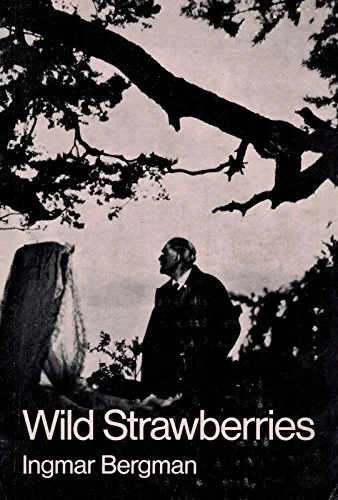
Take a scene from his fine film Wild Strawberries, which made a Vatican list of 45 important contributions to world cinema. Isak Borg, a seventy-eight-year old retired professor and widower, is on a journey to receive a lifetime achievement award for contributions to the sciences. His journey-by-car begins as a trip with only him and his daughter-in-law, but along the way they pick up three young travelers: a cute and energetic blonde woman and two men her age (twenties) who both desire her. One of the young men is studying to become a doctor, and the other is studying to become a minister. In the amusing scene I mean to describe, the travelers have stopped to rest and eat as Isak makes a quick visit to his centenarian but august mother. When Isak returns, the normally jovial blond is sitting glum and alone in the back seat of the car. Isak asks where her two male companions are, and the camera cuts to the nearby woods, where the young men are tensely slapping and yelling at each other, but their slaps never hit their intended targets. Instead of landing blows, the young men do a better job at feigning toughness while kicking up a bunch of dust. But what are they, in fact, arguing about? Well, nothing less than whether God exists or not.
The humor here relies on two things: First, Bergman writes the characters expertly, aware that this kind of immature bickering about God’s existence is typically a result of people’s emotional attachment to their beliefs instead of a sincere desire to consider their opponents' arguments. Watching this scene, I was reminded of a public debate between the physicist Lawrence Krause and the Christian apologist William Lane Craig. Kraus, forever attacking the lowest common denominator of religion and fundamentally incapable of acknowledging the weakness of his arguments, literally begins stomping his feet and whining shrilly like a child because of one of Craig’s, in this particular case at least, dubious readings of a violent passage from the Old Testament. It’s comforting to know that Bergman understood this childish form of “debate,” so common in today’s world, in 1957.
Besides Bergman’s amusing characterization of the two bickering men, the scene’s humor also resonates because of a humorous and poignant scene prior to the one just discussed. In this scene, Isak and his daughter-in-law and the three young companions have just stopped to eat lunch together. The group dines pleasantly on a patio overlooking a glimmering ocean. However, the pleasantries are soon interrupted by the bickering young men. The young man studying to be a doctor asks the potential religious man “how anyone today can study to be a minister?” He also states bluntly that “you once believed in Santa Claus. Now you believe in God.” To which the future minister retorts, “your rationalism is as dry as dust.” The young blonde laughs at their bickering, aware that the boys are arguing not in quest of truth but out of rivalry for her affections. The humor, however, soon turns poignant as everyone at the table asks Isak Borg, the esteemed professor and man of science, whether he is religious.
In contrast to the two young men, Isak declines a direct answer and instead thoughtfully and patiently recites lines from a lovely hymn, lines like “Where is the friend I seek at break of day?...I see his traces wherever flowers bloom…” The scene is vividly captured by Bergman, whose camera, as Isak recites the poetry, cuts away from the whole group and focuses only on a direct close up of Isak’s upper body and face. Isak looks into the camera and directly at the audience as he recites the poem. The verses, though pleasant and touching, could be interpreted as religious or pantheist or materialist. But Bergman, instead of trying to answer life’s ultimate questions in a movie, proposes ideas to us through the character of Isak. Through the lines he recites to the viewer, Isak asks us what we think about these ultimate questions, so the audience is invited to contemplate without being coerced into taking a side. Ultimately, Isak never reveals his spiritual beliefs, not even by the end of the film. But I find that satisfying. Ingmar Bergman is too good a writer and director. He does not want to tell us how to think. Like any good artist, he simply wants to point people to the right questions in a memorable way while respecting the audience’s intelligence.
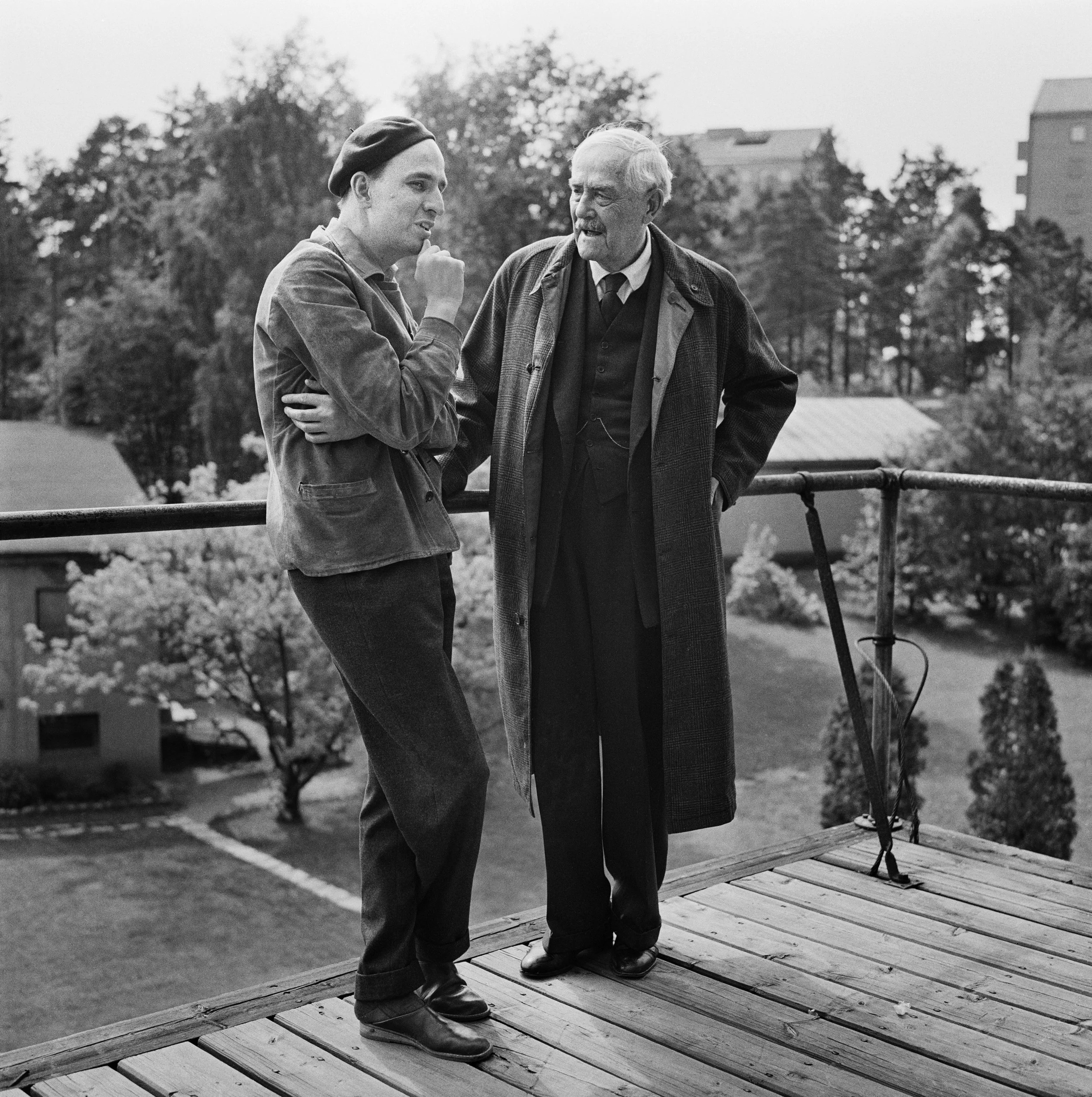
Ingmar Bergman (L) and Victor Sjöström (R) in 1957, during production. By Åke Blomquist / SvD - Bild från Stockholmskällan, Public Domain
The film has other strengths. An early scene in the film, for example, depicts a nightmare that Isak has about death, and the dream is shot as exquisitely surreal as anything in a Luis Bunuel or David Lynch Film. The film also has some weaknesses. Dreams and visions and memories, some good and some bad, follow Isak throughout the movie. Isak’s reflections on these memories and visions (as well as dialogue with his daughter-in law) force him to grow interiorly as the movie progresses, but some of the visions, especially Isak’s past relationships with women, are unabashedly Freudian, which is an unfortunate mark of a lot of “serious” 20th century art.
However, that contrast between the two young men and Isak Borg has resonated with me long after seeing the film again a few weeks ago. Are the two bickering young men not indicative of the current state of debate in our culture, both online and in-person, debates that are often wiser for people to avoid contributing to at all? The men also cling emotionally to their stances, unaware that they are arguing more to gain approval and prestige from the eyes of a third party (the beautiful young blonde). I am reminded of the current political climate. Does each party really use their reason without emotional attachment, or are so many decisions made emotionally (angrily often) in order to appease constituents and defeat opponents? And isn’t this kind of emotional antagonism the norm in religious discourse as well? It occurs not just between religious persons and atheist persons, not just between people of different religions, not just between catholics and protestants, but even between Catholics themselves. All too many Catholics—I admit to culpability myself sometimes—whether discussing the liturgy or the pope or national politics, seem so emotionally bent on trying to place oneself over and above a loathed other group of Catholics. It’s disheartening, especially as it often contradicts the Gospel message and scandalizes the increasingly growing number of people without any spiritual beliefs at all, people who look at all the discord and justifiably say: “see how these so-called Christians hate each other.”

In contrast, Bergman presents to us Isak Borg. At the end of the film, he attends his ceremony, which humorously goes against the audience’s expectations. Other people, for example, have also been awarded lifetime achievement awards, a large number of people actually. They are all forced to wear the same style suits and hats. Even the same medals are pinned to their outfits. The awardees are forced to march ostentatiously together as a large crowd watches with bored expressions; the onlookers are obviously more concerned with what they will do after the ceremony than with the blandly orchestrated pomp in front of them.
But Isak Borg takes it all in stride. He leaves the ceremony and returns to his hotel. As he begins to get ready for bed, he warmly embraces his daughter-in-law, begins to make amends with his son (who arrived on his own for the ceremony), and wishes the three young travelers well as they depart from the group and continue (happily now) on their own journey. In the final scenes of the film, Isak thinks back to some pleasant moments he had in his youth with his family at a lake-side cottage; especially affecting is a simple memory of his mother and father. The final shot is a close up looking down at Isak’s smiling and content face, a smile that radiates with Isak’s learned wisdom: the things of this world, including any prestige others might bestow on us, is ephemeral. Even our time with each other on this brief pilgrimage is ephemeral. So why is he smiling? Because Isak’s journey has led to interior growth, a kind of spiritual wisdom. Vanity of vanity, all is vanity, Isak now knows, but how we treat others, how we compose ourselves and act in the world gives us dignity and makes us models for other people, models of integrity instead of the all-too-common models of antagonism and slander and maliciousness.
In the end, Bergman doesn’t need to tell us what Isak Borg’s final spiritual beliefs are or what they might become. But memorably, at least for me, Wild Strawberries subtly suggests that most of us spend too much time judging others instead of judging ourselves and cultivating our own interior lives.
I seem to recall a wise Nazarin saying something similar a little over two thousand years ago.
