
Friday Links
May 8, 2026
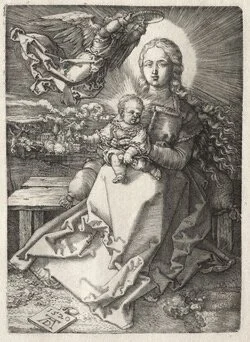
Virgin Crowned by an Angel, Albrecht Dürer
Announcing the Winners of the 2025 Jacques Maritain Prize for Nonfiction
The Wrong Kind of Black Poet
Why Portico? Micah Mattix and R.R. Reno talk about their new magazine
’A Small Rebellion Against the Machine’
The Laughter of the Father
Tod Worner and Katy Carl talk about Luminor
Announcing the Winners of the 2025 Jacques Maritain Prize for Nonfiction
And we have our winners! Daniel McInerny, Paula Huston, and Anthony David. You can find links to the winner essays HERE.
The Wrong Kind of Black Poet
Ernest Jesuyemi on his short experience as a National Book Critics Circle Emerging Critics Fellow:
In all of this, it is literature that suffers.
Why Portico? Micah Mattix and R.R. Reno talk about their new magazine
First issue is excellent and, of course, Micah’s taste is pretty much impeccable so…subscribe!
’A Small Rebellion Against the Machine’
Joel Mill and Seth Wieck talk poetry, Texas, flat tires, and more:
Most of my life is not spent writing poetry. By necessity of a mortgage and mouths to feed, poetry is an avocation more than a vocation. But poetry is a kind of fruit that grows from attentiveness. Poetry isn’t attention’s only fruit though.
My father-in-law, who probably hasn’t used the word beauty to describe anything except his four daughters, will lay tile in a rental house. Sometimes he’ll lay it in a diagonal pattern, which in terms of planning and waste of material is more difficult and less efficient, but he’ll say, “That looks better.” I hope that if I weren’t writing poetry, I’d find some way of practicing that attentiveness and extravagance.
Poetry provides me an immediate, material way to capture those moments when light glimmers through the cracks in creation, but a similar impulse might be satisfied laying tile.
The Laughter of the Father
An astute review of J.C. Scharl’s verse play, The Death of Rabelais, available from Wiseblood Books HERE:
In The Death of Rabelais, her recent verse play, J.C. Scharl has created something rare: an excellent comedy about death. It is, moreover, not only a comedy about death, but a comedy about comedy’s relationship with it. But the most impressive thing is that the play manages to take death seriously and, at the same time, be very funny.
Tod Worner and Katy Carl talk about Luminor
Story puts a body on an idea. It makes the abstract concrete. I have read so many works by people whose minds are full of brilliant thought and who can turn a phrase like nobody’s business and yet who aren’t writing literary fiction because they’ve not yet begun to render a world. We need such essayistic works too—Thoreau wasn’t a novelist. But in the parables Our Lord showed that he also valued the need for narrative, complete narrative. Jesus tells stories in such a compressed, poetic manner.
