
Go to the Literature
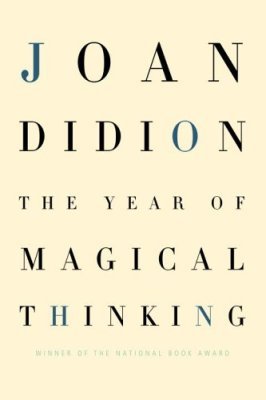
About five months into an unknown illness, which had stolen (among other things) my ability to concentrate, I thought I might have regained enough coherence to read a book, and from my shelves, I pulled Joan Didion’s The Year of Magical Thinking. I had read it only once, nine years before, but it had stayed with me. The book is Didion’s account of the year following her husband’s sudden death, a year which also included lengthy hospitalizations of their only child. I had chosen to reread this book because what I had learned in five months of illness was that sickness and grief had much in common: how they isolated you, how much they took from you, how they narrowed your experience of the world and those around you, how everything you heard and saw and thought and felt was filtered through them.
In the book’s fourth chapter, Didion writes, “In time of trouble, I had been trained since childhood, read, learn, work it up, go to the literature. Information was control.” I, too, had held this habit since childhood, though no one had trained me in it. I had trained myself. Before I even knew what I was doing, I became a person for whom story held ultimate meaning—a person who believed that anything could be worked out, if I could just get the sentences arranged in the right order. I also became a person who believed in the power of control. To cope with both the chaos of my upbringing and the chaos that raged in my own heart and mind, I became a person of discipline and determination. I did as much as I could to bend the world to my will, which was all well and good as long as I remained in what I now recognize as the safe confines of academia: study, work hard, get an A. Case closed. It took a little over a year from the time I finished grad school for that methodology to crumble around me.
In the wake of her husband’s death, Didion finds her own methodology failing, too. For one, as she notes, “given that grief remained the most general of afflictions its literature seemed remarkably spare.” After mentioning C.S. Lewis’s A Grief Observed, she lists the occasional depictions of grief in novels, poetry, and ballet. “Beyond or below such abstracted representations of the pains and furies of grieving, there was a body of sub-literature,” she writes, “how-to guides for dealing with the condition, some ‘practical,’ some ‘inspirational,’ most of either useless.” She then turns to what she calls “the professional literature, the studies done by the psychiatrists and psychologists and social workers.” Here, she finds accurate descriptions of what she’s experiencing. And yet, none of it enables her to get rid of her husband’s shoes, for fear he might come back and need them. None of it keeps her from getting into an argument with a doctor who wants to do a tracheotomy on her daughter, for fear that this procedure will be the very thing that keeps her from miraculously being healed the next day.
Information is control, but only to a point. We have hypnotized ourselves in the modern world, at least in the West, with our science and our high-rise hospitals, with all our ways to postpone and mask and push away death into the sterile, haunted places where we don’t have to look at it. All it takes—I knew full well—is for someone you love to die to find yourself floundering in a sea you’d been hearing all your life that we had mastered and chained. All it takes, I knew full well, is for someone you love to tell you they no longer love you to find yourself sinking into an abyss you’d been hearing all your life that love alone could pull you out of. All it takes, I was now learning, is for your body to betray you to find yourself bereft of every coping mechanism and comfort you had ever held onto.
For five months, I couldn’t read, but that was just the start of it. Perhaps it goes without saying that I also couldn’t write, nor could I run or, at times, even walk, nor could I leave the house aside from the many, many trips to the doctor and the pharmacy and the store. But again, that was just the start of it. On the worst days, which were most days, I could think of nothing else but my condition. Aside from work, which I was mercifully, mostly still able to do (“Necessity,” as Flannery O’Connor writes, “is the mother of several other things besides invention.”), all of my thoughts, efforts, and energy were directed, I won’t say to living, but to maintaining an existence. I have never, in all my life, felt such acute physical torment, never been seized by such a well-grounded fear that I would die—never wished more frequently or with more full-bodied sincerity that I was already dead.
And yet, I did not die, though there were times I begged for it. Times I screamed at God that if He didn’t do something, anything, I was going to lose my mind. Times when I believed I would never again think a thought that wasn’t about sickness, and even if I did, what would it matter? What good would it do? My life, such as it was, was gone. I as a person, such as I was, was gone. And so, when I finally reached a state when I thought I might be able to read, I understood why the pile of books I pulled off my shelves all had to do with grief. I understood why I started with Didion, whose words, nine years before, had sounded a gong from across the isolating wilderness of loss, where I had been wandering since my father’s death two years prior. I understood how she felt when she realized, no matter how many times she retraced her steps, it could not change what had happened.
I don’t know much about Joan Didion. The Year of Magical Thinking is the only book of hers I’ve read. From it, I gathered that she was raised Episcopalian and may have maintained some ceremonial attachment to her religion but nothing that she or I would call faith. What I see in her account of her grief is a sense of meaninglessness—the belief that this life is all there is, and though it has its loves and its joys, in the end, it doesn’t make much sense. I can empathize with this, to a point. But only to a point. For what I said about not being able to read for five months was not entirely true. The one thing I could read—the one thing I had read since childhood—was the Bible. I had read the Bible nearly every day, without fail, for almost thirty years, so reading it was less like reading and more like hauling to the surface stories that had long lived within me. In my sickness, I no more contemplated ceasing this daily encounter with Scripture than I contemplated ceasing to pray.

When I first began to realize, all those years ago, that my control would only get me so far, it was God I turned to—or rather, God who ran after me until finally, after months of chasing, He caught me. It was God I had clung to ever since and God I clung to now. Ill, alone, more or less abandoned by medical professionals, and entirely abandoned by every ability I had to get through another day, God was all I had left. I turned, day after day, through the pages of His Word. I turned, moment after moment, to Him. And when I started to feel the sickness begin, ever so slightly, to lift, I believe it was no coincidence that I finished the Old Testament and turned to the New. Here, I was struck, predictably, by the sheer volume of people who came to Jesus for physical healing. It seemed every other story was one of a blind man being given sight, a paralytic being enabled to walk, a leper being cleansed. It seemed every other story was one of utter desperation—people at the end of their ropes who had heard, at last, Someone had come who could help them.
“Go to the literature,” Didion writes. She’s wrong, but also, she’s right. It depends on the literature you choose. I believe in the power of literature to speak to us, move us, heal us, whether it is explicitly Christian or not. But I also believe that God’s Word holds a power no other book can touch. The day I finally thought I might be able to write something, anything, was the day my devotional centered around Job 19:26, “And after my skin has been destroyed, yet in my flesh I will see God.” I thought of Didion, writing through her grief without the hope that Job refused to let go of, no matter how his body wasted away. I thought of all the people, all over this world, desperate to believe they can control their fates, cheat death, find some kind of meaning within themselves. I thought of how we’ve got it all wrong. I think if we knew there was One who could heal us—One who, in the absence of physical healing, would be with us and sustain us, who would carry us even when we did not want to go on, carry us until, at last, we came to something like light at the edge of a dark and troubled wood—if we knew there was such a One, I think we would kneel before Him with nothing on our tongues but “my Lord and my God.”
