Fiat et Forma
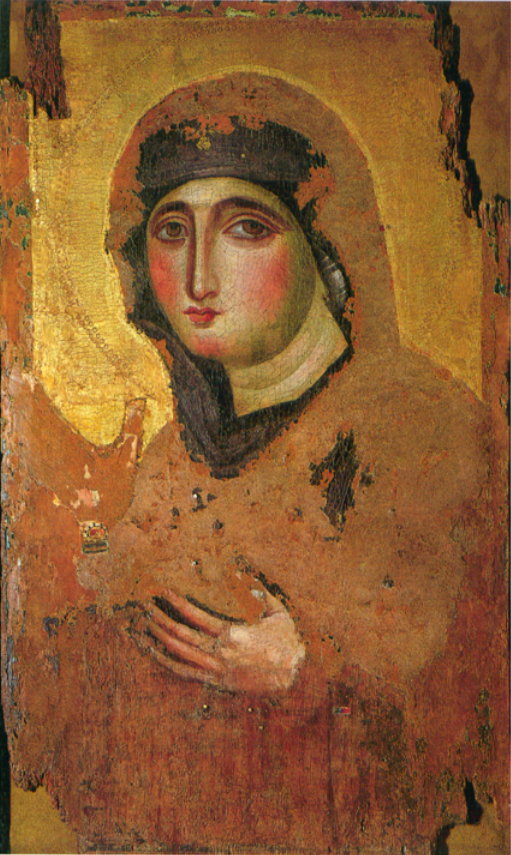
The Madonna del Rosario, perhaps the oldest icon of Mary in Rome, reputed to date to St. Luke himself.
I research and write about media ecology: the study of media as environments.i Media ecologists are interested in what happens as new media technologies and platforms are introduced into a society or culture. These new tools do indeed afford people the capacity to create content, communicate with one another, and perform tasks. But media are not mere tools. Their introduction in society, rather, functions to reshape the conditions within which persons live, work, and worship.
The language of ecology serves to emphasize this fact. An environment’s many systemic interdependencies ensure that new variables don’t just “add” to the environment; rather, the whole system is fundamentally and integrally altered. If a pack of wolves is inserted in a forest, for instance, the result is not simply the forest “plus” the wolves; it becomes a new kind of forest as food chains shift and recalibrate.ii
Just as natural environments are changed when a new species is introduced, mediated environments evolve when new media are integrated within a culture. When the first smartphone was released in the United States in 2007, we didn’t just get American culture “plus” the iPhone; we got an entirely different America, replete with cascading political, economic, and cultural impacts that we’re only now beginning to understand. Similarly, ChatGPT’s introduction (invasion?) into the media-sphere in 2022, and the generative AI maelstrom that’s followed, are reshaping the digital spaces we abide.
In such cases, when environments change—whether natural or technological—their inhabitants are also affected. Sometimes it’s by the “stick,” as when a rabbit is driven from its habitat by a new predator. But more often, and more subtly, it’s by the “carrot”: the environment itself begins to invite and habituate new patterns of life. In the natural world, this manifests as slow-moving evolutionary adaptations. The rabbit reacclimates to its environment as new risks and rewards retune its sensorium and reform its habits.
In the new media world, the “carrot” is especially pronounced. We’ve been gradually and subtly changed by our media environments, and the results have been damaging. Nicholas Carr, a prominent commentator on media, technology, and culture, argues that new media reshape the brain’s habits of attention, making sustained concentration increasingly difficult and increasing rates of depression and anxiety. His book The Shallows, which was runner-up for the Pulitzer Prize fifteen years ago, presented a swath of research to demonstrate how the internet, as anenvironment, works on persons in subtle yet persuasive ways—not simply by proposing falsehood, but by redirecting attention and inculcating desire.iii
More recently, Jonathan Haidt’s argument in The Anxious Generation applies media ecological insights to highlight the sharp rise in anxiety, depression, and social fragility among young people as the result of “phone-based childhood.”iv Haidt shows that constant connectivity and algorithmically curated attention streams don’t simply deliver content; rather, they stunt cognitive development, warp social skills, and foster chronic restlessness in adolescents. The crisis, in his account, is not merely technological but ecological: a generation formed within media systems that make sustained, interior reflection increasingly difficult.
Carr, Haidt, and (many) others bemoan the formative effects that media ecologies have on human psychology and sociology. Others, like Samuel James, in Digital Liturgies, have resourced the insights of media ecology to reveal new media’s proclivity for spiritual malformation.v (I can’t recommend that book highly enough.) The consensus, then, amongst both secular and religious, is that our digital media technologies are harming us.
What can I contribute to this conversation?
This year, on the Feast of the Divine Mercy—the day before my fortieth birthday—I was received into full communion in the Catholic Church. As I studied and prayed about whether to “swim the Tiber,” I found the Catholic doctrines concerning Mary not only spiritually nourishing, but intellectually enriching. Her spiritual posture is a kind of antidote to the malaise that our modern media ecologies tend to cultivate.
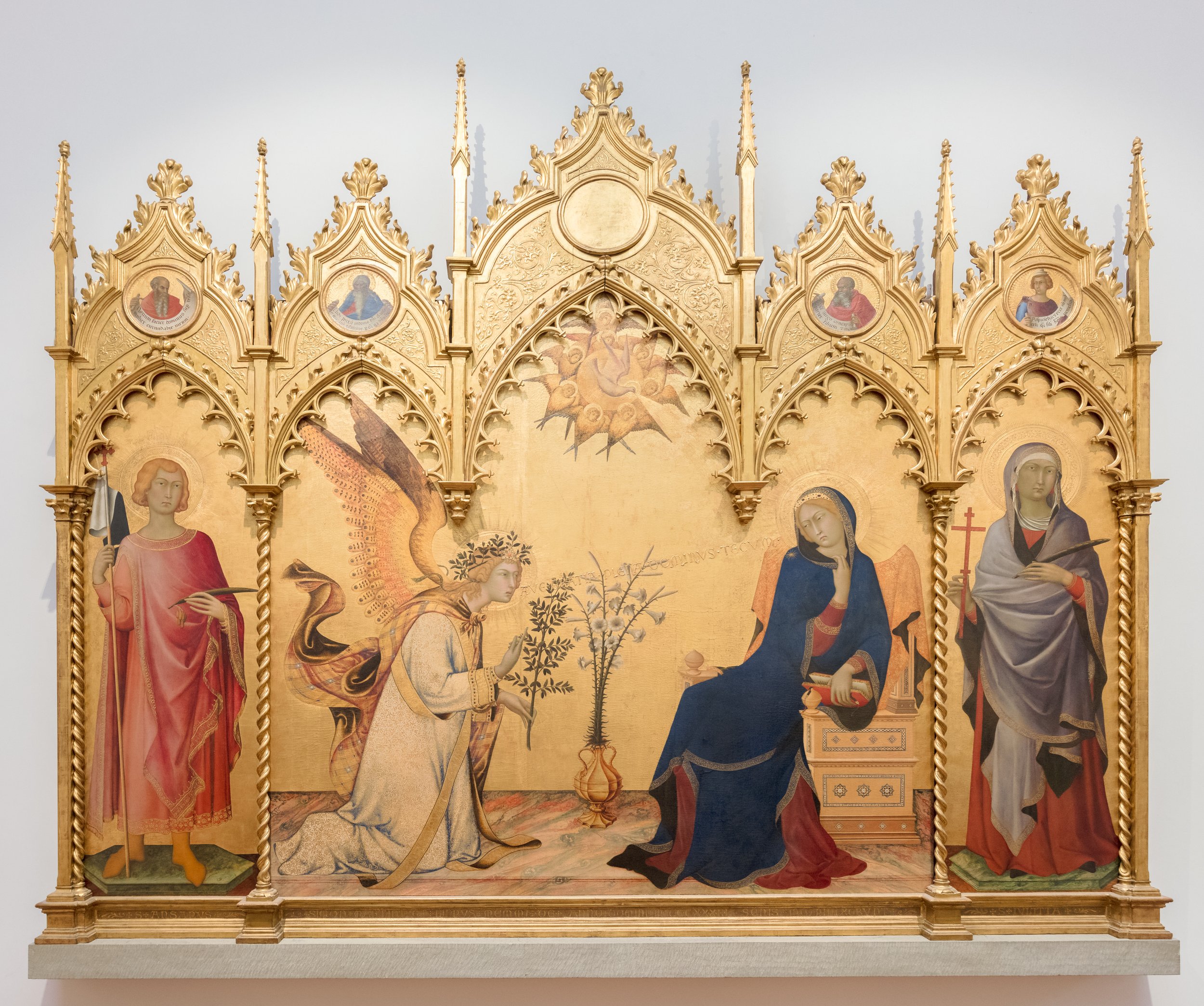
The Gospel of Luke records Mary’s assent to bear the Son of God. “And Mary said, ‘Behold, I am the handmaid of the Lord; let it be to me according to your word.’”vi This, her fiat, serves as the archetypal act of consent. She receives the Word of God, and assents to bear Him according to God’s purposes and will. Mary’s fiat is prior to both understanding and to action, yet the condition for both. In other words, only by assenting in faith—only by trusting—does Mary come to know rightly and act righteously. The Christian life begins here, for her as for us: to openthe self, in trust, to that which is higher.
Our modern media ecologies, however, encourage the opposite move. Instead of opening oneself to a loving God, digital media ecosystems facilitate and exacerbate closed introspection and individuated self-expression. In Carr’s most recent book, Superbloom, he shows how new media cultivate egocentrism.vii Social media algorithms provide us with a never-ending stream of curated content that caters to our likes and dislikes, while also furnishing us with a platform to craft and project an idealized self. Streaming media, too, facilitate highly individualized, me-centered experiences. And now, with generative AI, instead of bearing with another person in real and sometimes difficult conversation, I can “converse” with an AI-powered chatbot.
Altogether, our media environments craft a bubble of self-reference, an echo chamber, a house of mirrors—pick your metaphor—in which individual “autonomy” is lionized, celebrated, and then projected back into the environment as “authenticity.” Yet, if we take the Marian posture of trusting assent, which opens us to God’s creative work, we can combat the tendency to express ourselves in these kinds of egocentric, idolatrous ways. Instead of being “content generators” or “influencers,” we might be formed as Mary: receivers and transmitters of the divine Word.
Luke also tells us that Mary “treasured up all these things, pondering them in her heart.”viii After assenting to God’s purposes, she ponders His Word, ruminating on the divine mysteries. Here, Mary exemplifies non-instrumental knowing. She refuses to collapse mystery into utility, contemplatively abiding life’s seasons. For Mary, meaning is not constructed or grasped; rather, it unfolds as it is received and pondered.
Unfortunately, modern media ecologies don’t encourage such patient reflection. Instead, we’ve been formed by technique. The term (la technique), coined by French sociologist Jacques Ellul, refers to a society’s drive to make everything more efficient.ix One contemporary writer has defined technique as “the tyrannical imperative to optimize everything.”x Technique does not refer to the individual technologies that facilitate efficiency, but rather the cultural obsession with efficiency that emerges within technologized societies. Technique arises, that is, as an environmentalsymptom. In the developed Western world, at least, our media have instantiated in us a grammar of speed. We go fast not only because our media form us to go fast, but because they’ve created a world in which to go fast is deemed proper and good. To push back against this spirit of “optimization,” we should take our cue from Mary, who refused the impetus for immediacy. She waited in prayerful trust—the consequent posture of her prior assent. In opening herself to God, and pondering, she was formed according to His purposes in due time.

In John’s Gospel, when the wine runs out at the wedding at Cana, Mary tells Jesus’s disciples, “Do whatever he tells you.”xi Here, Mary makes two moves: she redirects others’ attention and calls them to obedience. She tells the disciples to attend to Christ and to do what He says—not what they think is best, nor even what she would do to fix the problem. Mary doesn’t draw attention to herself, or cling to self-importance, but points them to her Son. Her radical belief in Jesus is grounded in, and borne by, her prior assent and years of contemplation. When the time comes to act, she advises the disciples to listen to and obey the Master, as she has learned to do, in loving trust.
Conversely, modern Westerns’ attention is consumed and fragmented by constant data streams—visual, audible, and otherwise. We don’t obey because we’re not paying attention; or we are, but we’re attending to the wrong things. Our media environments distort the Word, and obscure the Image, as we inhabit cacophonous, ephemeral, digital spaces. Only as we learn to “do whatever He tells you” might we rebuff the tendency toward inattention and disobedience. And we can only do that, attend and obey, if we’ve first assented to and pondered His Word. For these are not isolated virtues, but a single disposition: a life attuned to the presence of God. Famed media ecologist Marshall McLuhan, an adult convert to Catholicism, understood this well. When asked in an interview what his faith meant to him, he proffered a very Marian response: “Prayer and paying attention.”xii
Mary is not just the greatest saint. She is, according to Hans Urs von Balthasar, the form of the Church in its purity, and therefore a perfect image of the Christian life.xiii We do well, then, as Christians, to learn from Mary in reforming our media habits. Let us follow her lead, bearing and sharing the Word not by technique, but in fiat.

i See, inter alia, Understanding Media Ecology series, ed. Lance Strate (New York: Peter Lang).
ii David Gordon, cited by Dennis D. Cali, Mapping Media Ecology: Introduction to the Field, vol. 4 (2017), xxii.
iii Nicholas Carr, The Shallows: What the Internet Is Doing to Our Brains, updated ed. (New York: W. W. Norton & Company, 2020).
iv Jonathan Haidt, The Anxious Generation: How the Great Rewiring of Childhood Is Causing an Epidemic of Mental Illness (New York: Penguin Press, 2024).
v Samuel James, Digital Liturgies: Rediscovering Christian Wisdom in an Online Age (Wheaton, IL: Crossway, 2025).
vi Luke 1:38, RSV-CE.
vii Nicholas Carr, Superbloom: How Technologies of Connection Tear Us Apart (New York: W. W. Norton & Company, 2025).
viii Luke 2:19, RSV-CE.
ix Jacques Ellul, The Technological Society, trans. John Wilkinson (New York: Vintage Books, 1964).
x L. M. Sacasas, “You Can’t Optimize for Rest,” The Convivial Society 2, no. 21 (2021), para. 18.
xi John 2:5, RSV-CE.
xii Brett Robinson, “The Patron Saint of Media Studies,” Church Life Journal (McGrath Institute for Church Life, University of Notre Dame), June 29, 2018, https://churchlifejournal.nd.edu/articles/the-patron-saint-of-media-studies/.
xiii Hans Urs von Balthasar, The Office of Peter and the Structure of the Church, trans. Andrée Emery (San Francisco: Ignatius Press, 1986), 203–10.