
Charlie Chaplin’s Modern Times
A secular friend of mine recently texted me a video of Louis C.K., the famous comedian. In the clip, which is from one of his stand-up specials, Louis walks around the stage holding a Bible. To amuse his audience, Louis opens to Mark’s gospel and reads the story of Jesus cursing a fig tree. Louis’s voice pitches higher and higher with sarcasm and disbelief as he reads of Peter and Jesus finding the cursed tree withered and dead the following morning. I laughed, but not for the reasons Louis intended. Louis wants his audience to find humor in how nonsensical Christianity is and to laugh at the credulity of all the world’s idiotic Christians. Instead, and I mean this without disrespect, I laughed at Louis C.K. Why? Because even though he wants his audience to laugh while also admiring his wit and wisdom, he doesn’t realize he’s behaving like the demented doppelganger of a late-night televangelist, one of those unfortunate souls who select random verses from the book of Revelation to predict political maneuvers in the Middle East or to prophesize which New Year’s Eve the world will end.
Making that connection amused me but also saddened me. Sad for the increasing number of intelligent people like Louis who, judging from his video, can’t read well, can’t approach something as historically and culturally important as the Bible by, I don’t know, reading it through one of the many sophisticated critical approaches in academia (historical criticism, source criticism, rhetorical criticism, narrative criticism, social criticism, etc. all). Or how about studying the text through Catholicism's sophisticated four-senses-of-scripture approach: the literal, allegorical, moral, and anagogical? Honestly though, anything is better than selecting verses at random in order to ignorantly parody or prophesize. My sadness was also a result of realizing that this type of “comedy” is becoming more prevalent everyday.
But a few weeks ago, I watched a mostly silent comedy that did the opposite. Charlie Chaplin’s imperishable movie Modern Times provided me with an incredible feeling that I rarely experience watching movies today: Absolute joy.

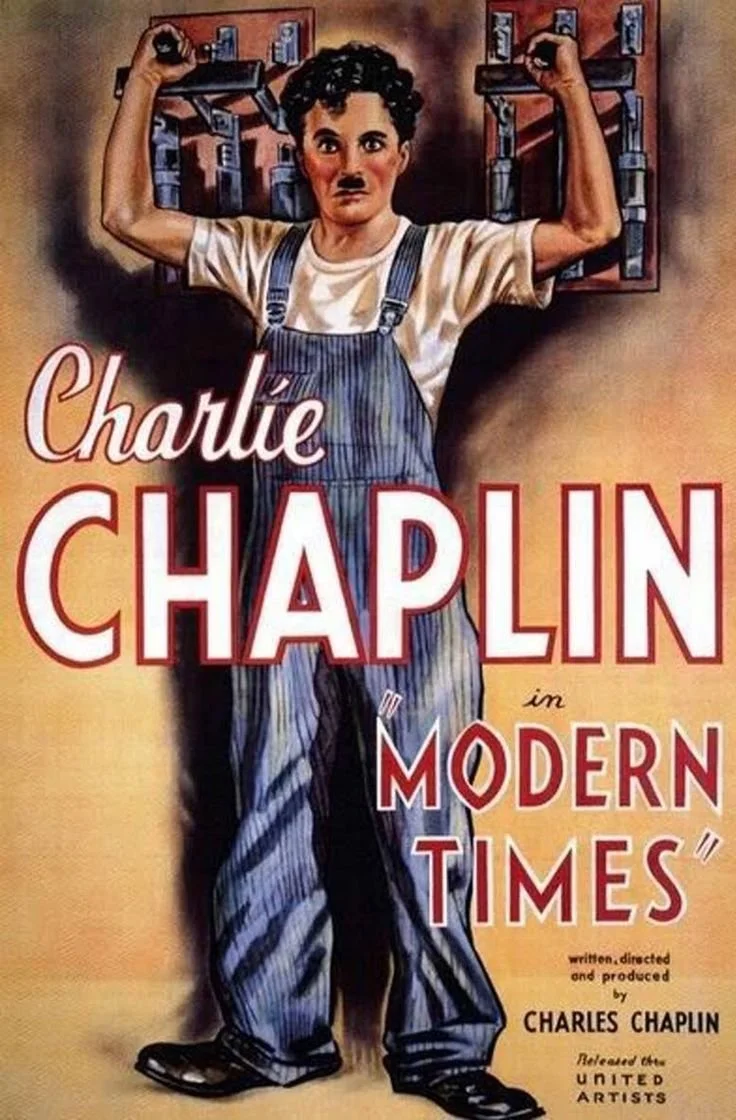
The movie actually begins inauspiciously. I started to worry that the comedy was considered classic because of its “profound exploration of how dehumanizing the modern world is,” or something like that. Not that we don’t need films that express that theme, but I wanted to laugh. So, when the movie begins with ominous orchestral music and heavy-handed symbols of whirling clocks and grinding gears, I was nervous. But my fears were quickly alleviated. Modern Times is a Quixotic masterpiece.
Chaplin’s character, The Tramp, moves from one cheerless job to the next throughout the film. He’s also wrongly arrested a few times. But for most of the movie, I rarely stopped grinning. In The Tramp’s first job, he stands along an assembly line holding a small wrench. A machine zips by with screws The Tramp needs to wrench a single time, but the machine speeds so fast The Tramp can hardly keep up, which causes him to repeatedly bump into and bowl over his fellow workers while trying to wrench each screw. The physical chaos is uproarious and probably took hours to choreograph.
And The Tramp performs the wrenching motion so much that when he’s granted a work break, his arm involuntarily continues to jerk up and down. This leads to a hilarious scene outside the factory: The tramp, arm still twitching, sees a woman wearing a dress with a familiar-looking design on her chest, a design that looks like two screws in need of wrenching, and The Tramp can’t help but chase after the now hysterical woman as he desperately tries to twist her bosom.
Chaplin’s physical and slapstick comedy is fantastic throughout the film. In a jail scene, The Tramp unknowingly eats a bunch of cocaine, which causes his already tense and jerky movements to intensify and wreak havoc throughout the prison. In a department store, where he is hired to be a security guard, The Tramp obstructs two robbers after accidentally causing them to drink too much rum. As a dock worker, The Tramp inadvertently causes a large ship to slide from its mooring and float out to sea. The Tramp’s jobs all lead to disaster. But we root for him the whole movie because he is so guileless and so full of joy and charity. At one point in the movie, he sacrifices his own freedom for a young gamine woman who is caught stealing bread to feed her orphaned brothers and sisters. It’s amazing that Chaplin can transform such sad material on the surface into such joyous comedy.
Take a famous scene towards the end of the film, one I was fortunate to watch with my nine-year-old daughter, who woke up a little after I did one Saturday morning and decided to see who this goofy, bowler-hated figure on the TV was. The tramp, out of jail once again, and now a father-figure to the gamine woman, gets a job with her at a restaurant. Hijinks ensue, of course. But in the most famous scene from the movie, The Tramp is forced to entertain a crowded restaurant greedy for entertainment. The Tramp finds himself center stage. From the sidelines, the gamine urges him to sing and dance. He does. It’s a nonsense song, but The Tramp’s dancing had me and my daughter in stitches. He repeatedly makes this move where he slides backwards with his butt almost lunging out towards the guests. It’s ridiculous but incredibly charming, and needless to say, hilarious. My daughter and I still try to mimic the dance for fun.
Coincidentally, during the days after watching the movie, I discovered other people who loved the movie and found joy in The Tramp character in general. At a holiday party, I talked with my ninety-year-old grandfather about Modern Times. He smiled the entire conversation as he told me about his favorite scenes. And he loved hearing that my daughter was now aware of Charlie Chaplin. Also, I am currently reading Kyle Knausgaard’s autobiographical novel: My Struggle. In volume two, Knausgaard describes seeing Modern Times in a movie theater with his pregnant wife. So charmed by the movie, Knausgaard confesses to buying a box-set of Chaplin’s movies so that he and his wife could watch them with joy nightly until their first-born arrived. The Tramp appears to be a beloved character to almost anyone who encounters him.
The 45 films on the Vatican’s list are split into three categories: fifteen films are in the category of religion, fifteen are in the category of values, and fifteen are in the category of art. Modern Times is placed in the “art” category, and indeed, there are incredible set pieces that could be analyzed for their artistic quality, like the beautiful home The Tramp and the gamine woman imagine could be their own if they just find the right job. The home is dazzling white and filled with antique decor, beautiful furniture, and royal cutlery. The humor and poignancy of the movie still shine through the gaudiness of the scene. One of my favorite moments of the dream sequence occurs when a cow walks into the kitchen so our two protagonists can squeeze fresh milk for their breakfast, which is funny but also, like much of the movie: poignant. The viewer is reminded that the outlandish dreams of the poor are often in direct relation to the brutal realities of their poverty.
But I also believe that most, if not all, of the films on the Vatican list can be analyzed through all three categories. In fact, as I watched and laughed along with the movie, I made a religious connection to the book of Acts. In Modern Times, The Tramp moves from one terrible job to another, and even by the film’s end, he never finds the secure job he desires. The gamine woman loses her brothers and sisters to orphanages, and her father is murdered during an otherwise peaceful protest from all the jobless. But again, radiating through all of this sadness is the joy of The Tramp and The gamine woman (played charmingly by Paulette Goddard). In fact, The final piece of advice that The Tramp gives the gamine woman and the final shot of the movie are so hopeful and so positive that I hugged my daughter as we watched it.
And I thought about the book of Acts. Stephen is a Martyr, stoned to death while looking angelically up at the heavens. Paul and his followers are imprisoned and beaten several times throughout the book, but they are always happy. I am reminded of Paul and Silas singing hymns and praying while imprisoned together, or Paul standing before King Agrippa and saying he is fortunate (happy) to be standing in front of him to make his appeal, despite the fact that Paul has been through so much physical pain and imprisonment. This is one reason the book of Acts is such a joy to read. It reminds us, as Modern Times does in its own way, that no matter life’s difficulties, we should always consider ourselves happy and fortunate because of the eternal grace we’ve received.
So, I come back to the Louis CK video. Yes, there is a lot of banal comedy and art in the world, but plenty of quality comedy and art exist as well, especially if we take the extra time to seek it out. One of the joys of watching films from the Vatican list is that regardless of my thoughts about any of the films, I can always find something of value in them. Art that lasts typically has something of lasting value to say, and Charlie Chaplin’s Modern Times is no different.
And it’s a whole lot of fun.
