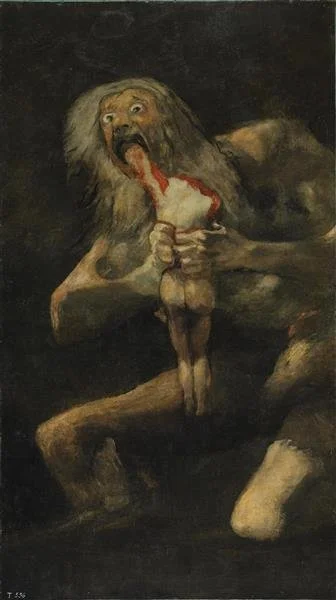
Saturn Devouring One of His Sons, by Francisco Goya
There is a lot that has been said about the rightful comeuppance and wrongful vilification of masculinity, toxic and healthy respectively, in modern media. Without rehashing the death of examples from the last thirty years, it is clear these criticisms proceed from an overarching frustration with the patriarchy. Aside from the arguable legitimacy of these frustrations, it is the role of Christianity, especially Christian storytellers, to see through and beyond these legitimate, but superficial, criticisms. How does Christianity break this cycle?
To show that this phenomenon has not slowed down, consider two recent, highly rated and popular, streaming television series on Amazon, The Boys and Invincible, feature prominently storylines that revolve around struggling, reckoning, and reconciling, with manipulative, absent and/or abusive fathers. This trend is found at the box office as well. 2025 saw Clown in a Cornfield, based on the popular novel, hit theaters with a slasher mystery that reveals just such a generational struggle. Just last May, the recently released Is God Is features the tagline “make your daddy dead. real dead” on its poster and follows two sisters on a quest to “confront their past and seek revenge.”
Though I am not yet familiar with Is God Is, I know that the daddy issues addressed on Clown in a Cornfield, The Boys and Invincible go beyond the nuclear family and resonate with the greater patriarchal presence in American culture (thanks to our, ahem, Founding Fathers).
Patria, of course, comes from the Latin for father and fatherhood and represents not only its inherent masculinity, but also an authoritarian domineering. We find the struggle against fatherhood, biological or societal, in literature as far back as stories were told. Two of Western civilization’s founding myths, Oedipus Rex and Hesiod’s “Chronos devouring his children,” reflect on this ubiquitous human struggle.
Each subsequent generation gradually moves into prominence by virtue of his youth and vigor, but this movement must be violently taken. Oedipus must kill his father (well, he’s fated to, anyway). Zeus overthrows Chronos. Using Biblical culture, this was largely the arc of the Baal cycle as well. These archetypal myths reflected the perennial progression of society. The children rise up to take control from their parents, but the parents do not let go so easily. Replace Oedipus’s mom with “equity” and the allegory is revealed.
As modern culture, and as a result its literature, progressed, this struggle became slightly more subtle and less violent. One finds it presented to various degrees in works like The Brothers Karamazov by Fyodor Dostoevsky and Fathers and Children by Ivan Turgenev. Both of these works highlight the philosophical struggle between older practices and/or philosophies with newer progressive (or regressive, depending on which character you ask) ideas. This would progress to what we see now as shown with previously contemporary examples.
Christianity has built into its essence the mechanism to break this cycle. His humble kenosis of the Incarnation, his sacrificial act at his Crucifixion, and his subsequent triumph in the Resurrection, all showed how Christ breaks the cycle of violent domination that humanity wrongly perceived was the true order of reality. Similarly, Christ’s submission to, and then exaltation by, the Father also breaks the cycle of struggle that typified generational relations.
Christ seeks to do the will of his Father. He subjects himself to the Father’s will to the point of suffering and death. This reality is misunderstood when the “will” of the Father is seen through the lens of power. This misunderstanding is just a perpetuation of the same father-son-struggle cycle. While the will is a “power” of the soul, it need not necessarily be competitive as the previous dynamic assumes. A “power” is an extension of the essence of something, and taking into account the Christian understanding of God’s essence as “love” (cf 1 John 4:8), the primary “power” by which God can only be understood must be through the lens of love. If Christ is the visible icon of the invisible Father (cf Col 1:15), and Christ’s primary action of love is an action of sacrifice, then one must conclude that God’s will, the power that extends from God’s essence, would also be sacrificial love.
Where the previously mentioned ancient and modern iterations of this generational divide go wrong, or go right in terms of their diagnosis at least, is the point in which the will of the older generation, the “fathers,” deviated from sacrificial love. Chronos and Laius, Oedipus’s father, desired to exert their wills over their sons so that they could maintain power and control. Omni-Man from Invincible and Homelander from The Boys sought to dominate the entire world. The adults of Clown in the Cornfield hated how control over their lives was slipping away to a generation because of a world they no longer understood. In all of these power superseded love. Even more tragic, this power could only be met with more power, nearly always to violent ends.
Only when sacrificial love supersedes power can the victory be “won.”
If Christ perfectly fulfilling the will of the Father, and that will being sacrificial love, breaks the cycle of generational struggle, then it also follows that the Son would not just ascend to the Father (and not in place of the Father), but that the Son would also be exalted by the Father (Mark 16:19; 1 Peter 3:22). This is just part of the significance of the Ascension of Jesus. If the Resurrection was the “firstfruits” of the promise God made to humanity through Christ, then the Ascension is the completion of that promise (cf 1 Cor 15:20).
What ancient myths and modern stories can show vividly and accurately is a picture of human nature devoid of grace. It is not totally depraved, but it is fallen. When humanity broke its relationship with God, the order of Creation was affected. Every relationship suffered from this rupture. We see this primarily in the relationship between men and women, as Genesis 3 made clear, but is similarly apparent in every other human relationship as well as humanity’s relationship to the natural world. What the Gospels provide is a model for healing in relationships. Jesus expresses this in his healing of marriage by declaring himself the bridegroom and the Church his bride. He expresses this healing of generational wounds being the obedient to his heavenly Father and by the Father’s exaltation of Jesus to his right hand.