A Pair of Walkers In Brooklyn
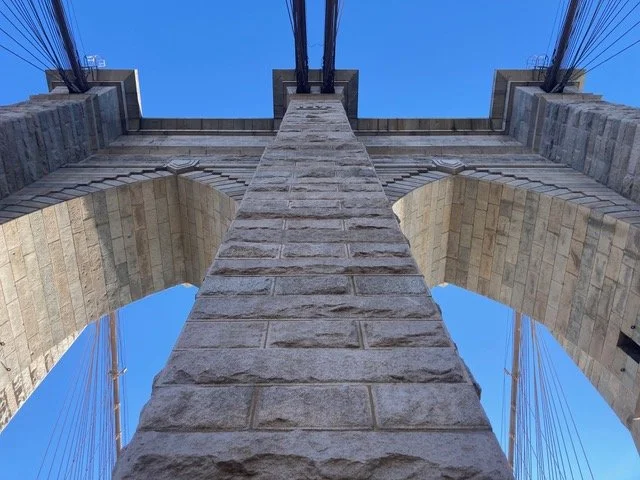
A view of the Brooklyn Bridge from the perspective of a walker. All photos provided by the author
It seems my daughter, my oldest, is off to college and I don’t want her to be. Greed and selfishness pull at me, wanting to keep her small and tugging the tail of my coat. Better angels tell me to let her go. But they all need to keep quiet a moment. She, like me, wants to turn her head and have a look back before moving on. The strange thing is that on her Christmas break she doesn’t want to turn back to the town we’ve called home the past few years or to Jackson Heights, Queens, where I had clutched her hand each day as I brought her to and from her little Catholic school. No, she wants to go back to my old neighborhood in Brooklyn, a place we haven’t visited since she was six years old.
This bears some explanation.
My mother died when she was six years old. Of my three children, my oldest is the only one with clear memories of my mother and her house and that neighborhood. And of my children, she’s the one who looks most like her, so much so that her merest gesture or grin can stop me in place.
Now she has a plan: to walk over the Brooklyn Bridge from the Manhattan side into Brooklyn.
The Brooklyn Bridge. A pleasure to walk. A miracle of engineering. Supposedly the East River crossing that causes the least grief for the Department of Transportation. I’ve walked its mile-long expanse a million times. Our own little family has walked it before, on smaller legs and with less patience. But now she wants to go a couple of miles into Brooklyn, right down to where I grew up in Carroll Gardens, where the old neighborhood abuts Red Hook, where my father had been raised.
The day we go in early January bursts open bright and clear with a towering blue sky greeting us in a winter already too long and gray with cold. We emerge from the subway just outside City Hall. I stare up like a gape-mouthed tourist. The new buildings are puzzle pieces that don’t fit.
Every New Yorker has his or her own skyline. Its contours get etched into your brain early and remain forever fixed. You have no compass apart from the heights of the tallest buildings you remember from that skyline. The one we’re looking at is not even the one I remember from a few years earlier. It’s definitely not my skyline. Mine is the one of the Twin Towers, the skyline of the late 20th century, the skyline of before 9/11. Before this century took an early and mad swerve into places no one expected to go.
Mounting the pedestrian walk of the Brooklyn Bridge, I try to give my daughter a sense of that world. She often feels out of place in our time. When I was younger I did too, but now I’m not so sure. Between 1989 and 2001 the dread fears of my latchkey, make-the-best-of-what-you’ve-got childhood where nuclear war was not only possible but likely were diminishing. As the 20th century clocked down, we thought, maybe—just maybe—things would be okay. Maybe each of us could be who we wanted to be in a world that just didn’t seem to care.
I tell my daughter of all this and of that day, that awful day, when the Twin Towers were absented by madmen from a skyline stenciled on my brain. Of the smoke rising straight up and then down into the harbor and out even into Brooklyn where a thin gray coat of ash settled on the cars and the streets and even inside our apartment because we had left the windows open that morning. Of the people who had disappeared and were never seen again. Of not knowing what would happen in the years after.
The bridge itself takes us to another century and another conversation. Here is the 19th century transcribed in stone and cable. Here is the history of confidence and ambition, both civil and personal. One of my great-grandfathers had been a laborer on this, the first great East River crossing. He had stood on this bridge using skills in stone he may have acquired in Italy and brought here. My hand may rest on a stone he once held. Across my life I have touched the stones wherever I know he worked—here on the great bridge and at the Grand Army Plaza arch near the main branch of the Brooklyn Public Library, on Liberty Island at the base of the Statue of Liberty.
The immigrant makes the city and the city makes the immigrant a citizen. My illiterate peasant ancestors built the monuments and dug the holes that the great subways later filled and sewed the garments the people wore and drove the trucks and manned the fruit stands and signed their names with Xs on their naturalization papers. And here I am, no longer Italian but fully of that blood, an American, a writer. And here is my daughter, half-Italian, entirely American, entirely better than the lot of her ancestors combined.
I think of what I’ve read of the bridge’s first years of operation, with trolleys being pulled back and forth across its expanse by electrified cables and horses and carriages clomping along in the other lanes. A bridge with a foot in the old and the other in the new. Then there’s the bridge as it had been in my youth, battered and a bit beat-up, with the wooden planks of its pedestrian crossing feeling worn and worrying as you stepped on them. I tell her a little of who I was then and who I was with and wonder what it would feel like if that me and I met somewhere about the bridge’s midpoint.
Easing down the walkway toward Brooklyn, I take pictures of my daughter before the only skyline she’s even known, the one of a single new World Trade Center tower. But then Brooklyn comes up fast and much—not all—is the same. Down below the walkway, not far from the bridge’s Brooklyn anchor, is a plaque on a building that once housed the Brooklyn Daily Eagle, a newspaper that gave Walt Whitman a steady income as he wrote “Crossing Brooklyn Ferry.” Whitman’s ferry is long gone. But the bridge completed in the last years of his life remains.
We come into the park on the Brooklyn side that makes up Cadman Plaza. Family memories mix with my own. Here my grandmother had a picnic with her three oldest children sometime in the 1930s. I have a picture of it. They look poor. They sit on a rough blanket but my grandmother is all smiles. My grandmother was a fisherman for good cheer in a storm-tossed life.
I once came to this park with my uncle, the eldest of the kids in the photo, my mother’s brother. He had pointed out the Korean War memorial in Cadman Plaza dedicated to the Brooklyn boys like him who had gone off to serve but who hadn’t come back home. My uncle turned away talk about his war with a joke about how he hadn’t been shot at in a war but rather a “police action,” which is what they called Korea when he had served. My mother told me how as a little girl she had watched him walk up the block in his uniform after three years away from home, a stranger to her that her mother was weeping over.
My grandmother’s love comes back to me in Brooklyn’s familiar blunt winter’s light. It comes in memories of meatball sandwiches and squeaky kisses, in smothering hugs and hands clasped over hearts bursting with pride, in percolated pots of coffee and Italian pastries, in surprise visits and Sunday dinners, in prayers made over fevered heads and crocheted blankets tucked under feet. To me, it’s the purest kind of love a fragile human being can give and share and carry. I want my daughter to understand it. Impossible. All I can hope for is to give her and her siblings a hundredth of what was given me.
Cadman Plaza turns into Court Street. The court buildings and Borough Hall melt away as we enter the commercial district of the area once called South Brooklyn. My home. But Court Street was really Gram’s home. No errand up Court Street ever took five minutes with her. Court Street was her kingdom and she was its queen. My daughter can’t picture Court Street as it is now with high-end restaurants and cute boutiques. She must see it as it was, working-class Italian mostly, bound by blood and bars and churches. Shops were owned by people you knew or families that had lived there for a hundred years. An ethnic small town within a big city. A single patch on New York City’s tribal quilt.
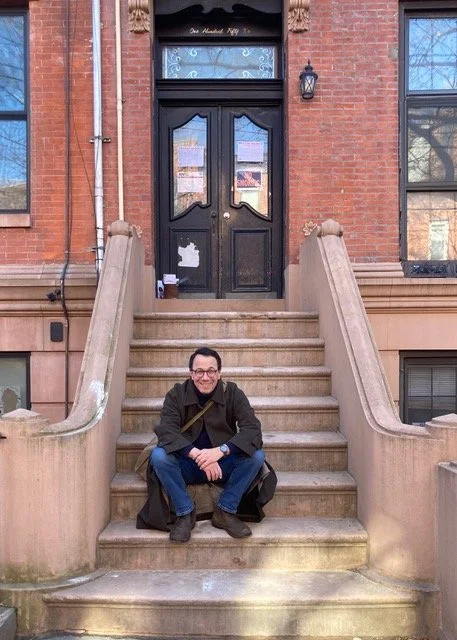
The author on the steps of his childhood home
My mind’s eye sees those shops again. Here’s the Community Bookstore packed to overflowing with new and used books, lorded over by a beatific bearded owner who smokes a pipe and always knows exactly what you’re looking for. Here’s Scotto’s Funeral Home, where generations have been waked, and Johnny’s Candy Store, where I play Donkey Kong and Spy Hunter in a store lit only by afternoon sunlight or shoot pool down in its cellar where the older boys smoked cigarettes. Here’s V & R Pizza, where for two bucks you can get two slices and a Coke and sit for two hours, and Lung Fat, the Chinese restaurant with takeout just as good as a better-named Chinese place, Me and My Egg Roll. Across from Carroll Park, where in my mind old Italian men in dark shoes and white socks still play bocci, my family is still dressed to the nines and celebrating First Communions at Casa Rosa, and another couple of blocks down I’m at Angelo’s Barber Shop where my neck is always soaped and scrapped clean with a straight-edge razor. My brother is unpacking boxes at his after-school job at Dave’s Five and Dime, where Dave’s widow watches him and every customer with hawkeyed fears of theft. There’s the Key Food where my mother pushes her shopping cart each week with clipped coupons in her purse, hoping she won’t have to put anything back at the register we can’t afford, and there’s Anthony’s, the butcher with the sawdust-covered linoleum floor where Gram always gets a taste of the cold cuts before buying anything and haggles prices even as her meats are rung up.
Before these storefronts, on hot summer days or sweet spring ones, are the old folks sitting on lawn chairs who live in the apartments above. They watch the street, everything and everybody, and to each one Gram says hello. I almost feel like I’m with her again now as she shows me off and my brother and mother too if they’re with me. She’ll brag of us for an hour if you let her, saying how blessed she is to have us, and if she gets good and worked up she’ll tell each of them how she can’t understand how that dirty no-good sonuvabitch father of mine could ever leave us.
The last part was not entirely true. It was a shorthand to explain the mess of my parents’ marriage. My mother left my father after years of trying to get him to leave the bottle. But that was many broken things ago, promises and dishes and bank accounts and hearts and bruised body parts. I always hated how Gram loved us so much she needed to tell all that to all of Court Street, thinking that somehow would make up for things.
I don’t tell my daughter much of that as we walk. I remind myself to never tell her of the bad things in full. Never in full.
I also don’t tell her of how Gram spent about two years just lying in bed all day staring at the wall as Ma worked and my brother and I did our best to take care of her in the couple of hours before Ma got home from work. Gram herself had broken for a time. She had too much love in her. She had tried to fix our world into perfection and couldn’t. Looking back it’s not a surprise. She couldn’t understand what she saw as pure selfishness: a man who loved a bottle more than his own blood, who sought not to fix and give, but to break and take.
Yet I loved him. Just as my mother had. Just as his mother-in-law who spent two years staring at a wall trying to understand that had.
We walk on. The outlines of my misspent youth come into view. The corners where I smoked cigarettes and played handball, the houses of friends where we drank while parents were away, the places of sneaking and experimenting, the sidewalks of fighting back against bullies, the friends who saw me just as I was, the girls I puppy loved who still glow in my mind.
We pass the home of one girl I loved in particular. I sat on rooftops and in school parks with her, listened to her play the bassoon, spun Led Zeppelin albums with her, showed her some of my first scraps of writing. She was funny and warm and beautiful but her father didn’t like me much because I was Italian. He tried to keep us apart and in the end I suppose he finally did. I wonder if I were to walk past her if she’d still know me. I stand across from her apartment building, my daughter sifting my face for the musings of my mind. What was it about that beautiful time between that girl and me, just a few months of my life a lifetime ago? That time feels as solid as a prayer and as fleeing as a breeze. So short and insignificant compared to the years I’ve loved my wife and we’ve raised our children. And yet it remains in me and I in it.
But so few things are the same. Most of the buildings down Court Street, yes, but not the stores or the people who walk the streets. This was a strange place, known and unknown. Signposts were right but not the details. A parallel universe built on the slippage of time.
Relief comes through the sight of a familiar diner. Same plateglass windows and worn-down booths and tables and wood paneling along the walls. Shambling now with hunger, we take a table by the window where we could look out and back in. My daughter likes the stories attached to the memories. I like having someone to tell them to.
We eat and look out and I study this young remarkable woman who is somehow my daughter and I’m grateful to have had so much time with her all her life. Like a heaven-sent reminder, a pair of daycare workers come leading a group of very young kids down Court Street, each little hand holding a very long rope. The sight saddens me, kids being walked like dogs. I grieve for their parents. My wife and I struggled and stretched schedules and often came up short when bills needed to be paid but somehow not one of the kids had ever gone to daycare. My mother had taught me this. You sacrifice where you can for your family.
I look at my beautiful daughter. I have had so many days.
My daughter looks down at her menu and again she reminds me of my mother. Like my daughter, my mother delighted in simple things—a meal out at a diner, an old movie on TV. My daughter has already traveled far beyond me, far beyond her. She’s seen more of the world and understands it better than I did at the same age. She knows herself more.
Our lunch is heavy but needed. It helps us make the last leg of the journey. We move closer to my old block and I spy more familiar and faint echoes. The hardware store is still there. Passing it I’m reminded of how I learned to plaster and paint and change fixtures and do basic repairs in a house that was always in need. We cross Fourth Place and I think of an old friend, long dead, with whom I went to my first concerts. I think of his sister, beautiful and blue-eyed and elf-eared, who I had secretly loved but never told how I felt. Diagonally across the intersection from the hardware store is a bar that was once known as Hanley’s. Four generations of the same family had owned it, going back to the 19th century. By the time I was visiting it regularly my old man was on the wagon. We’d sit in Hanley’s, he and I, him drinking a club soda and me nursing a beer, talking about baseball or politics but never about what was behind us. I never told him of how I had wished he had taken me across the street to the hardware store to teach me as a father teaches a son how to fix things. Even with those silences those were good days between us, rare ones, because they felt like they could be built upon. But then a doctor misdiagnosed him with lung cancer and he hit the bottle again and hard.
I look through the plate glass windows into the dark bar that had once been Hanley’s where my father and I once had a moment with the daughter that he never knew because that misdiagnosis sent him back to drinking. At first, he drank out of self-pity and fear and then when he learned he would not die right away he drank out of a feeling of a second lease on life but I knew where that kind of drinking led. I didn’t want any part of that. We stopped speaking, again. I had met just my wife. It was too many broken things ago.
I keep looking through the plate glass window into the dark bar alongside my bright daughter and can’t find the words to connect what I had been and hoped for with what I was and could no longer be. My father died of a heart attack the week we found out my wife was pregnant with her. I want to tell her that I had always wanted him to be proud of me in the way I was proud of her and her siblings and that I still wish among so many wishes that I could have one Christmas or Easter with the living family I had been blessed with and the dead one that had made me. It’s a sad, stupid thing. I swallow it before it comes out.
We walk on, down another block. Here we could turn down Liquer Street and reach my old block where I was raised. This was the block she knew, the house that had been my mother’s and before that her parents’ and grandparents’. But the old house is gone now and replaced by an ugly thing my brother and I have nicknamed the Spaceship, which we saw a couple of times after driving back from visiting our mother’s grave. Neither of us want to see it, so we stay on Court Street to stand in front of St. Mary’s.

St. Mary Star of the Sea. Parish of me and mine, where many of us were baptized and eulogized, received into the sacraments, married and forgiven of our sins. I was an altar boy here with good priests of pure smiles and Christlike understandings of mercy and with ones in tight Roman collars who smelled of harsh judgement and liquor. I watched incense smoke rise into the multicolored light coming through stained glass windows as if it were the physical manifestation of the Holy Spirit and saw newly married couples being peppered just outside the doors with rice and later bird seed. My own parents had been married here, as had my grandparents. And I trailed so many coffins out these doors.
But we can’t get in. The gates of St. Mary’s are locked. I find myself glad of it because the last time I had been here was on the day of that funeral Mass for my mother and I had vowed to never step into the old church again. A chapter had closed here in this church and around the corner on the old block. The plants tended to by my mother in her little backyard would get overgrown. I had to step forward.
Now our forward takes us to the next corner where St. Mary’s School once stood. The building had long ago been sold to a secular private school where the new owners had cut the crosses off the old front gate and pulled the statue of Mary honoring the St. Mary’s boys who had died in the Second World War from the front yard.
Even with the changes, it’s good to hear the muffled voices of children coming from the schoolyard out back and through the closed windows. The school had been closed for too long before the diocese sold it. People hold on for too long to things no longer needed.
We stand before the front door. I had been dropped off here decades before on my first day of kindergarten by my parents. I remember wearing a corduroy jacket and holding both my mother and my father’s hands as we had crossed Court Street.
My daughter and I make our way across that same corner now to visit the house where I had lived up until the age of seven. The house is still there though, undergoing some kind of renovation. She wanted to visit this house in particular. She has an idea to write a story set in it. I look up to the windows of the top floor apartment where we lived. I can see my old bedroom window and the windows of my parents’ room. Stories dribble out of my mouth about playing with Star Wars figures on the front step with a kid named David who lived across the street, of going up the corner to the local grocery story at age five or six with a small list from my mother, of having super-hero battles with my brother on the vast field of my parents’ bed. Yet nothing awful comes to mind. My daughter takes a picture of me sitting on the front steps. I’m smiling in it.
She continues to be ambitious. She wants to walk the whole way back now but this time up Clinton Street. And we do under its barren tree branches, in that stark Brooklyn sunlight that sets the even walls of attached homes alight with beauty and hope. We see hints of an older Brooklyn in the architecture. I show her boot scrapes in wrought iron railings and cemented-over coal chutes in the slate sidewalks quarried from the Catskill Mountains. I show her the converted carriage houses and we try to imagine which oversized houses in the area they once belonged to. I had hoped to show her the branch of the Brooklyn Public Library where I had fallen in love with reading, but it’s closed for renovations. Something feels like it’s keeping me from looking back too deeply.
Clinton Street always held an old residential attractiveness to it. It was always a fine place to walk from my working-class neighborhood to the (even then) more affluent Brooklyn Heights. There’s a timelessness to those old redbrick and brownstone houses that get bigger and better-looking along the way. I felt connected then as now to the history of Brooklyn. Once I had hoped to own one of these suckers. My daughter thinks of them as beautiful too and marries her dreams to my retirement and finds a fine house we could all live in when she’s rich and I’m old. It’s a house I once loved too.
Clinton Street eventually crosses Montague Street, which leads down to the Brooklyn Heights Promenade, that place of postcard picture vistas of Lower Manhattan. On Montague, I’m thrilled to find the Japanese restaurant my wife and I used to go to when we were young and broke. Who we were then comes right back to me. Rich in young love, passionate to just be with one another. A splurge once every couple of weeks for some sushi was our trip to Paris. My wife’s face comes back, her hair short and her eyebrows arched and mischievous. What a time. What a gift that woman has been to me.
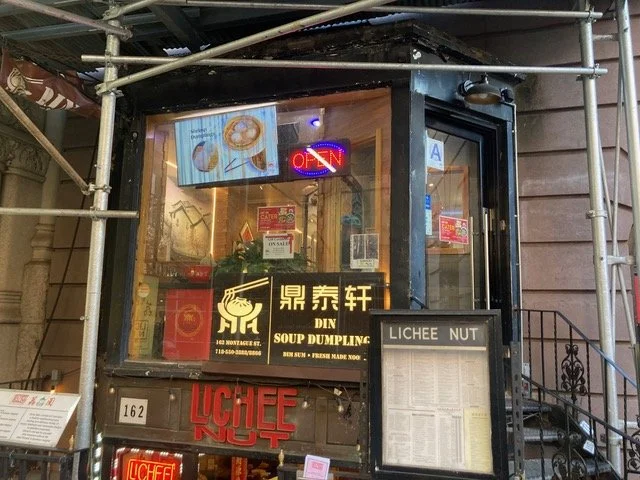
A Japanese restaurant, full of memories
We walk on. I tell my daughter of bookstores and record stores and clothes shops that no longer exist and how being in them as a working-class boy made me feel like I had the opportunity to taste culture and hope to contribute to it. Before long we’re on the Brooklyn Heights Promenade overlooking the East River and the Statue in the harbor and the great city across the way that’s both ever-changing and eternal because centuries have seeded it with the hopes and dreams of natives and immigrants alike. But in this space was also my youthful view of the wider world. I looked out on Manhattan and saw where I wanted to get to and what I wanted to leave behind. My daughter sees that too.
Yet the skyline is not mine anymore. The view of the Brooklyn Bridge on this side has been marred by a black monstrosity of a skyscraper someone has built behind it. This is not my world. And not really my home. But it had been good—even all the bad—when it was mine. I still love what has made me. I still love everyone who stuck their fingers into my clay to shape me. I wouldn’t be me without them, without this place. Maybe I wouldn’t have this wonderful girl walking beside me or her mother or sister or brother at home.
But home. What is home to a guy as unsettled in his being as I am?
I thought by now I would feel some stoic confidence from my accrued years. Yet I still feel alone in crowds and crowded by thoughts when I’m alone. I can smile and charm my way through things. I can say confident things but most of the time I’m just winging it, including fatherhood. I don’t belong in Brooklyn anymore. I don’t know where I belong now. My daughter is in college and won’t need me much longer. Home? Home requires connection. Sometimes I can’t even connect with the people I love best because of my own inadequate babblings. “Only connect,” E.M. Forester once wrote. Baloney. The only place I ever feel complete connection is in the silence of a forest. Only then do I understand that the divine eyes that can see me there are really the only ones who see me best.
I try to remind myself that people almost always feel apart and dislocated, even from the people and places they love best. The irretrievable past pulls us one way while the hopes of the future stretch out our fingers ahead. The present is only an occasional epiphany of joy.
Yet I have such a moment, right here, right now, on this bench staring out at Manhattan with my daughter. My joy is in this moment between us, in the connection made. Despite all the memory tangled up with our exercise, it’s been a fine day. One I’ll remember for the rest of my life.
What is home then? Maybe it’s in the acts: my grandmother making a meatball sandwich after school, my mother taking on the burden of single parenthood, my father buying me a beer in that old Irish bar, my teenage sweetheart kissing me on that roof, my long-dead friend going to Madison Square Garden with me. It’s me fixing that broken fixture for Ma, greeting those old folks all along Court Street, seeing my brother stocking shelves in his afterschool job, sharing sushi and a life with my wife, walking with my children. It might even be in what I’ve written here, in admitting that I don’t know everything, in understanding that I’m still in the process of forming. And maybe it’s in the fact that I once held my children’s hands and no longer have to.
Things are not the same. They never will be the same. But the fine days like this will continue to come and continue to pass. And be remembered. And in that, I am—we all are—home.