Editor’s note: H.S. Theophilus, the pseudonymous author of this essay, is a convert to Catholicism, a retired physician, and a recent graduate of the Master of Arts in Evangelization & Culture at The Catholic University of America, in collaboration with the Word on Fire Institute. H.S. Theophilus writes on Christology, Scripture, evangelization, and the relationship between faith and contemporary culture, with particular attention to truth and Christian witness in a secular age.
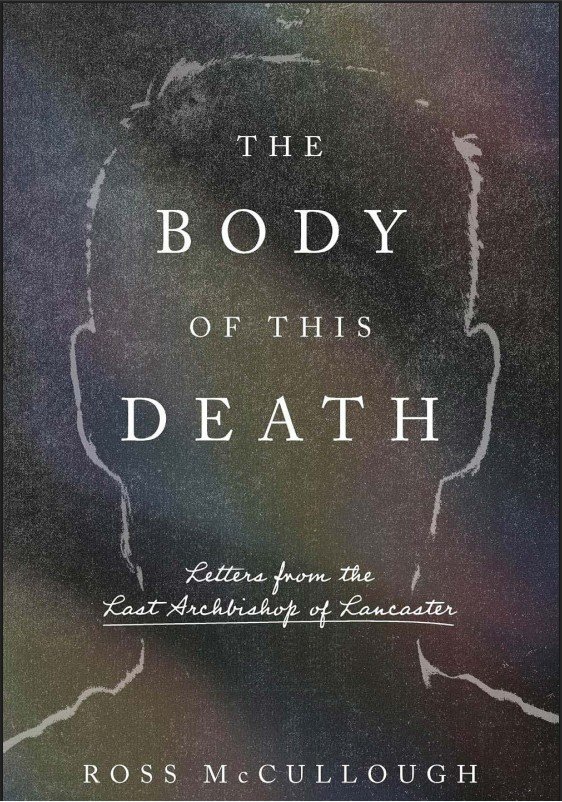
Some books argue, while other books tell a story. Then there are books that stay with you, books that are not driven by a single thesis but by a deeper theological vision. Ross McCullough’s The Body of This Death: Letters from the Last Archbishop of Lancaster belongs to this last category. It cannot be reduced to one argument, or even to the sum of its many arguments. It cannot be easily summarized, because it does not aim primarily to convince but to reveal. Presented as a series of letters written by a dying archbishop in a future where Christianity has largely lost its place in public life, this unsettling and deeply perceptive work unfolds with quiet seriousness, revealing something more troubling than overt defeat: what remains when a Christian way of seeing the world has faded.
From the title alone, the reader is placed in just such a world where Christian witness has not so much been refuted as it has disappeared from view. This possibility did not strike me as speculative. I once lived in a world where Christianity was not openly attacked because it was simply absent: unseen in public life, unspoken in culture, and in many ways inaccessible even to inquiry. It was, in practice, unavailable as a lived reality. And yet this absence was not the absence of religion. In that world, Islam was everywhere, shaping public and private life so completely that it could not be ignored. What the archbishop describes is something different from what I experienced: not a world where another tradition has taken its place, but one in which a once-solid Christian confession has decayed into a belief in anything and everything, or in nothing. McCullough’s vision speaks to a world I have already known in another form. The full weight of this recognition becomes clearer as the letters unfold.
Theological Reflection at the Edge of Death
The epistolary format is essential to the book’s power. Letters are personal, unfinished, and often written under pressure. McCullough places the reader inside the archbishop’s experience rather than above it. He is not constructing an argument or building a world. Rather, he writes as a man nearing death, trying to hold together what is already coming apart.
This becomes clear in the way his reflections unfold. They circle the same concerns: death, memory, and the fading clarity of belief, not as a rhetorical device, but as a reflection of his condition. After a funeral, he asks with a directness that is difficult to ignore, “Did we not already die in Baptism? Why then be stripped again of our flesh?”
The question is not resolved. It lingers. The letters do not move toward conclusion. They return to the same points, as if remembering is itself the force that holds faith together. In another reflection, he returns to this same pattern, not to resolve it, but to remain within it. The archbishop does not offer answers, but remains within a tension that cannot be resolved. Death is both already undergone and still to come.
The fragmentation of the letters mirrors the fragmentation of the world the archbishop inhabits. Christianity has not been refuted. It has become difficult to recognize. It is no longer assumed, no longer reinforced by shared memory, and no longer visible in the structures of daily life. What was once taken for granted now requires a decision. The loss, as McCullough presents it, is imaginative, more than it is intellectual. Christianity has not been argued away; it has been rendered invisible.
The Body as Witness
One of the most striking elements of the letters is the archbishop’s attention to the body, particularly its experiences of imperfection, from middle-aged joint aches and tired eyes to a child’s unbrushed teeth. His reflections resist any attempt to separate the spiritual from the physical. Against both secular and religious distortions, he insists on the unity of the human person.
In one of his most forceful passages, he describes the modern tendency to subordinate the body to the will: “The desires of the body no longer have a divine ordination… but become instead whatever our souls want them to be… whatever the spirit wants; whatever the body can be made to accept.”
This goes beyond critique to diagnosis. The body is no longer received as meaningful but treated as something to be shaped. Elsewhere, the archbishop returns to this same concern, insisting that the body is not something to be remade at will, but something received and ordered. In response, he writes that the body is not merely physical but already formed by the soul: “The body itself is not just the body… our one needful thing is an ordering of the interior and exterior together.”
Here the book touches something deeply Christian. Faith transcends mere ideas; all logic falls apart unless it grounds itself in the Logos, the Word made flesh. The Incarnation is not secondary but central. To lose sight of the body is, in a real sense, to lose sight of Christianity itself.
The archbishop’s own decline makes this unavoidable. His body becomes a witness. In a world that seeks to manage or transcend the body, his dying brings back into view what cannot be avoided. The body restores a clarity that has been lost.

Death and the Purification of Hope
The nearness of death gives the letters their urgency. The archbishop approaches death as a reality to be endured rather than a concept to be explained. Death presses upon his reflections, immediate and unavoidable. His writing returns to death’s paradoxes and harshnesses again and again, circling without resolving.
In reflection on those who have died, the archbishop observes, almost unexpectedly, that “those who grew distant in life can grow closer in death… what we lose in presence we make up for in access.”
This does not collapse into sentimentality. Without denying the rupture that death brings, the insight reveals the paradox at the heart of Christian hope: Death creates both separation and communion, loss and nearness. Death wounds, but it also discloses. Death removes what is visible while intensifying what is unseen. Surfacing the contradiction does not resolve the tension, but allows for acceptance, for the peace that passes all understanding.
This peace seems perfectly compatible with the Archbishop’s restless intellect, which continually circles the same reality from different angles. As he suggests elsewhere in the letters, this restless return is not an attempt to explain, but a way of remaining within what cannot be resolved. Death cannot be made manageable. It cannot be reduced to a comforting narrative. It remains difficult; even the language used to speak of it begins to show strain.
And yet, through that strain, something becomes clear. As death draws near, what has been sustained by habit begins to fall away. Cultural support, shared practices, inherited assumptions, and environmental reinforcements of belief can no longer carry the weight of faith. What once seemed stable is revealed to have depended on what surrounded it; what remains must now stand on its own.
At this point, the interior life, previously important, becomes paramount. The question of loss no longer touches only how Christianity appears (or doesn’t) in the world; it also probes what faith rests upon when everything external is taken away.
The archbishop’s letters suggest that Christian hope must undergo just such a purification. It must be separated from what is secondary, from what has sustained it but is not essential. In this stripping-away, this kenosis, everything that once supported faith falls back, and only what is truly believed remains.
There is no indication that this is easy. It exposes how much of what is called faith may never have fully belonged to us. Belief, when seriously tested, may be revealed as fragile or not deeply rooted. But what remains after the harrowing, even if small, may be more real than what came before. This movement from support to exposure must be lived in order to be understood.
When faith is no longer reinforced from the outside, when it must stand without support, what remains is not the comfort of belief but its truth. At the edge of death, a hope that is no longer inherited must be chosen.
A Different Religious Order
The world the archbishop inhabits is aggressively secular but also infiltrated by a different religious vision. Islam has become a major alternative framework, shaping significant corners of public life and moral imagination.
This does not feel distant to me. I was raised in a world where Islam structured everything, and where Christianity was almost entirely invisible. It was not something one could easily inquire about, and even encountering it required discretion. Bibles were not available in bookstores or libraries. I remember secretly asking for a small, pocket-sized Bible from a close friend and reading it in secret. This was before the Internet offered easier access to information.
That experience makes certain aspects of the archbishop’s world immediately recognizable. While the situations are not identical, they share parallel conditions: the persistence of Christian faith without visibility, without reinforcement, and without a place in the shared social imagination.
The archbishop does not caricature this reality. He recognizes its coherence. At the same time, he turns the critique inward: “Your imam is right in part to blame us for all this, our interiority become immateriality.”
The problem arises both from external pressure and from an internal thinning. When faith becomes purely interior, detached from embodied life, it loses its power to shape reality.
Islam, as I experienced it, offered structure and discipline sourced from clear rules for daily practice: prayer, fasting, dietary laws, social norms, dress regulations. There was seriousness in all this, but something remained incomplete. The transformation often remained external. One could fast during the day and return unchanged by night. What was missing was transformation from within, a change at the level of the heart. This is what the Bible calls for: a circumcision of the heart, transcending any external observance and reaching the will itself. There was also a question of truth to be discovered beyond regimes and formulations. Faith in Christ did not suspend reason, but fulfilled it, allowing the mind and the will to move together toward what is true.
What I encountered in Christianity was not less seriousness, but a deeper seriousness. In Christ, the religious demand moves inward. The question is no longer only what one does, but what one becomes.
The call that first drew me to Christianity came from within Scripture itself. The continuity between what was spoken in the prophets and what is fulfilled in Christ pointed to something that could not be fabricated. I recognized in Him the voice of the shepherd. What had been a search became a recognition. In Christ, justice and mercy are not opposed but united. He is not distant. He enters into human suffering.
This is what begins to fade in the near-future, dystopian, yet all too plausible world McCullough describes. Christianity remains present, but no longer as a shared way of life.
The Loss of Christian Memory
Running through the letters is a concern about what has been handed down and what has been lost. This is not only a loss of belief, but a loss of vision. Fewer people are able to see. Both doctrine and the conditions that make doctrine intelligible are revealed to be in danger.
The archbishop describes this danger as “a failure to allegorize… the luminosity of the literal sense could never last without the illuminations of the allegorical to surround and sustain it.”
When the world is no longer perceived as meaningful beyond what is visible, Christian claims are at risk for rejection, because the symbolic and the sacramental appear to have collapsed. Without these stable frameworks to support meaning, even the literal loses its clarity. The archbishop follows this to its conclusion, in which history itself appears as “a dilapidated maze of vanities… the cosmos wasting away unresurrected in entropy.” This is not simply a loss of belief. It is a loss of vision. The world is no longer experienced as ordered or meaningful. It becomes something to manage, not something to understand.
In such a world, tradition cannot sustain itself. It may remain in fragments, but it no longer forms those who inherit it. Practices continue without depth. Language survives without meaning. Faith, tragically, is forgotten, and without faith, not even reason can prevail for long.
Fidelity Without Illusion
And yet, the book does not end in despair. The truth of the archbishop’s convictions continues to resonate beyond the apparent point of no return. His voice is marked by loss, but it does not collapse. What emerges is a form of fidelity stripped of illusion. Faith, no longer sustained by culture or visibility, shines forth because it is true.
This becomes clearest in his refusal to break the seal of confession. Pressed by external authority, he is urged to act outwardly in a way that could arguably be justified by intention. He refuses. “Though no one were to know that I betrayed the seal, it would still be a betrayal… It is a duty to God.”
What is at stake is not only a moral decision, but a vision of faith. He rejects the idea that outward denial can be separated from interior belief. Truth must be embodied.
Elsewhere he exposes the logic directly: “Why worry about outward denials, since God only cares about the heart?” The archbishop rejects this sophism completely. To deny faith outwardly while continuing to hold it inwardly is not a neutral act. It fractures the person.
This is what fidelity looks like in his world. Though it cannot restore what has been lost, though it does not appear effective, it remains true in substance.
The archbishop, in extremity, recalls a Carthusian whose miracles were halted so that no attention would be drawn to him. The aim was “to change the world without the world realizing who had changed it.” This story becomes an image of Christian witness: hidden fidelity, invisible triumph.
In another form, I have already lived something of this. There were moments when my faith had to be held quietly, without support, and often without confirmation. Scripture could only be read in secret. A Bible must be hidden. Churches had to be entered carefully. Faith, not reinforced from the outside, had to be held from within.
What sustained me through this underground time were not arguments, but words, Christ’s own words, the voice of the Shepherd: “Whoever loves father or mother more than me is not worthy of me… whoever denies me before men, I will deny before my Father.” These were not easy words to accept. They were demanding, even unsettling. They did not remove the weight of the opposition I was facing; they made it heavier. To follow these words meant choosing against what was closest to me, against family, against everything that had formed my life.
And yet, this hard saying of Christ’s did not weaken me. It clarified what was at stake. It stripped away any illusion that my faith could remain private or without consequence. In that clarity, these hard words gave strength, revealing that the cost of following them was itself a part of the truth I had come to recognize.
So I left my home, my country, and everything familiar. As an only child, that decision carried weight. There was no support, no security, no reinforcement. But those words did not allow for ambiguity. They did not make the decision easy; they made it clear.
This is why the archbishop’s fidelity is recognizable. When everything falls away, faith becomes a decision made in truth. Besides, isn’t what the archbishop observes in his world what we are beginning to see in our own, even in the West?
The Question That Cannot Be Avoided
In one sense, McCullough’s book leaves much unresolved. It offers no program, no strategy for recovery. But in another sense, it brings everything into focus.
What remains when everything else falls away? Not a system. Not a culture. Not even a shared memory. A person. That person still speaks, asking us, even now: “But who do you say that I am?”
It is a question that cannot be inherited. It cannot be answered by culture or habit. It must be answered personally. If Christ is who he claims to be, then nothing essential is lost, even if everything else disappears. If he is not, then no recovery of culture will be enough. In the end, the future of Christianity does not depend on its place in society, but on whether this question continues to be asked and, more, answered as Peter answered it: “You are the Christ, the son of the living God … To whom else shall we go?”