Falling In Love
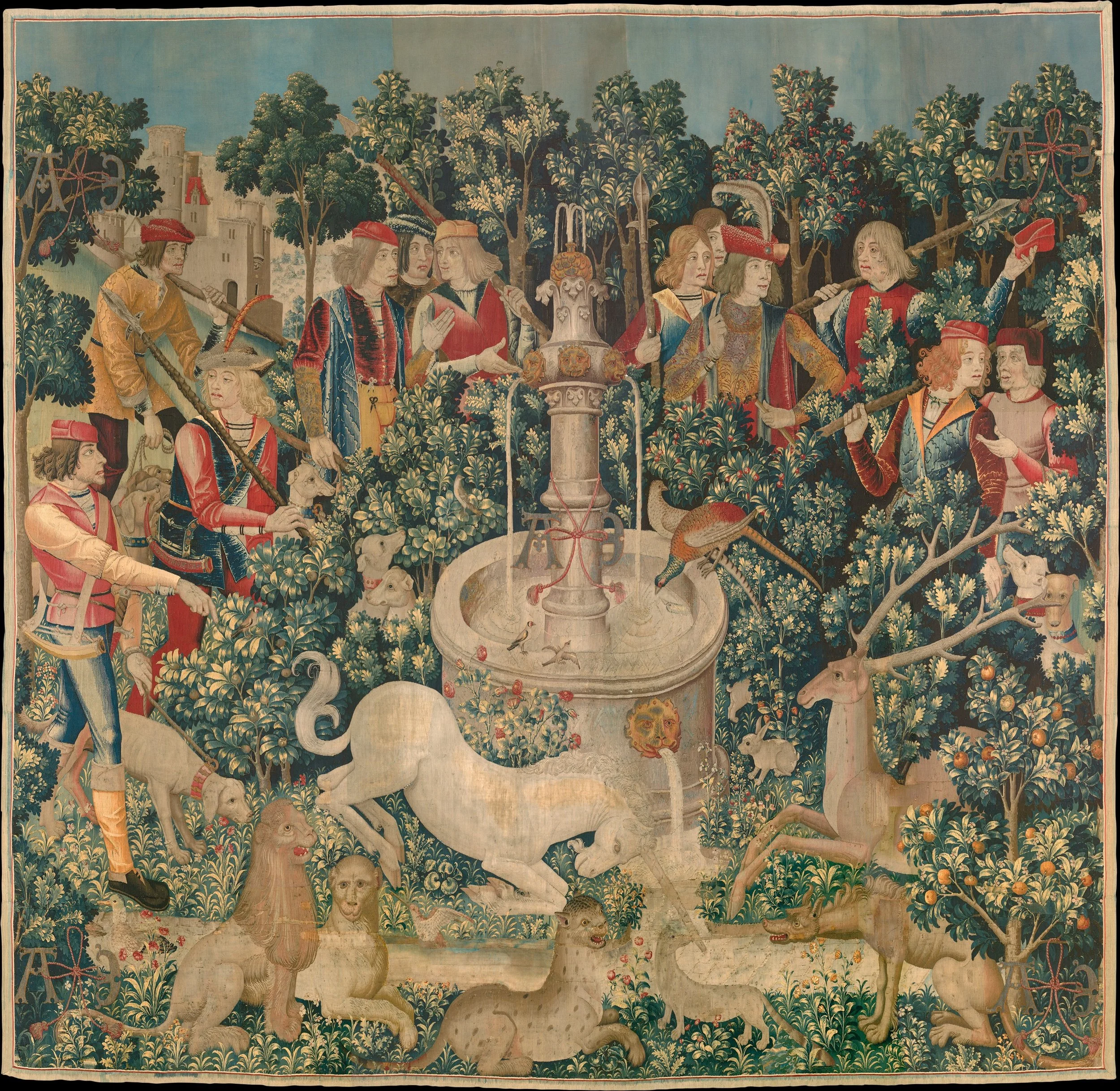
The Hunt of the Unicorn is a metaphor for chasing and capturing romantic love
When Shrek finally manages to cross the moat of boiling lava, escape the incinerating breath of the dragon, and reach Princess Fiona's bedroom at the top of the castle, he shakes her roughly and shouts,
“Wake up!”
The princess is indignant.
“What kind of greeting is that?” she demands. “You're supposed to wake me with a gentle kiss!”
Shrek rolls his eyes.
“Oh yeah? Where did you get that idea from?”
“I read it in a book,” Fiona responds with utter confidence.
Would Fiona have fallen in love with Shrek had she never read the story of Sleeping Beauty? Did the idea of falling in love with a complete stranger really come from a book?
The experience feels so overwhelming that most of us assume it must be as universal as mother-love itself. Yet the seventeenth-century French writer François de La Rochefoucauld once suggested that love might be largely learned. As he famously said, “We would never have fallen in love without love stories.”
According to this view, love stories teach us how to fall in love. Our imaginations absorb these narratives until they shape the way we experience attraction. We might call this the “Shrek effect.”
The very word “romance” originally referred to stories written in the vernacular languages of medieval Europe. These stories—often tales of knights, adventures, and courtly love—helped shape the Western imagination about love. It is therefore tempting to think that what we call “romantic love” might simply be a cultural invention produced by centuries of storytelling.
Yet the anthropological evidence suggests something deeper. According to anthropologist William Jankowiak of the University of Nevada, who conducted a famous cross-cultural study of romantic love, evidence of romantic love appears in the vast majority of human societies. Examining ethnographic records from 166 cultures, Jankowiak and his colleague Edward Fischer found evidence of romantic love in 147 of them.
But if romantic love is nearly universal, why have so many societies historically discouraged it—especially when it comes to marriage? For most of human history, marriages were arranged primarily for economic, social, or political reasons. Romantic attachment was often seen as a disruptive force that might interfere with family alliances or social stability.
And why would a Bantu boy in Zimbabwe fall in love with a Bantu girl without ever reading a love story? Where on earth would he even get the idea from without stories like Sleeping Beauty or The Fault Is In Our Stars? Is “falling in love” written into our DNA? Is it somehow necessary for our survival as a species? If it is, then why have most cultures throughout history suppressed romantic love as a dangerous emotion that could disrupt the almost universal tradition of arranged marriages?
A former student of mine, Josh Mathews, who taught English at a large Chinese university for three years, once told me about walking past the college soccer field late at night and seeing it covered with bodies—hundreds of students sitting or lying together in the dark, kissing and holding each other. Yet very few of these couples, he said, would ever end up marrying each other.
Marriage decisions in China are strongly influenced by family expectations and parental involvement. Many students understand that the partners they date during college may not be the people they will eventually marry. For some, those university years become the only period in which they feel relatively free to choose their own partners.
Romantic love flourishes—but often without the expectation of “happily ever after.” In other words, the feelings of romantic love may be universal, but the idea that love and marriage go together like a horse and carriage may be a relatively recent cultural development.
And yet something still seems missing from both explanations. Neither the “storybook theory” nor the cultural theories quite captures the strange intensity of falling in love. Anyone who has experienced it knows that it feels less like learning a cultural script and more like being struck by lightning.
For a deeper explanation we must return to Plato, the ancient Greek philosopher who wrote one of the earliest and most influential reflections on love. In his dialogue Phaedrus, Plato describes love as a form of divine madness. According to Plato, when we fall in love something extraordinary happens inside the soul. Beauty awakens a memory of a reality our souls once knew in long distant world.
Plato called this process anamnesis—a re-remembering. Before birth, he argued, the soul had glimpsed the eternal Forms, including the Form of Beauty itself. When we encounter beauty in another person, it triggers a sudden and powerful recognition. The soul remembers something it had almost forgotten. For Plato therefore, falling in love is a remembering, and the wisest of us — the true lovers — have the best memories! Plato, therefore, concludes that the experience of falling in love is supernatural — something caused by the gods, rather than by love stories or DNA.

It is also the only theory that seems to explain my own inconsolable experience of falling in love as a college sophomore: when Kay first smiled at me it felt like a sudden lurch of “memory.” I was nineteen. And she was eighteen. I had met many girls. But I had never before felt this. After years of female deprivation growing up in an all-boys boarding school in South Africa, my romantic dreams of true love were finally coming true!
But I made a strange and agonizing discovery: I discovered that the more time I spent with her, the more unbearable my yearning for her became. I found it hard to sleep, hard to swallow, and impossible to study. Waves of euphoria kept rushing over me and then receding, leaving me with a desperate ache -perhaps a premonition of the deeper heartache that awaited me. I had no idea who this petite sophomore really was. I only knew that I was experiencing something I could never explain. Was it a strange neural hurricane sweeping through the amygdala of my forebrain? (And if so, what triggered it?) I had read dozens of love stories, but none of them seemed to be coming to mind. My grades that semester plummeted to a 1.4 GPA. And my love for Kay remained stubbornly unrequited.
Yet what Plato helped me to see was that my feelings for her were very real -even though never fully reciprocated. They were real because they were supernatural — a divine vision of who she really was: a girl created in the very image of God. And seeing this image can be an overwhelming sight.
C. S. Lewis suggested something remarkably similar. In his famous sermon The Weight of Glory, Lewis writes that every human being carries on their shoulders a “weight of Glory”—the image of God stamped indelibly upon them. And if we could truly see this glory in one another, said Lewis, we would be tempted to fall down and worship them—a practice which did in fact spread across Europe, starting in Languedoc, France at the end of the 11th century, as knights would secretly express their adoration to ladies who they could only worship from afar.
Yet the vision fades quickly, and Courtly Love could not endure for long. We cannot sustain such intensity. Our attention falters, our desires shift, and the extraordinary moment slips away. We then conclude that the experience must have been an illusion.
But perhaps it is not the vision that fades. Perhaps it is our eyes.
Lewis believed that only in heaven will we be able to endure the full brilliance of the divine image in one another. Given eternity, we would have both the time and the capacity to bear the incredible weight of glory present in every person we meet. But not on Earth.
For now, we are given only brief flashes—sudden stabs of romantic love: reminders of the eternal love story to come. Heaven, after all, is described in the Book of Revelation as a wedding feast. And we, if we accept the invitation, are The Bride of Christ. And God has been wooing us since the beginning of time.